Car security installation guide
Helpful tips for putting in a security system


For a smooth installation — prepare
You're probably eager to add a security system to your vehicle. That's great. And you'll save a lot of money by installing it yourself. That's smart. But, please do not turn the first screw before you map out a complete, step-by-step plan of attack. "Ready, Fire, Aim" is no way to install a security system.
You don't have to do it all in one day. Break the job into bite-size pieces. Verify that each segment of the system works as intended before moving on. For example:
- Step 1 — Find a spot to mount the "brain" (control module) and siren. Hook the siren, LED indicator and valet switch to the brain, taking great care to route and connect the wires in a safe, secure way. Connect the power and ground leads to the brain. Test.
- Step 2 — Position your sensors in their intended mounting locations and connect them to the brain. Test the coverage area of the sensors and make final adjustments before you fasten them down.
- Step 3 — Tie into your door triggers and your power door lock circuit for keyless entry. Tie into your dome light and parking light circuits. Test these functions. When everything is working properly, secure the brain to the mounting surface.
If you have time to do it all in one day, fine. But don't rush it. And don't drive your vehicle until you've secured any loose wiring. Remember to disconnect your negative battery cable before you start mounting and connecting your system components. That will keep you from running your battery down or short-circuiting any of your components.
You'll need to have the battery cable connected while you test wire functions or switches. But don't forget to unhook it before you splice wires. Check your vehicle owner's manual to see if there are any special procedures to follow when disconnecting the battery cables.
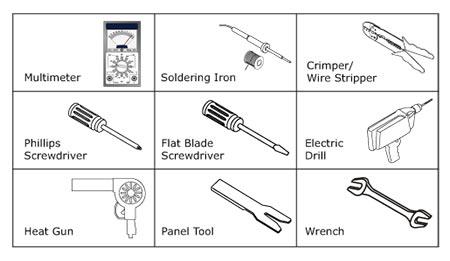
Tools needed (depending upon vehicle)
Make sure you have the tools you need before you begin
You probably already own the basics: screwdrivers, wrenches and an electric drill. In addition to these basic tools, you should have the following available:
- A panel removal tool to get behind your dash and the other places you'll need to access.
- A wire cutter/stripper. For many vehicles, plug-in interconnect harnesses simplify security system connections. But even if you use a harness, you still may need to splice some wires together.
- To make secure wire connections, you need a soldering iron and/or a crimping tool.
- Use heat-shrink tubing or electrical tape to protect your connections.
- A wiring diagram, specifying sensor wire colors and functions, comes in handy and can usually be found via an internet search. If none can be found, you'll have to check each wire's function with a meter while activating the sensor.
- Use a multimeter (voltmeter) to verify the functions of vehicle wires you splice into, or to determine what kinds of switches your vehicle has. You need to test the wire because car makers occasionally use different color wires than the ones specified on their wire color sheets.
- DO NOT USE A TEST LIGHT instead of a multimeter. Test lights draw too much current and could damage sensitive circuits in your vehicle.
Vehicle interface modules
Many cars today feature an immobilizer security system that won't allow the car to unlock or start without first sensing the presence of a chip imbedded in the key or key fob. If you have such a vehicle, you'll probably need a preprogrammed vehicle interface module (like a Fortin EVO-ALL) which tells your vehicle through its computer databus that it's okay for an aftermarket security system to unlock the doors without that chip. Each interface module comes preprogrammed for your specific vehicle, so you'll have to identify your vehicle exactly when you order one.
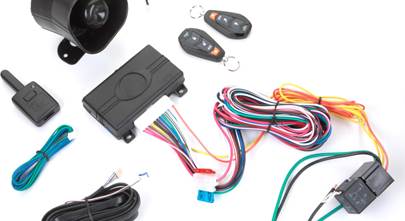
Also, an interface module will greatly simplify your security wiring, as a lot of the vehicle's sensors and actuators are accessible via the databus, so running wires around your car to each separate sensor becomes unnecessary. For many vehicles there is a T-harness available — a single harness that plugs in between your car and the interface module. Then usually only a single "data-to-data" harness is necessary to connect that module to your security system's brain module.
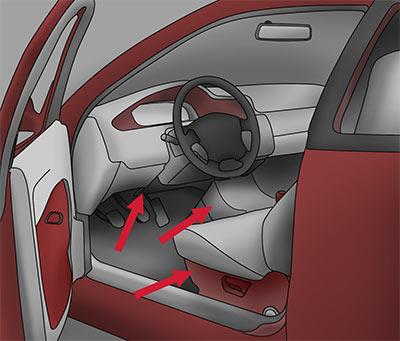
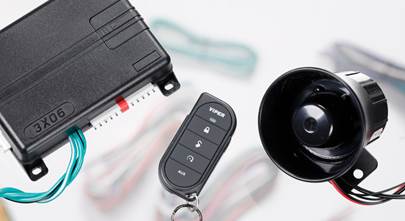
The small alarm "brain" should be installed somewhere close to the center of the car and out of sight. Under a seat, under the dash near the steering column, or even under a center console are good locations.
Mounting the alarm brain
Some locations to consider:
Under the dash near the steering column is a likely spot.
Pros:
- It's close to many of the wires you may want to tie into.
- It's up high, so you should get good range with your remote control.
- It's easy to reach, which makes installation and service easier.
Cons:
- An experienced thief will probably look there first and could silence the system by yanking wires out of the brain. If you're worried about that, look for a less obvious spot behind the dash (behind the glove box or behind a kick panel).
Under a front seat is another suitable location.
Pros:
- Once you remove the seat, it's a very convenient area in which to work. Most seats are held in place by a bolt in each corner.
- It's reasonably accessible, but not too obvious to a thief.
- It is isolated from electrical interference.
Cons:
- If your car develops a leak or you leave a window down during a storm, the brain could end up in a puddle (you could elevate it on a block of wood to be safe).
- Your remote control range might suffer a bit and you'll probably have to extend most of the wiring.
-
Warning: removing your seat could deactivate your vehicle's SRS system.
If you do need extra wire to extend the leads from the brain to switches, sensors or a power source, take the brain plug with you to the hardware store. Buy stranded wire that matches or exceeds the gauge (thickness) of the leads you need to extend. For sensors, 18 gauge or larger should work fine. For power leads, 16 gauge or larger is usually required.
If you put the brain under a seat, do not cover it with carpeting because too much heat could build up inside the brain. If you have a stereo amplifier under a seat, do not put the brain nearby. Electromagnetic radiation from the amp could interfere with the operation of the brain.
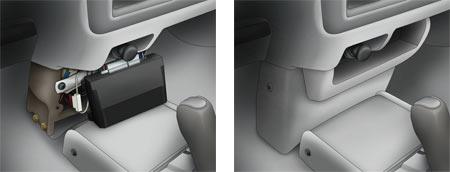
An alarm brain installed behind a center console panel
Wherever you decide to put the brain, remember to check what's behind the mounting surface, so your screw won't accidentally penetrate fuel lines or any wiring. Your alarm brain has a built-in pigtail-type antenna wire. It is important that the wire point straight away from the brain (a drinking straw acts as a good reinforcement), or at a right angle to the brain. Do not cut or ground this wire.
Mounting the siren
Mount the siren under the hood, high in the engine compartment, preferably at least 18 inches from heat sources such as exhaust manifolds, radiators and heater cores. Aim it parallel to the ground, or toward the ground. Never mount it with the horn facing up — water can collect in the horn, causing the siren to malfunction.
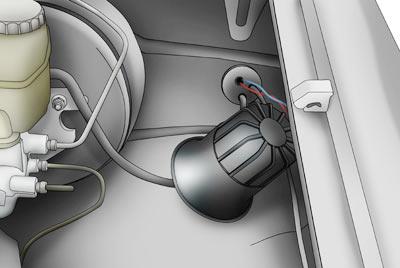
Mount the siren in your engine compartment and route the wire back through your firewall
In some vehicles, you can mount your siren to the inner fender panel. If you have a choice, pick the spot that's hardest for a thief to reach. Route the siren wires away from a thief's reach as well.
If you mount your siren to a metal surface, use sheet metal screws. Do not use drywall screws. If you mount your siren to a plastic inner fender, use nuts and bolts to secure it. Determine what's behind the mounting surface, so that your screws won't accidentally penetrate fuel lines, brake lines, vacuum lines, control cables or wire bundles.
Mounting the flashing LED
Your security system comes with a little flashing light, called an LED (Light Emitting Diode), that mounts in your dash or center console. Its purpose is to warn would-be thieves that a car security system is armed and ready to wail if they try to break in.
Mount the LED in an area that is highly visible from both sides of the vehicle. Check the hole-size requirement before drilling. Inspect the area behind the mounting surface to make sure there is sufficient clearance and a path for the wire.
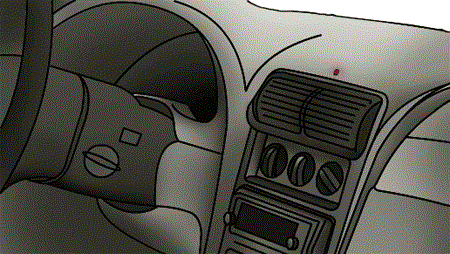
A bright, blinking LED will go a long way to discourage would-be thieves
Sensors
Position your sensors inside your vehicle, not in the engine compartment or anywhere else they could get wet. Attach shock sensors solidly to a metal surface, using screws. Try to take advantage of an existing screw in your vehicle. If you can't find a good one, you'll have to supply your own screw. As an alternative, you can strap the shock sensor down, using nylon wire ties. Do not use Velcro or tape.
You should mount your shock sensor relatively close to the center of your vehicle (under the dash is good), so it can detect shocks from both front and rear equally well. When you adjust your shock sensor's sensitivity, apply impact from all sides of the vehicle. Keep in mind that an extremely sensitive setting yields the most false alarms. That's true of any sensor.
Locate your motion sensor down low near the center of your vehicle. Do not mount your motion sensor until you have thoroughly tested its coverage area. You may have to try a few different spots before you find the one that gives you the best results.
Pin switches
Pin (plunger-type) switches are sensors that trigger the siren when a door, hood or trunk opens. In most cases, you can tie into the pin switches that are already in your car. Look for the switches that turn on the dome light when you open doors. Tap into the wires leading away from the switches. They can usually be found behind your kick panels.
Some vehicles also have pin switches for the trunk and hood. Generally, the easiest place to tie into pin switches is at a floor-level courtesy light or a pin-switch wire behind a kick panel. Pin switches can have either a negative (-) trigger or a positive (+) trigger. If you have a wiring diagram, it'll show you which kind your vehicle uses.
If you don't have a wiring guide for your vehicle, here's a way to test your switches:
With your multimeter set to measure DC volts, connect the black probe to ground and the red probe to the wire you think is the pin switch wire. A negative trigger switch will read 0 volts when the door is open and 12 volts when the door is closed. A positive switch will read 12 volts when the door is open and 0 volts when the door is closed.
If your vehicle doesn't have pin switches, you can add the ones that may have come with your security system (we also sell them separately). Some vehicle manufacturers use mercury switches instead of pin switches for hood/trunk lights. They are extremely difficult to tie into, so you will probably want to install pin switches.
When installing the pin switches, keep in mind that they require about 1/4" clearance above the mounting surface with the door, hood or trunk closed. Never mount them in a drain path or in a pit or depression, where water might pool up.
Connecting the brain to your parking light wiring
Your car will have its parking lights wired either off a single circuit or in a parallel configuration. Most European cars use a parallel circuit. Most American cars use a single circuit. If your car uses a parallel circuit, you will have to tie both sides into the parking light output wire of the brain, using a dual-make relay.
If you'd rather locate the wire under the dash, instead of at the parking light switch, make sure you don't use one that's tied into a dimmer circuit. Test the wire with your multimeter, and see if the voltage drops when you dim your dash lights. Since most dash lights connect to the parking light circuits, you can expect the dash lights of your car to flash along with the parking lights.
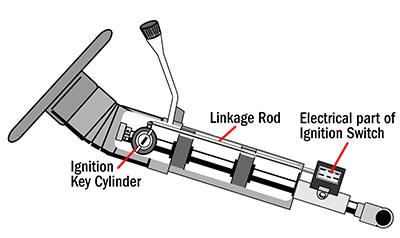
To connect the starter disable feature, you'll need to tap into your ignition system. Some cars allow you to do this by plugging into a central relay box, but others require you to splice into the wire.
Starter Disable/Interupt
The starter interrupt is a relay, built into most systems we offer, which ties in between the ignition switch and the starter solenoid. The starter solenoid main power feed draws a huge amount of current, so the solenoid feed wire going to the starter cannot be spliced into. The wire that you tie into is the small wire going to the starter solenoid that tells the solenoid to energize when you turn your key to the "start" position.
To verify that you have found the correct wire, test the wires at the steering column to find the one that reads 12 volts only when the starter is cranking (not while the engine is running). Following the instructions supplied with the alarm, splice the starter disable wire (or outboard relay) into this wire.
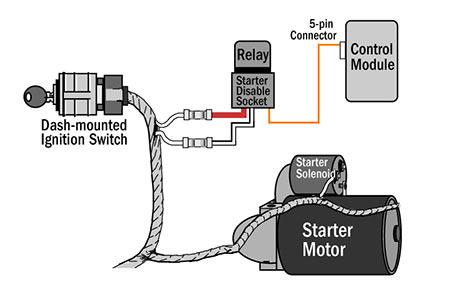
Properly spliced starter disable wire
Valet switch
The valet switch lets you bypass the system when you leave your vehicle for service or valet parking. This means you won't have to give your remote control to anyone. The valet switch is also used for programming the alarm system. The valet switch is usually a simple switch or button that connects to a wire coming from the brain. Mount the switch out of sight so that it won't be obvious to a thief.
Most alarms require that the valet switch be activated only with the alarm disarmed and the key on. Not following the procedure called for in the owner's manual may result in a malfunction.
Wire routing and terminating
Any time you tie into a car's electrical system, maintaining the reliability of the car's electrical system is a big priority. Here are some tips:
- Encase your wiring in protective loom.
- Solder or crimp every connection, never use wire nuts or simply twist and tape.
- Use heat-shrink tubing to protect your splices. If you can't use heat-shrink tubing, tape the splice and secure your tape with a nylon wire tie to help keep the tape in place.
- Use grommets when running wires through freshly drilled holes.
- Keep wires away from high heat.
- Make sure wires do not rub against any sharp metal edges.
- Use the right size multi-strand copper wire with good quality insulation.
- Secure the wiring with nylon wire ties so it won't fall into your pedals or get pinched by other moving parts. Ties also bear the weight of the wire, and this ensures that vibrations won't put too much strain on your terminals.
- When connecting the main power wire to the battery, install a fuse holder within a few inches of the battery. Use a good quality ring terminal to attach the wire to the battery terminal.
- Use a star washer when connecting wires to chassis ground, and scrape away any paint or grime that might prevent a good connection to the bare metal. If possible, connect ground wires beneath an existing nut and bolt. If a nut and bolt aren't available, use a #10 machine screw with a lock washer.
- Run wires through the firewall using a factory-cut hole, if possible. Look at the hood release cable to see if wires can be run alongside it. Some cars will run the release cable between the inner fender well and the fender. In this case, you must remove the inner fender (the plastic guard above the tire). If you decide to drill your own hole through the firewall, determine that there are no obstructions on the other side of your drilling and don't forget to use a heat-resistant grommet or firewall bushing.
Soldering tips
- Strip the plastic insulation back about 1/2" on each wire.
- Slip a piece of heat-shrink tubing over one wire.
- Place the two wires parallel but pointing in opposite directions.
- Wrap the bare wires around each other. Make sure you have a smooth connection, with no stray wire strands sticking out that could poke through the heat-shrink tubing.
- Heat up the soldering iron and "tin" the tip by applying some solder directly to it. This cleans the tip of the iron (the rosin in "rosin core" solder is a cleansing agent) and makes the process of soldering easier.
- Heat the wire until it gets hot enough to melt the solder.
- Touch the solder to the wire and let it melt until it covers the entire splice with a thin layer of solder, then remove the soldering iron.
- Let the solder cool for about 10 seconds until it's cool to the touch. Do not blow on it — that could crystalize the solder making a "cold solder joint" which could fail. Keep the wires still until the solder cools.
- Finally, slide the heat-shrink tubing over the splice and heat it. A heat gun works best to heat the tubing, but if you're careful, you can also get satisfactory results using a match or lighter.
Crimping tips
- Always position the seam in a crimp-on connector against the rounded side of the crimp tool. Let the tooth of the tool depress the solid side of the connector opposite the seam.
- Check the crimp connection by gently pulling on both wires. A proper connection will not come apart.
Alternative connections
If you don't have a soldering iron or a crimping tool, you can still make secure and tight connections for your wiring by using a Posi-Products connector kit. You strip the ends of your wires, insert them into the connector, and hand-tighten them together. You get a strong, low-resistance electrical connection, and you can reuse the connectors, too.
Multimeter tips
- The negative (black) lead of the multimeter connects, touches, or clips directly to the chassis ground of the car. (Chassis ground is any metal part of the car which is physically common to the point of the car where the negative battery cable connects.)
- Connect the positive (red) lead of the multimeter to the part of the circuit being tested.
- If you poke a hole in the insulation when you probe a wire with the tip of the multimeter, cover the hole with electrical tape.
Testing the system
If you have a timed dome light on your car which is hooked up to an instant trigger or sensor input, make sure the dome light has timed out and turned off before testing the system. Some alarms must be programmed to delay until the light is out.
When testing entry through the doors, make sure you test all of the doors. Some vehicle manufacturers use a key-sense wire on the driver's dome light switch (this is the wire that makes your car chime when you've left the key in the ignition). If you have tied your door entry alarm wire into this key sensing wire, your alarm will only sound when your driver's door is opened. Test each door, one at a time, to make sure each door triggers the alarm.
False alarms are usually the result of sensors being set too sensitively. If you experience a lot of false alarms, dial the sensitivity back a bit.



Victor A from Tampa
Posted on 7/19/2021
this may sound like a stupid question but can you wire the the 18 gauge starter wires from the remote start to the 10 gauge wires close to the Body Contrtol Module of the car, or do I need to run those closest to the actual push to start button?
Buck Pomerantz from Crutchfield
on 7/20/2021
stephen bodzak from Forked River
Posted on 12/4/2019
have a 95 bronco with dealers installed alarm and keyless entry, my daughter some how ripped some of the wire connected to brain was able to get all back in place to plugs going in, but 2, brown color wires, 1 from each plug, I tested both to ground to see if power. 1 no power the other 1 low voltage , do they just get spliced together ,can not see any other wires to connect them to ,tried to find brain plugs in to see colors to find were they go the brain has ford rite on t but some one told me it is a code alarm ,sorry if not making sense trying to get description to you right, had 2 stock's is hard f or me to get what I want to say out of my brain ,all works but need to know about the 2 brown wires, before I screw something up thank yo u
Buck Pomerantz from Crutchfield
on 12/5/2019
Michelle Catapang
Posted on 9/5/2019
Thank you for this content. The guide is well-detailed and easy to understand.
stephen bodzak from Forked River n.j
Posted on 3/29/2019
hi my 95 ford truck as a alarm that works like all others but on the das it has the blinking light bot it is 3 wire the switch shows armed solid blinking and a stuttered blinking when light is switch to valet mode you just push in the blinking light to change modes ,need a new one can not find ,do you know were to get or do you have one thank you
Buck Pomerantz from Crutchfield
on 3/29/2019
Steven Peterson from Boise
Posted on 12/5/2018
I have a 1998 GMC Sonoma, will the viper system work well with it?
Buck Pomerantz from Crutchfield
on 12/6/2018
Buck Pomerantz from Crutchfield
Posted on 10/19/2018
Ruel, Not knowing what your vehicle is nor the circumstances of your security system installation, I can only assume that you need to connect all the wires of every actuator that you want to control to the system.
Ruel
Posted on 10/13/2018
Hi...do I need to connect all wires going to door actuator from module box? or just connect one pair to master central locking? Thank You
William from Smiths Falls
Posted on 5/9/2017
This is excellent! Thanks so much!
Joseph from Davenport
Posted on 8/1/2015
Thanks for the guide!