
How to choose and install surround sound speakers
Options for every space and budget

In this article: We'll cover everything you need to know about choosing and setting up surround speakers, including...
- Sound bar systems
- Receiver-based systems
- Different types of surround speakers
- Wired vs. wireless surround speakers
...And we'll also share some installation tips.
More and more, people are choosing to stay home to watch movies, rather than going to the local cineplex. The price of tickets, snacks, parking, and babysitters adds up to an appalling amount, so over time a home theater can pay for itself.
If you’ve been streaming movies at home without a sound system, you’ll be surprised at the immersive sound you can get with a quality surround system. I made that investment several years ago and never looked back.
You may already be on the way to having a sweet, cinematic setup. If you have a home theater receiver with just two or three speakers, adding a pair of surround speakers will give you a basic surround sound system. Some sound bars have surround sound capabilities with the addition of specially matched speakers.
What are surround speakers, anyway?
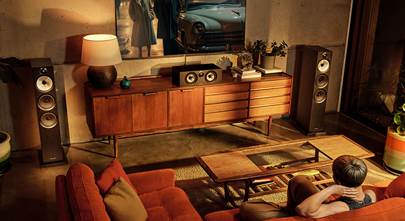
Surround speakers are designed to immerse you in audio that imitates real-life sound experiences. By placing multiple speakers to the side, rear, or even above your main listening area, you create a multidimensional soundscape. Dolby and DTS are the main formats used in most visual media that uses surround sound.
The front three speakers in a receiver-based home theater system are great for dialogue and the main action on screen, and a sound bar by itself performs a similar role. But the surround speakers carry sound effects, like helicopters flying overhead, footsteps that sound like they’re coming from behind you, or a baseball whizzing past your ears.
You may be wondering how many speakers you need or which type you should choose, and that depends on the system you have or want to set up.
Sound bar systems
Surround sound used to be reserved for home theaters with a separate receiver and speakers, but it wasn’t always practical for cramped spaces. Plus, sound bars are simpler to install — in many cases, just a plug-and-play experience.
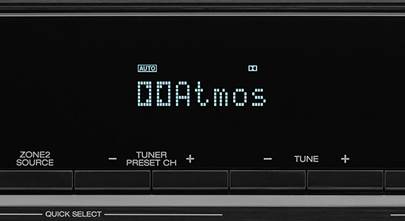
Many sound bars come with advanced surround sound formats like Dolby Atmos, which adds “height” channels to create a more immersive 3D audio effect. Plus, you can get a sound bar system with a pair of wireless surround speakers included, or for purchase separately.
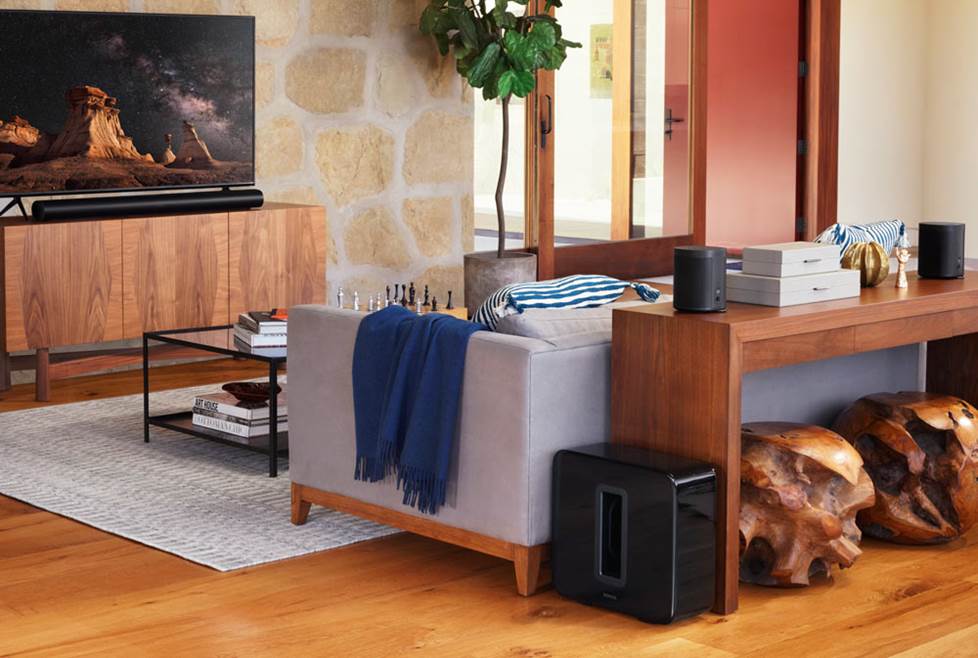
Many sound bars have the option of wirelessly connecting surround speakers.
A great advantage of many of these systems is that the surround speakers and subwoofer are usually wireless. Sonos and JBL have terrific options in the sound bar arena.
Home theater receivers and speakers
Most surround sound enthusiasts feel that a classic home theater system gives a more enveloping experience. You need a home theater receiver and at least five speakers. A 5.1 system requires a pair of front speakers, a center channel speaker, a pair of surround speakers, and a subwoofer. However, systems go beyond 5.1 to 7.1, 9.1, and higher for a system tailored to your preferences. Check our Intro to home theater speakers article for more information on all the different types of speakers in a surround sound setup.
Keep in mind that you don’t have to go all out and buy everything all at once with a classic home theater. You can start with two or three speakers and add your surround speakers later. While brand consistency generally contributes to a more accurate and natural sound reproduction, you don’t necessarily need to stay with the same brand.

Voice-matching your surround speakers to your front speakers has the best results, but it's not always necessary.
Timbre matching and dynamic range are the key elements to coordinating your sound. You can choose another brand with similar qualities. For example, Klipsch may be an appropriate match for Definitive Technology speakers.
You may have heard this called “voice-matching”, and it’s important to get the voice-matching right for the front and center speakers. It’s less critical for surround speakers, since they’re mostly for sound effects. But if you plan on using your system sometimes for all-channel music, try to get all the speakers voice-matched. As always, If you’re confused about what would be best for your system, talk to one of our friendly Advisors for guidance.
Types of surround speakers and ideal placement
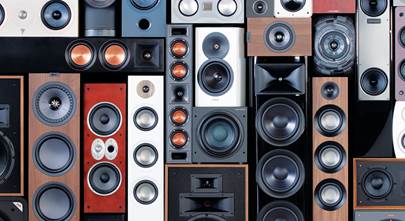
There are a few different types of surround speakers. Here’s a breakdown of the most common options and their roles, with some tips on placing them for the best surround sound experience.
Rear and Side Speakers
Rear and side speakers are used in 7.1-channel and higher speaker setups. They provide ambient sounds and special effects, enhancing the overall experience.
Rear speakers are placed to the right and left, both slightly to the rear of the listener to create a sense of spaciousness. They’re used in 5.1-channel and higher setups. Side speakers are positioned to the left and right of the main listening area, preferably a little wider apart than the front speakers.

Place your rear and side speakers wider than your front speakers for an expansive sound field.
Height Speakers
Height speakers reproduce overhead sound effects. They can be in-ceiling speakers, speakers mounted high on a wall, or Atmos enabled speakers. Height speakers add a vertical dimension to the sound, making it feel like it’s coming from above.
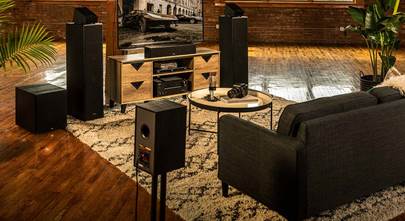
For a 5.1.2 Atmos system, the height speakers usually go slightly behind the listening area, but for a 5.1.4 Atmos system, you can add height speakers towards the front, as well. For a more streamlined system, you can use front tower speakers with height speakers built into the top, or with add-on modules.

A 5.1.4 Dolby Atmos system can give you rich, immersive sound that brings your movies to life.
Choose your height speakers carefully. If you decide to use the Atmos enabled reflective speakers, make sure your ceiling is flat and no more than about 10 feet (3 meters) high. If your front speakers have a flat top, you can place these small, wedge-shaped speakers on top of the front speakers. Otherwise, a shelf, stand, or entertainment center will work.

Atmos sound can be achieved by using speakers that reflect sound off the ceiling for overhead effects.
Dipole and Bipole Speakers
Dipole and bipole speakers have two sets of drivers that sit on opposite sides of a wedge-shaped enclosure. They create a diffuse sound field for an enveloping atmosphere. These speakers are ideal if you just want to stay with a 5.1 system, and they are quite effective when ideal room placement can’t be achieved. Place these speakers on either side of your listening area, wider apart than your front speakers.

Dipole or bipole speakers are a fantastic choice for diffusion of sound in 5.1 systems and challenging rooms.
Properly positioning your surround speakers will give you a more immersive, lifelike experience with your home theater. But ideal placement isn’t always achievable, due odd room layouts, windows and doors, open floor plans, and more. Check out our article on speaker placement for some ideas. Or go directly to Dolby for the nitty-gritty on tiny setups to huge layouts.
Wired vs. wireless surround speakers
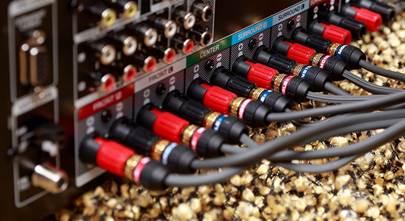
I hate the tangled mess of speaker wire that runs from the back of my receiver, along the sides of my living room, to my surround speakers. That’s why I’m considering wireless surround sound. There’s more than one way to achieve audio nirvana, whether you’re using wired or wireless surround speakers.
Wired, receiver-based surround sound systems used to be the norm because that was the only setup available! But when wireless systems came onto the scene, they weren’t the most reliable, so wired systems had more advantages than wireless systems when it came to sound quality. Now there are many sound bar-based wireless surround sound systems available, along with a few good options for adding wireless surround sound to a receiver-based system.

Minimize tangled wiring with a wireless surround sound system.
Wired connections provide a stable and consistent audio signal, free from the interference and compression issues that can sometimes plague wireless setups. You don’t have to worry about a sketchy Wi-Fi or Bluetooth connection, so your cinematic or musical experiences remain uninterrupted. The reliability extends to speaker synchronization as well, with no signal lag. However, a wired system requires more setup time, especially if you want in-wall or in-ceiling speakers.
Some room layouts are challenging for a wired setup. It may not be practical to run wire to the back of a room, especially if the wires cross a high-traffic area in your home. Customers have been asking us about adding wireless surround sound to their receiver-based setups for years, so we're very excited that technology has finally advanced enough to make it a reality. We expect to see more and more wireless surround sound solutions in the coming years, but there are some options that may work for you now.
One solution that works with many setups is the OSD Nero WRSKII wireless transmitter and wireless receiver/amplifier with sub out. Connect the WRSKII transmitter to your existing home theater receiver. Then, connect the WRSKII receiver/amplifier to a pair of surround speakers and a powered subwoofer. This cuts the amount of wires coming from your home theater receiver to your speakers. The WRSKII transmitter has speaker wire connections, as well as preamp RCA inputs, making it a viable option for virtually any brand receiver.
For solutions that work with Yamaha and Sony, check out their latest offerings. Yamaha MusicCast receivers support wireless surround sound with the addition of MusicCast wireless speakers. And Sony entered the arena in 2023 with their new home theater receivers that support wireless surround sound with compatible Sony wireless speakers and subwoofers.
How do I install surround speakers?
Unlike floor-standing speakers, you can’t just put small surround speakers on the floor and call it good. Rear speakers can be placed on a table or a credenza behind your couch and aimed at ear height. Side and rear speakers need to be placed on stands or mounted on the wall, with the tweeters aimed at the person or persons in the main listening area (or “sweet spot”).
We have a variety of stands and mounts that work for surround speakers, and we even have some flat speakers that mount on the wall like a framed picture.

Use speaker stands when possible, and aim surround speakers with the tweeters at ear height.
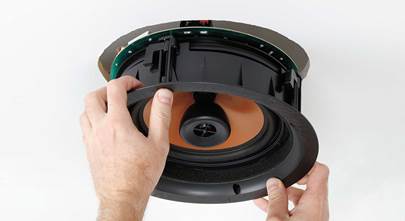
Another option is to go the in-wall route, which is great for hiding speaker wires, but holes must be cut in the wall. This option works best for new construction, but existing listening rooms can be retrofit for in-wall speakers. However, if the room layout changes, the in-wall speakers may not be in a great position for your home theater.
For height speakers, you can mount the speakers high on the wall, pointing down to the listening area, or use in-ceiling speakers. SVS Prime Elevation speakers or similar are great for on-wall height effects. While in-ceiling speakers are perfect for height effects, the same problems apply to in-ceiling speakers as in-wall speakers — cutting holes for installation and non-optimal placement if the room layout changes.

Speakers mounted high on the wall and pointed toward your listening area add height effects to your sound.
Hide that speaker wire!
If you go the in-wall or in-ceiling speaker route for your surround speakers, you can run the speaker wire through the walls. It’s simpler with new construction, since the wiring can be placed before the wall studs are covered. Make sure you use wire that’s specifically rated for in-wall use labeled CL2 or CL3.
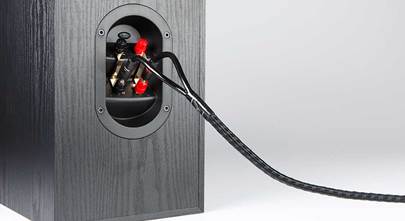
Even if you have external speakers, you can still run wire in the walls. Just put a wall plate with speaker connections near the external speakers. The wire in the wall connects to the wall plate on the inside, and speaker wire runs from the speaker to the wall plate where it connects using banana plugs.
Instead of running wires willy-nilly across the floor, try using flat speaker wire. You can run flat wire behind baseboards, cover it with rugs, or snake it up and over window and door frames. Cord covers and custom crown molding designed for hiding wires and cables offer a polished look to your surround sound setup.
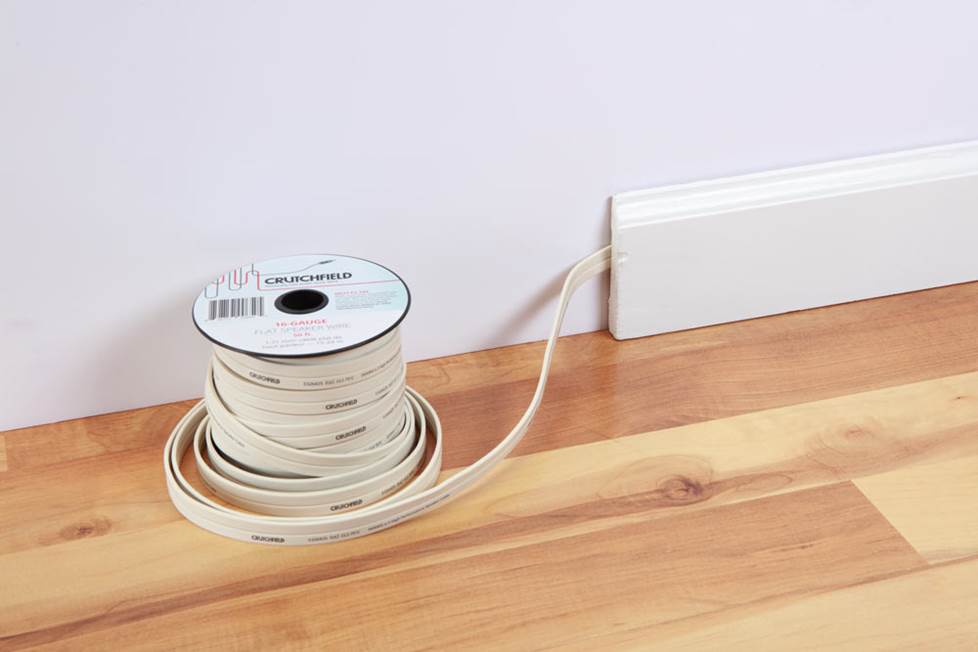
Flat speaker wire is easy to hide, minimizing trip hazards from wires running across your room.
As previously stated, there are a myriad of sound bars with the option for wireless surround speakers and subwoofers. In fact, most sound bars either come with the wireless option, or you can purchase them separately. Some, like the Samsung HW-Q900H link to Samsung QLED TVs to utilize the TV speakers for a richer sound. For nearly all options, you’ll still need AC power, so even though the signal is wireless, the power isn’t!
We're here to help
Need help choosing surround speakers? Get in touch with one of our Advisors.
Our expert Advisors know the gear inside and out. Your Advisor can send specific Crutchfield pages to your screen, saving you a lot of browsing time. You'll get a shopping cart loaded up with everything you need for your home theater.
Have questions about installing your speakers? Contact our friendly tech support gurus. Free lifetime tech support is included with your Crutchfield purchase.


Bob
Posted on 5/23/2023
Unboxing the system, running the speaker wires, connecting the HDMI and speaker wire, tv and the devices is the easiest part. The hardest has always been cable management. Have a plan and the material you will need before you start. And take your time to do it right.
Archer A. from Crutchfield
on 10/17/2023
harry daniels from west grove
Posted on 10/3/2022
thanks great help
Martin Davila from Corona Ca.
Posted on 3/8/2022
What do you think of connecting the back floor standing speakers Epic CF-3s to the main left and right posts on the receiver but leaving the to the left and right of sofa like if they were surround sound speakers ? Then placing the bookshelf speakers in front to the left and right of the TV but connected to the surround sound posts on the receiver? I'm trying this because my Epic CF-3s are too big to put in front. What are pros and cons? Thank you
Kramer Crane from Crutchfield
on 3/9/2022
I know it's tempting to route the main channels through your awesome tower speakers, but I'd stick with them as ultra-capable surround channels in this scenario. Thanks again, and happy listening!
Gene Mitchell from Mariposa
Posted on 10/5/2021
I had the Onkyo 6 channel For years until I over loaded A generator and fried the Amp. Are there any repair services available these days or is everything a toss and repair? I'm close enough to Fresno and Merced to drive to. I simply run three front speakers in this home but if I wanted full surround sound I brought out the rear speakers for the movie or event. My other home in Vegas I installed directional ceiling speakers I found at the CES show.
Kramer Crane from Crutchfield
on 10/6/2021
david stevens from louisville ky
Posted on 9/11/2020
There are ways to get rear ambiance without surround. Try dynaquad matrix.
liubu from kentucky
Posted on 5/19/2017
great
dan danfield from Silicon Mound CA
Posted on 1/10/2017
Even better, add number 6: call us and we'll tell you what to do......
Kramer Crane from Crutchfield
Posted on 1/10/2017
Hi Paul, feel free to give one of our expert Advisors a call. They can discuss the specifics of your system with you, and will help you find the best solution for your home.