Room acoustics guide
How acoustic treatment can make a good audio system sound even better

In this article: How do you get great sound from your home audio system? There's a 3-part formula:
- Good gear
- Proper speaker placement
- Acoustic treatment of your listening room
This article will show you how to improve the acoustics of an existing room. Building a new space? There’s also a section on how to design a room with good sound in mind.
T
he sound you hear in any room is a combination of direct and reflected sound. Direct sound travels straight from your speakers to your ears. Reflected sound bounces off your walls, floor, ceiling, and furniture before it reaches your ears.
Reflected sound can add a pleasant spaciousness to your sound. But it can also distort sound by making certain notes sound louder while canceling out others. Problems caused by reflected sound can include:
- Midrange and treble that's too bright and harsh
- Bass notes that are boomy, with a muddy "one-note" quality that drowns out deep bass
- A vague or smeared “soundstage”
The soundstage is the three-dimensional effect that makes you feel like you’re listening to a live performance. You hear the placement of the instruments from one side of the virtual stage to the other (and from front to back, too).
When reflected sounds arrive at your ears at different times, the soundstage tends to collapse. The music doesn’t move you nearly as much as it could.
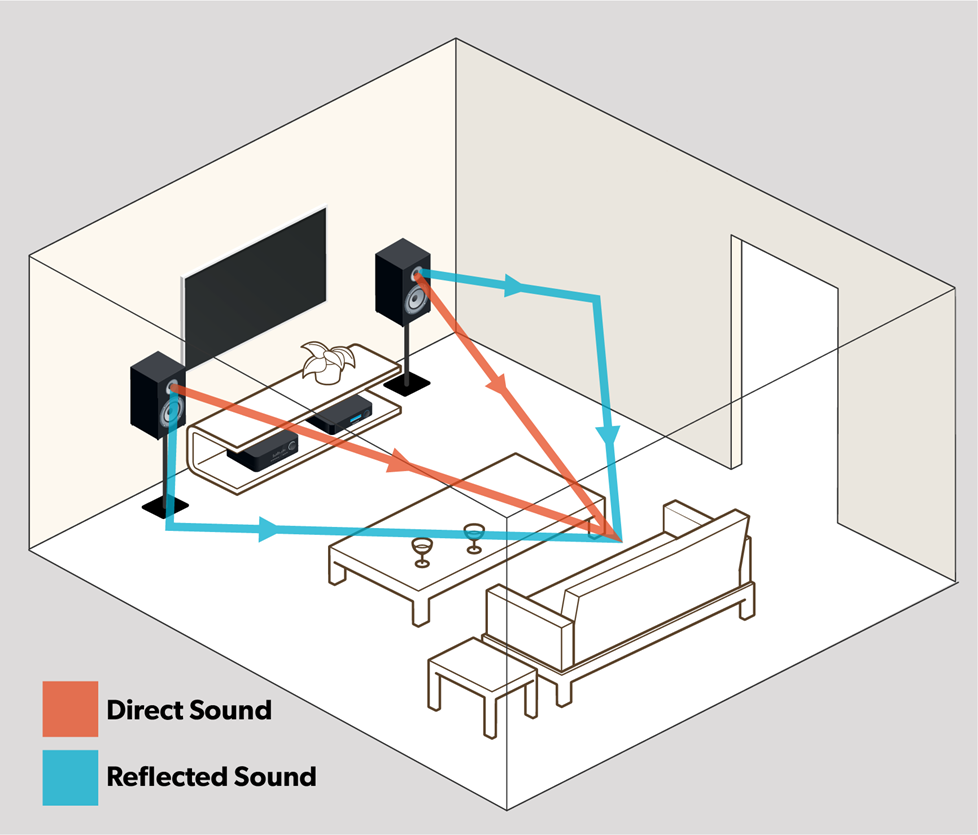
In addition to the sound from your speakers, you hear reflected sound from your walls. Your room's ceiling and floor contribute reflected sound, as well.
Simple DIY acoustic treatments
There are two main ways to control reflected sound:
- Absorption – install sound panels, curtains, or other objects that soak up sound waves to prevent reflection.
- Diffusion – strategically place objects that scatter sound.

Interior décor solutions
Do you have a large expanse of glass in your listening room, like a picture window or French doors? Try installing drapes over them to absorb sound.
If you have wood or vinyl flooring, place an area rug between your seat and your speakers.
To diffuse sound, fill a bookcase or two with odd-shaped books. Place them to the sides or the back of your listening room.
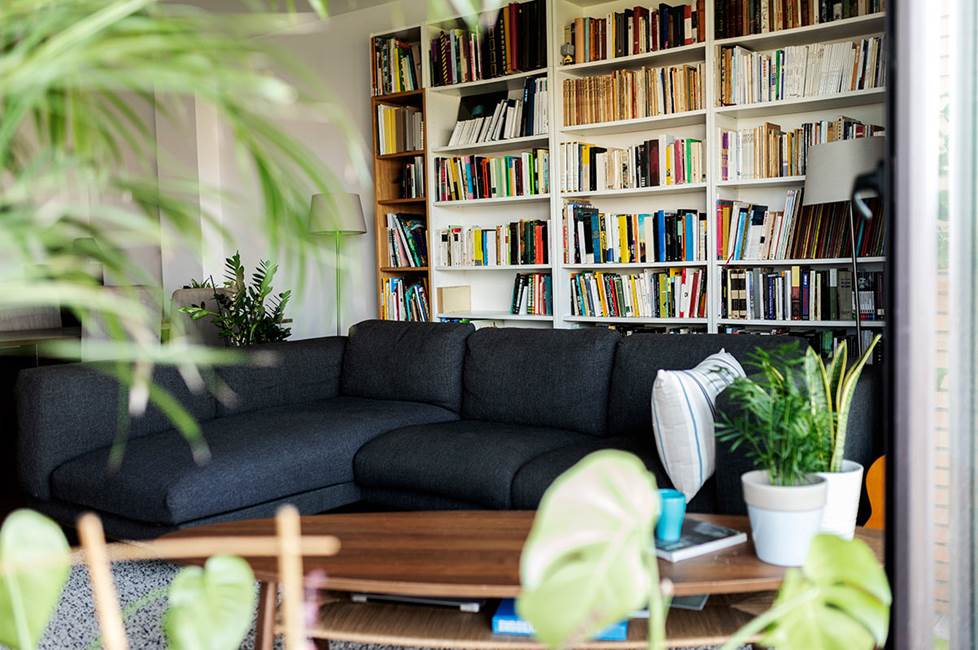
Bookshelves filled with different-sized books help to diffuse sound reflections.
You can try to dodge reflected sound by moving your chair or sofa away from your wall. Move it a few inches at a time until you find the sweet spot. You’ll probably need to be closer to your speakers, but not too close.
One more thing: Angle your main speakers toward your seat, rather than straight toward the back wall. This “toe-in” reduces side wall reflections and creates a more focused soundstage. The tradeoff is that those improvements may only be appreciated in a narrow “sweet spot.”
System calibration can help, too
Home theater receivers with automatic speaker calibration can help digitally correct for room problems. So can powered subwoofers with built-in bass equalization.
Deep dive: The science of room acoustics
Want to know if there’s more you can do? Read on! We'll look at the science behind reflection, absorption, and diffusion. And we’ll give you some more in-depth tips on how to find and fix your room's trouble spots.
Why are the effects of reflected sound so noticeable?
Our ears are amazingly good at locating the source of a sound. Even with your eyes closed, you can usually locate the position of someone speaking to you in a room.
To locate the source of a sound, your brain perceives the timing differences between the direct and the reflected sound.
But our ears aren't perfect. Sound that arrives at our ears soon after the direct sound is perceived as being part of the original sound.
Early reflections that are not too loud or delayed too long can add a pleasant spaciousness.
If the reflection is too loud, or if the delay lasts too long, you'll hear a distinct echo. The echoes in a highly reflective room make it much more difficult to locate the source of a sound.
There are several different ways that room reflections can interfere with your enjoyment of music and movie sound. Let's start by talking about how sound reacts to the dimensions of your room.
What are standing waves?
Parallel reflective surfaces (like opposite walls or floor and ceiling) produce a phenomenon known as "standing waves." Standing waves distort bass and lower midrange frequencies.

As sound waves bounce off of walls again and again, certain frequencies will be boosted in some spots and attenuated in other spots.
Room resonance: hot and cold spots
To understand the effects of standing waves, think of how a microwave oven works.
The microwaves that heat your food are reflected around the oven. As these reflections collide, some are reinforced while others are canceled. This creates hot spots and cold spots on your plate of food.
The sound from your speakers acts in much the same way. It's reflected back and forth between the parallel surfaces in your room. This creates areas of differing loudness – "hot" and "cold" spots.
You can easily hear these standing waves if you play some music with a lot of bass.
Take a walk around your room, listening in different spots. You'll probably notice that the bass sounds stronger near the walls and especially in the corners, where standing waves tend to collect. These are specific types of standing waves called "room resonance modes."
To fix problems with standing waves in an existing room, try these tips:
- If your chair or sofa has its back against a wall, move it away from the wall.
- If your seat is in the middle of the room, move it a little closer to or farther from your speakers.
- Room corners are notorious collection points for standing waves. Install bass traps to reduce or eliminate these standing waves.
Flutter echo
Stand in an empty room and clap your hands. You’ll hear flutter echo – midrange and high frequencies bouncing between parallel surfaces. Mid- and high-frequency soundwaves are much shorter than those of bass notes. Their reflections bounce around like reflected light.
Flutter echo affects music by blurring transients (fast musical attacks). It adds unpleasant harshness to the midrange and treble. It’s why the same pair of speakers will sound different in different rooms.
How do you tame flutter echo? Apply sound-absorbing or sound-diffusing material to the side walls. See our step-by-step instructions below. Carpeting or acoustic ceiling tile will reduce floor/ceiling flutter echo.
Absorptive treatments are very effective at taming flutter echo. But they won't cure all room acoustics problems. In fact, using too much absorptive material can result in a room that is too acoustically "dead."
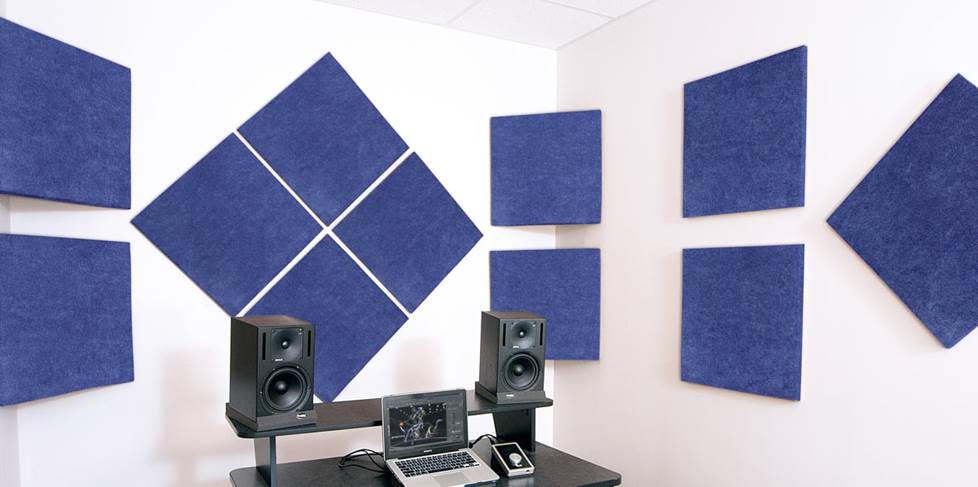
Acoustic panels reduce sound reflections and tame flutter echo.
You don't have to treat every surface in your room. Treat a few key spots to get maximum sound improvement for your investment.
Locating your room's reflective trouble spots
Now the fun begins. You're going to learn how to locate your room's reflective trouble spots.
The reflections that bounce once off the side walls toward your seat are called "early" reflections. Controlling the early reflections is crucial to achieving better sound.
So, how do you figure out where these early reflections are coming from? Use a mirror.
Sit in your listening position. Have a friend slide a mirror along the left wall at the height of the tweeter. When you see a reflection of the left speaker in the mirror, mark the spot on the wall with a piece of tape.
Continue moving the mirror until you see a reflection of the right speaker. Mark the location.
Repeat this procedure on the right wall.
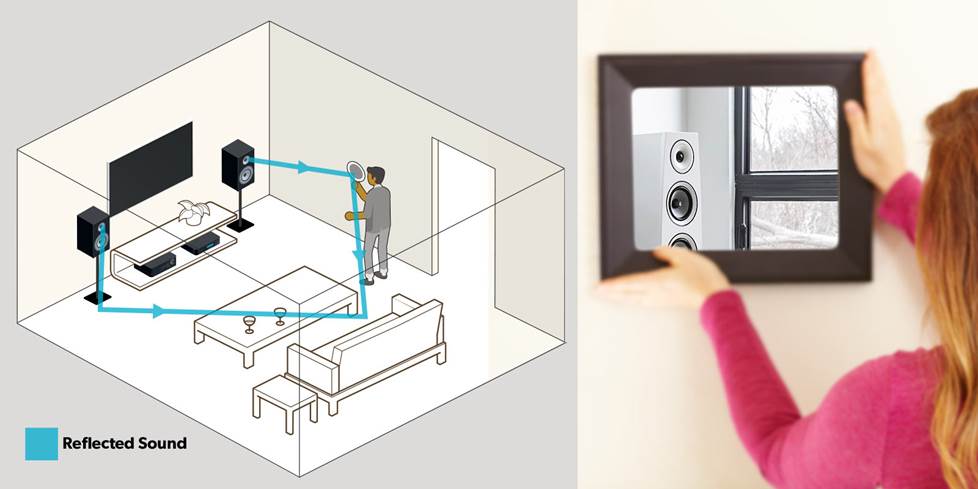
Use a mirror to locate side wall reflection points. That's where you need to apply acoustic treatments.
Now it's time for your rear wall. Use the mirror technique again to find and mark the reflection points for each speaker. If possible, repeat the wall procedure on the ceiling.
How to fix your trouble spots
Now that you’ve located your reflection points, it’s time to cover them with absorptive material.
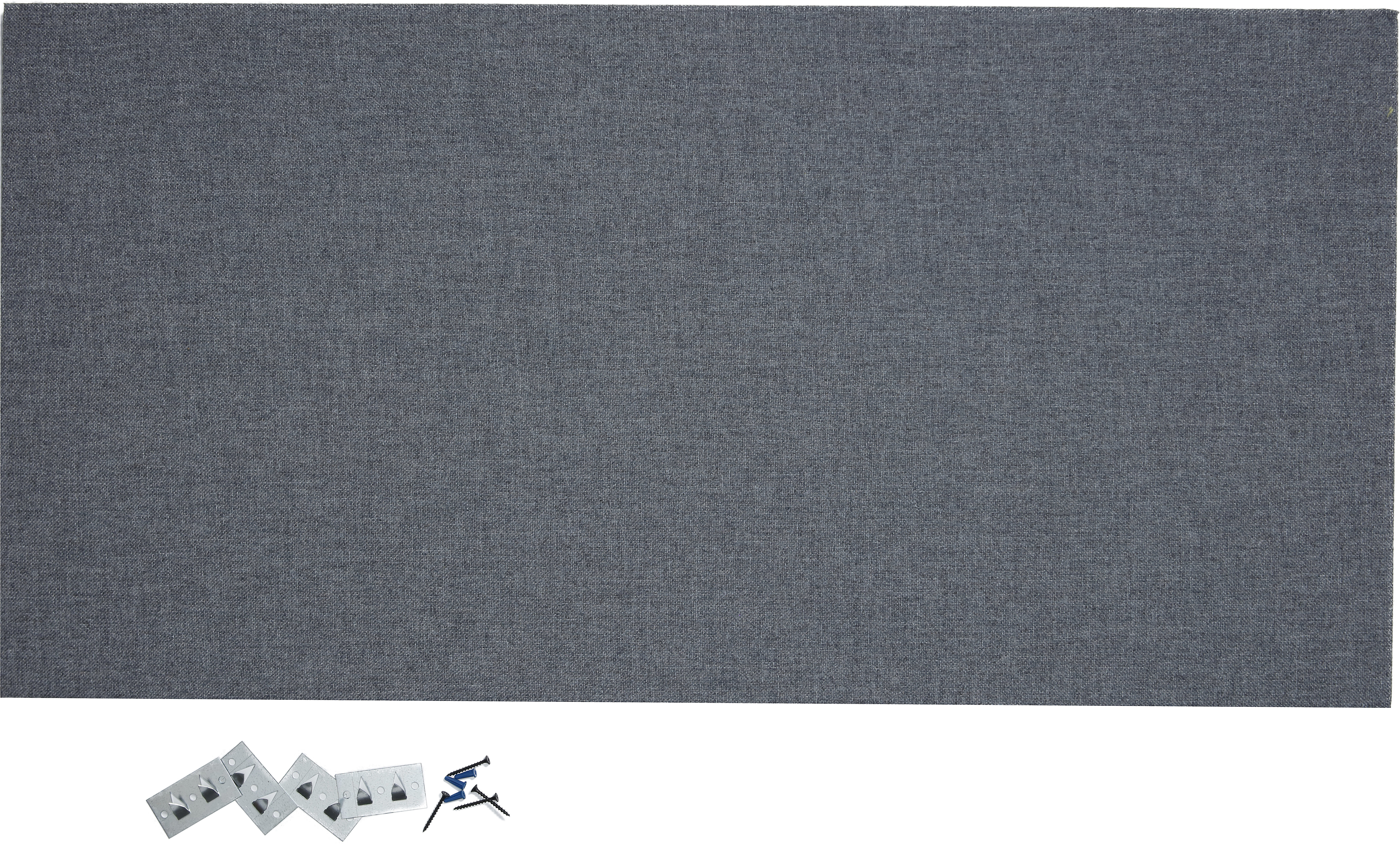
You can purchase acoustic panels in a variety of shapes, sizes, and colors. Or do a little internet research for recipes to make your own.
Your wall panels should extend at least 18" from each side of the marked locations. The material should be at least as high as the tops of the speakers.
The wall behind your listening area may also require treatment, especially if it’s very close to the back of your seat. The rear wall is the surface that would benefit most from diffusion products or a bookshelf.
Bare floor between your listening spot and your speakers should be covered with an area rug.
If you find any reflective points on your ceiling, apply sound panels that extend at least 12" on either side of each marked location.
When to use diffusion
In some situations, absorption is not the best choice.
Say your system is in a room with thick carpeting on the floor, acoustic tile on the ceiling, and heavy drapes covering much of the wall surfaces. You’d have nearly all of the high-frequency reflections being absorbed and nearly all of the bass sounds being reflected.
The sound in this room would be unpleasant: thick and boomy in the bass with little or no sense of spaciousness. An over-absorptive room can also make spoken dialogue sound unnaturally dry.
Diffusion is the scattering of acoustical energy. It tames reflections without making your room sound too dead. A bookcase filled with odd-sized books makes a very effective sound diffusor.
How to design a room for good sound
If you have the opportunity to build a listening room or dedicated home theater, carefully consider the dimensions.
Certain room shapes are fundamentally bad. A cube is one of the worst shapes for a room — each resonance mode gets triple emphasis. You'll also hear more standing wave distortion in rooms with two equal dimensions, or rooms with dimensions that are multiples, like 8' x 16' x 24'.
Here are some room dimension ratios that are much better:
| Height | Width | Length |
|---|---|---|
| 1 | 1.4 | 1.9 |
| 1 | 1.3 | 1.9 |
| 1 | 1.5 | 2.2 |
| 1 | 1.2 | 1.5 |
Applying the 1 : 1.4 : 1.9 room dimension ratio to a room with an 8-foot ceiling yields dimensions of 8'H x 11.2'W x 15.2'L.
Go big, if you can. The smaller the room, the more its resonance modes will color bass response.
A high, sloped ceiling tends to scatter ceiling mode effects.
The sound-absorbing effectiveness of some common room surfaces
Fibrous materials like carpet and drapes provide significant absorption above 500 Hz but have little effect on lower frequencies. Conversely, window glass and drywall can absorb bass frequencies but are very reflective above 500 Hz. The most successful approaches combine materials like these with room treatment products.
Try to balance the amount and frequency of the absorption in your room to achieve some bass and high-frequency absorption. Typically, bass absorption is more difficult to achieve.
The Master Handbook of Acoustics by F. Alton Everest and Ken Pohlmann includes essential information for building or remodeling a listening room.
Need help?
To learn more about speaker placement, read our how-to articles for stereo or home theater systems.
For help with your system, please contact a Crutchfield advisor.