Capacitors FAQ
What's a capacitor? What they do and when to use one

C
apacitors store up power from your battery and alternator, then release it to your amp during peak demand for more consistent bass. They are often used as a buffer zone between your amp and your car's electrical system to prevent the car's lights from dimming during loud playback. But how does a capacitor work? Do you really need one?
» What's a capacitor used for?
» Will a capacitor add power to my system?
» What size capacitor should I get?
Q: What's a capacitor?
A: A capacitor, or cap, is an electronic component that can take up, store, and discharge electrical energy. Because they can do all that quickly, capacitors are used to filter or buffer any sudden changes in a circuit's voltage, smoothing the ensuing signal.
Q: What's a capacitor used for?
A: In car audio, large outboard capacitors, sometimes called stiffening caps, are used to prevent lights from dimming when loud bass notes play. They accomplish this by supplying the amplifier with a quick jolt of power.
Q: Will a capacitor add power to my system?
A: A capacitor does not add power, it helps maintain a steady level and amount of the power that's already available. Your vehicle's alternator is the ultimate source of that power, and if it can't supply enough of it to run your sound system to begin with, adding a capacitor won't help.
For more details, check out What's the most powerful amp I can hook up to my factory system?
Q: Even if my lights don't dim, won't a capacitor still improve my system's low end response and overall sound?
A: Not really. A cap prevents the sound from deteriorating due to under-voltage, but doesn't actually improve the sound. It supports the amplifier by feeding it the power it needs for short bursts. So, while not improving sound quality directly, a cap does make it easier for the amp to perform its best.
Q: What size capacitor should I get?
A: The rule of thumb is to put in 1 Farad of capacitance for every 1,000 watts RMS of total system power. But there is no electronic penalty for using larger value caps, and in fact, many see benefits with 2 or 3 Farads per 1,000 watts RMS. The larger the cap, the more charge is available for the amp when it needs it.
Get everything you need
Give your subwoofer amp the boost it needs with a capacitor. We also have all the installation hardware you need to get your capacitor and amplifier up and running.
Q: How do I hook up a capacitor?
A: If you don't have the instructions that came with your capacitor, you should know first off that a cap can be dangerous. It can charge and discharge so much power so very quickly that it can weld metal objects, like tools and jewelry, and melt its own insides out.
A new cap comes completely discharged, so it's safe. A resistor or wired light bulb usually is included in the package. Wiring the bulb or resister across the cap's terminals allows the capacitor to discharge slowly and safely. The same bulb or resistor, wired differently, also gets used to charge up the cap safely.
As in all car electronic installations, start by disconnecting the ground cable from the car battery. In this installation, also take out the in-line fuse on the amp's power wire next to the battery.
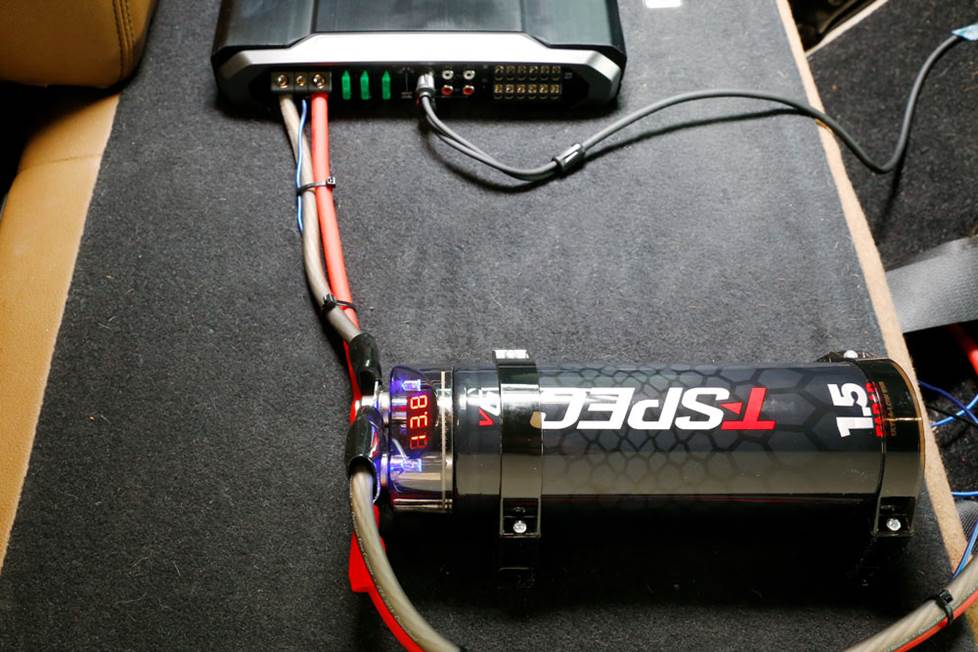
A capacitor should be mounted as close to the sub amp as possible using the shortest wires possible. This is so the extra charge doesn't have far to go to get to the amp quickly. Make sure the cap gets mounted securely and won't become a dangerous flying object in the event of an accident.
A capacitor has two poles: a positive and a negative. They should be clearly marked on the capacitor. The positive connects to the same positive power lead that goes to your sub amp's positive, 12 volt, connection. Use the same gauge wire as the amp uses for its power. This can be accomplished with a distribution block. Or, sometimes, the cap comes with multiple connection terminals that make it easier to wire it into your system. The multiple terminals act just like a distribution block so, for instance, the power wire coming from your battery can connect directly to the cap's positive terminal while a short cable connects from there to the amp's positive power connection. The negative pole of the capacitor connects to your chassis ground, just like the amp. The best practice is to use the same bolt the amp uses for ground. Make sure all the paint is scraped off around where you put the chassis ground and the connections are clean and tight.
Next, you need to charge up your capacitor. If done too quickly — it could "pop," destroying the cap.
If you don't have the original charging/discharging resistor or light, you'll need to get one. An automotive 12-volt test light, the kind with a bulb, not a small LED, will do nicely. Otherwise, you can use a high-wattage, low resistance resistor, available at most electronics parts stores. The exact value doesn't matter, but get one with a value of 10-1,000 ohms along with a rating of 1-20 watts. The lower the resistance, the higher the wattage should be.
Take the test light or resistor and connect it to the two terminals of the amp's in-line fuse holder (where you took the fuse out earlier). Re-connect the car battery's ground cable. The resistor will get hot, or the bulb will light up, while the cap charges. After 10 to 30 minutes, the bulb will fade out, or the resistor will start to cool. Remove the light or resistor carefully — they can get very hot. As you replace the fuse, you may experience a small spark — that's okay, but should remind you of how powerful the electric forces involved are. Your capacitor is now installed.
Q: My capacitor has a third terminal. What's that for?
A: Some caps come with a built-in meter that displays the voltage. If a meter were to stay on constantly, it could drain the car's battery. So caps with meters often have a remote turn-on lead connection, just like car amplifiers, so the meter turns off with the system. A thin, 18-ga. or so, wire should run from the cap's turn-on connection to the amplifier's remote turn-on terminal, or any other switched 12 volt power source.

T-Spec 3.0-farad capacitor


_mobile.jpg)




Keith from Round Rock
Posted on 11/6/2024
What model(s) of capacitor have a remote turn-on connection? I need a capacitor for a vehicle that sits unused for weeks (or months) at a time. My current capacitor kills the (even brand new AGM) battery when the vehicle sits unused for that long.
Buck Pomerantz from Crutchfield
on 11/7/2024
Nathan
Posted on 12/10/2023
Both my capacitor and amp have a remote power terminal. Do I attach the wire from the head unit to the amp or capacitor? Do I need to also run a bridge connection between the amp and capacitor? Unsure if wiring the remote power on the capacitor would effectively "turn off power" to the amp or if I really need to wire both.
Buck Pomerantz from Crutchfield
on 12/11/2023
Cali
Posted on 11/18/2023
I have a Compustar DroneMobile remote start and cellular vehicle tracking system in my 2010 Toyota Prius with JBL. Every few days, especially in the winter months, I get an alert that my ignition battery is low, and have to start the car and let it run for 20 to 30 minutes to keep it from discharging. Would a capacitor help extend the time between when I have to start the car? If not, do you have any other suggestions that could achieve the same goal? Other possibly relevant info: Along with the above system, I have a dashcam, and an aftermarket Pioneer touchscreen radio with a backup cam, none of which receives power when the car is off. I don't have any upgraded speakers, subs, or amps. Thank you for your time, Cali
Buck Pomerantz from Crutchfield
on 11/19/2023
eric from honolulu
Posted on 9/22/2023
i have two jl xdm600/1 amps hooked up to one t spec capacitor 1.5 farad . can i put the fuse for the amps after the capacitor?
Buck Pomerantz from Crutchfield
on 9/22/2023
lee girard from Muskegon
Posted on 7/1/2023
If a cap is for ac circuits then why does it work with a 12dc volt car Battery
Buck Pomerantz from Crutchfield
on 7/1/2023
Dennis Snyder from Youngsville
Posted on 6/5/2023
This is one of the best explanatory write-ups I have read. If you worked for Crutchfield in 1989, you may remember me as one of the instructors in Raleigh, NC, teaching your first class of certified installers.
Eric LaCruze
Posted on 5/24/2023
My new Boss 2 farad Cap instructions say 'Do not use a shared ground with the Amp' Why not?
Buck Pomerantz from Crutchfield
on 5/25/2023
Ian Z from New York
Posted on 3/18/2023
What are all pieces needed to connect a capacitor into an already existing sub system? For example, do they sell a capacitor kit like they do an amp kit, or will a 2 channel-4 gauge amp kit suffice? I only ask because my audio installer mentioned spade terminals, connectors, speaker wire etc. Thanks.
Buck Pomerantz from Crutchfield
on 3/20/2023
Jesse
Posted on 3/2/2023
Hi, Can I ground my amp to my cap, and ground the cap to the chassis. So only with one wire to the chassis?
Buck Pomerantz from Crutchfield
on 3/2/2023
Robert from sanford
Posted on 2/14/2023
There are motorcycle batteries that are LiFePO4 made by Noco that are reasonable. I am curious if they would have the same affect as a capacitor as well as store energy which removes draw on car battery.
Buck Pomerantz from Crutchfield
on 2/15/2023