How to choose a crossover
Send the right signal to your speakers and tweeters

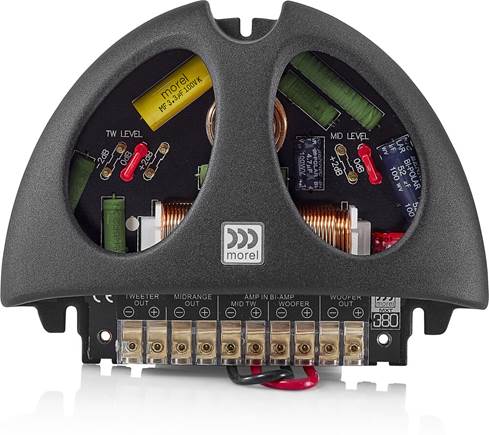
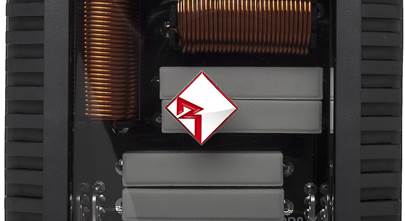
Morel MXT380C 3-way crossover
A crossover is an electronics device that takes a single input signal and creates two or three output signals consisting of separated bands of high-, mid-, and low-range frequencies. The different bands of frequencies feed the different speakers, or “drivers,” in a sound system: tweeters, woofers, and subwoofers.
Think of a crossover network as an audio traffic cop, directing highs to your tweeters, midrange to your woofers, and low bass to your sub.
Without a crossover, a messy, sonic "traffic jam" results. Your midrange and sub duplicate too many of the same frequencies and your sub wastes time trying to put out high notes it wasn't meant to handle. A "fatal pile-up" could also occur, with your tweets being destroyed by some renegade tractor-trailer of a bass note thumping along in the wrong audio lane.
Because they're essential, you'll find crossovers in some form almost any time speakers are present. For instance, if your home stereo uses a pair of 2-way bookshelf speakers, it uses 2-way crossovers (inside the speaker boxes). Within each crossover, a high-pass filter blocks the lows but passes the high frequency notes to the tweeter, while a low-pass filter blocks the highs and passes low frequency notes on to the woofer.
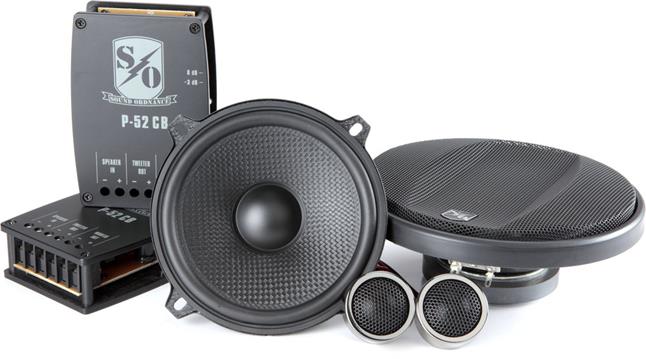
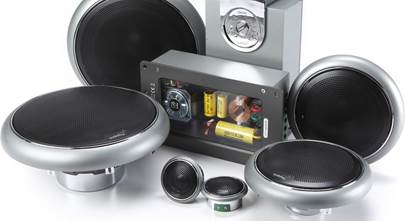
Sound Ordnance P-67CB component system: woofers, tweeters, and crossovers
The crossover “networks” of coaxial, full-range car speakers are usually built into the speakers, and often consist of small electrical components like coils or capacitors. Crossovers for 3-way systems, those systems utilizing tweeters, midrange drivers, and subwoofers, include, besides high- and low-pass filters, “bandpass” filters which play frequencies between two points by utilizing both a high-pass and low-pass in the same filter network. So, for example you could have a midrange driver only playing 100 Hz to 2500 Hz.
Active or passive?
There are two basic kinds of crossovers: active and passive. Passive crossovers don’t need power to filter the signal as desired. Active crossovers require power and ground connections, but give you much more flexibility and fine-tuning control over your music.
Active systems
A sound system is termed “active” when each driver (tweeter, woofer, sub) has its own channel of amplification. This dramatically increases the available power, dynamic range (softest to loudest sounds), and your control of the system’s tonal response over the whole audio spectrum.

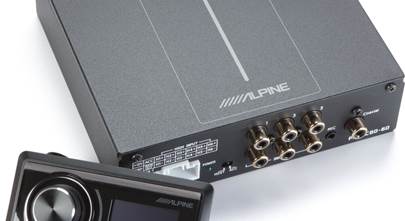
AudioControl's DM-810 processing includes multiple crossovers to match signals to speakers.
An active crossover gets wired between the receiver and amplifier and cuts out the unwanted frequencies before the amp wastes energy boosting them, so the amp can focus on only the frequencies you want to hear. Active crossovers usually have volume controls on every channel or pair of channels so you can keep all the “voices” of the different drivers in balance. Some active crossovers include other sound-processing features like equalization for further tweaking of the sound to your personal satisfaction.
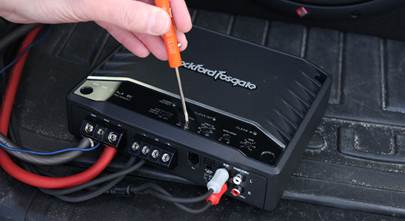
The only potential disadvantage of an active crossover is that since it requires +12V, ground, and turn-on connections, it presents more of a challenge to install and set up than a passive crossover. But with a little time and care this shouldn't be a problem, and the rewards and advantages of an active crossover make it clear why you'll find one in virtually every competition-level car audio system. Likewise, stereo systems tuned for high-quality sound will make use of crossovers in order to keep the speakers playing clean and clear.
Passive crossovers
A passive crossover doesn’t need to get hooked up to a power source to work. There are two kinds of passive crossovers: component crossovers that connect between the amplifier and speakers, and in-line crossovers that fit in between the receiver and the amp.
Component crossovers
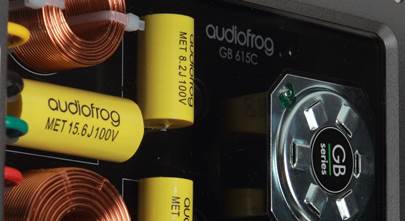
Passive component crossovers step into the signal path after the amplifier. They’re small networks of capacitors and coils usually installed near the speakers. Component speaker systems come with their crossovers set for optimum performance, and they are simple to install and set up. A full-range signal exits the amplifier and goes to the passive crossover which separates the signal into two parts and sends the high notes to the tweeter and the mid and low notes to the woofer. Most passive component crossovers have optional settings that let you turn down the tweeter some if it seems too loud for the woofer.
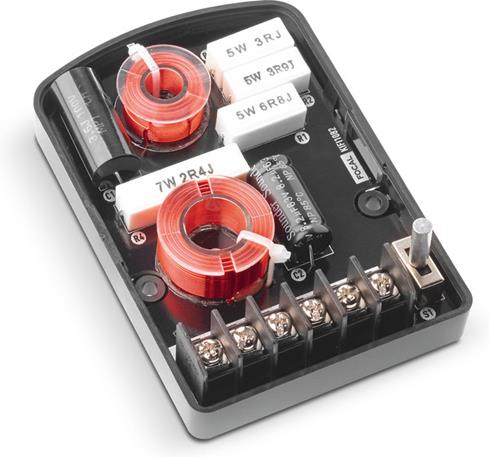
Crossover for a Focal Performance PS 165AS component system
Since it is filtering a signal that has already been amplified, a passive crossover wastes power, releasing the unwanted parts of the amplified signal as heat. Also, speakers actually change their impedances when playing which also changes a passive crossover’s crossover point, or frequency response, leading to inconsistent sound definition, especially around the vocal regions. (This is another advantage to using an active crossover, which is unaffected by speaker impedance.)
In-line crossover
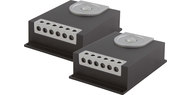
Besides passive crossovers that operate on speaker-level signals and connect between your amp and your speaker components, there are also in-line crossovers that connect before the amplifier. They look like little cylinders with RCA connectors on each end and simply plug into your amplifier’s inputs. In-line crossovers make sure your amplifiers don’t waste energy amplifying signals you don’t want — like high frequencies to a subwoofer amp. Installing an in-line crossover is a great and inexpensive way to sharpen the sounds of your system, especially in a component speaker system.
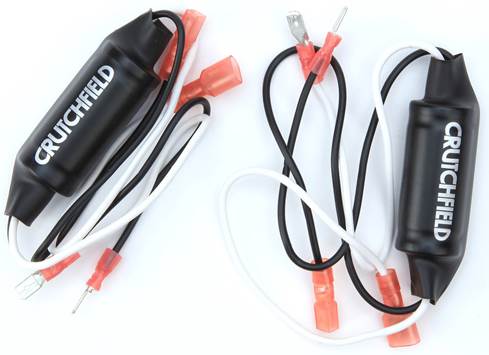
Crutchfield Bass Blockers in-line crossovers
In-line crossovers each come set to a specific frequency and can’t be adjusted. Another disadvantage of using in-line crossovers is that they react differently to different amplifiers, possibly changing their crossover points unpredictably.
For future upgrades and expansion, go active
If you plan on expanding your system in the future, it's wisest to go with a separate outboard crossover, instead of relying on the ones built into your receiver and amplifier. While these built-in crossovers work well, they don't offer the total system control of an outboard unit. Also, if you ever upgrade your amp, you don't have to give up your crossover.
Tuning your system
Varying your crossover points is one approach to "tuning" your speakers. You can expect this adjustability from just about any active crossover. Setting crossover points also helps define the overall tonality of your system.
Setting your low-pass filter above 100 Hz gives you the type of boom many rap fans are looking for, while pushing it down to 80 Hz tightens up your bass and improves front soundstaging. Because each output channel on an active crossover usually has its own level control, you can even use this component to compensate for varying efficiency or sensitivity ratings among your speakers.
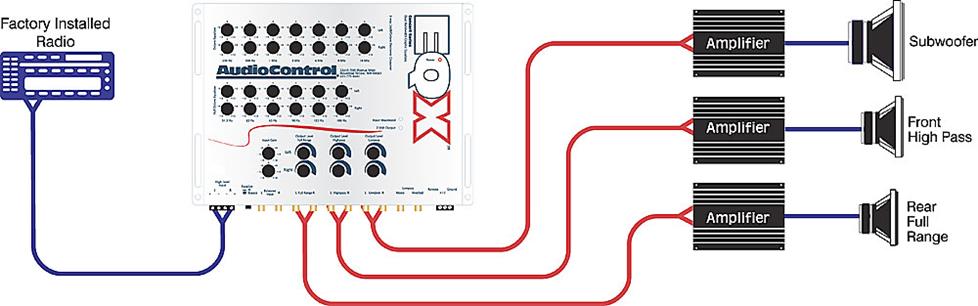
How a stereo 3-way crossover fits into a system
Let there be music
Let's look at an example. Take a simple three-way crossover network:
- lowpass filter with a crossover point at 80 Hz;
- highpass filter with a crossover point at 3,000 Hz;
- bandpass filter with a low crossover point at 80 Hz and a high crossover point at 3,000 Hz.
You hop into your ride, slip in a CD and suddenly a hefty dose of unadulterated Dave Matthews Band is headed straight for your speakers. The lowpass cleans up Carter Beauford's kick drum and the low notes on Stefan Lessard's bass, and passes these tones below 80 Hz to your subwoofer system.
Meanwhile, your highpass sends cymbal crashes and acoustic guitar harmonics to your tweeter, while limiting frequencies below 3,000 Hz. And Dave's vocals, Boyd Tinsley's violin, and other sounds between 80 and 3,000 Hz find their way through the bandpass crossover to your midrange drivers.
The crossover assigns the proper frequencies and levels to the various speakers in your vehicle, the pieces of the sonic puzzle fit together perfectly, and DMB sounds righteous. It's all good.
Get Everything You Need
You'll need patch cables and power wires to connect an active crossover.
Check out all of the crossovers and other sound processors available at Crutchfield.





Ali Naser
Posted on 8/1/2023
hey there i'm buying the kappa 753T tweeter and i'm wondering if need a passive crossover or not? so if i need i should buy the 2 way or 3 way just to pulg only the tweeter nothing else
Buck Pomerantz from Crutchfield
on 8/2/2023
Miguel from Little rock
Posted on 6/18/2023
Excelente imformacion
Jim Davidson from Fortaleza, Brazil
Posted on 5/25/2023
I am renovating two older Brazilian made Sansui speakers. Inside each are an 8" woofer, 5" mid range, and two identical 1" tweeters - all Bravox brand. No crossovers. How can I improve the sound installing crossovers and of which type? The renovation costs as much as a new pair of JBL A130's. So I may just replace the older Sansui's.
Buck Pomerantz from Crutchfield
on 5/25/2023
Colin from Austin
Posted on 2/6/2023
I had purchased 2 sets of Kenwood Performance components, upon installation my rears sound great but the front drivers set is distorted and the front passenger tweeter isn't working, all wiring is correct as I've gone through it multiple times. Would adding wire into my Bass Blockers that came with the speakers cause this?
Buck Pomerantz from Crutchfield
on 2/8/2023
Samminder Singh from Collierville
Posted on 1/22/2023
Hello, I have a Focal RSE-165 component system that comes with two passive crossovers for the tweeters(2 connection terminals) and mid range woofers(2 connection terminals). I am using a Sony XAV-AX5500 car stereo on my 2006 Honda Odyssey (No navigation system, 6 speakers) . I am wondering if I need to use them as I have a High and Low pass filter option on my head unit, but will this be sufficient? I am confused because the end that goes toward the head unit on the passive crossovers is two + and -, but where would these connect to in terms of my car stereo?
Buck Pomerantz from Crutchfield
on 1/23/2023
Matt
Posted on 10/5/2022
Hello, I have component speakers (twitters indl dashboard and midbass speakers in front doors with crossover) and in trunk is subwoofer. All is connected into amp (4 chanell) sub is bridged. But i think i can do it more of power from my subwoofer currently my amp is braking power i think. So i really thinking about buy second amp (monoblock) and current 4 chanell amp and there create full range speakers from my twitters and midbass in doors without crossover). So what do you think about this? From component speakers inc crossover to - -> full range speakers where will be connected az chanell 1 and 2 twitters with HPF 3.8kHz and midrange speakers will be connected into chanell 3 and 4 with HPF 120Hz and LPF 2000-2500Hz. I am curious about your answer :)
Buck Pomerantz from Crutchfield
on 10/7/2022
Enyi Chukwuka from Enugu state Nigeria.
Posted on 9/16/2022
I just read your article from Nigeria, how do benefit from your give away and also how can I buy your crutchfield bass blocker crossover.
Buck Pomerantz from Crutchfield
on 9/16/2022
Jason from Auburn
Posted on 6/13/2022
Hello, I have a Lexus 2022 GX 460. It has a factory Pioneer amp that I'm told already sends specific frequencies to each channel (7) with a total of (9) speakers. Up front I have 3 way components. The Tweeters and mids are run parallel as ch 1 and ch 2 left and right. I want to upgrade my 3 way components. Do I need crossovers, or will that just cause issues because the amp is kind of acting like a cheap DSP. I see that the tweeters have bass blockers. I don't know if the mids and tweeters are getting a full signal or not. The woofers in the doors (separate) ch only play lows.
Buck Pomerantz from Crutchfield
on 6/15/2022
Samuel from Nairobi
Posted on 4/10/2022
Good lessons
Rakesh t from ramgundam
Posted on 3/4/2022
Sir I need an help that I'm so confused in my 3way setup mainly in high frequency drivers Sir I'm having 8in no of 110 wtss high compression drivers and an active corssover and seprate amplifier for those hf drivers But I don't know how to connect them and get good results by not making any mistake I want to use 4nos in one chanel and another 4 in another chanel of amplifier crown xls2502 it is giving me 440wats at 8 ohms but I'm confused here that 4of these 110×4=440 Giving me the same match to amplifier but if I connect 4 of them in parllel it will be 2ohm load it is not suggested but Ive seen some pictures of making series /parllel connection Does it works is it required to have a passive network or can I drive them by using my active crossover by giving only high frequency please solve my problem sir