Car speakers FAQ

When you're shopping for speakers, it's only natural to have questions. This FAQ is a great starting point whether you're considering upgrading from factory sound for the first time or you're looking to optimize your current system.
Sound and performance questions
- What kind of a difference do new speakers really make?
- How much power do I need for my new speakers?
- Will my factory radio power aftermarket speakers?
- Do speakers with a higher efficiency rating sound better?
- Does the type of tweeter make a difference in the sound I hear?
- What difference do cone materials make?
- What innovations in aftermarket speakers can help improve the sound of my system?
- My front speakers sound distorted when I crank up my system. Is there any way to improve their performance?
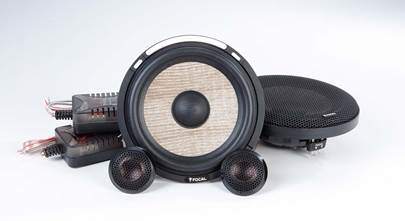
- What advantage do I gain by choosing component speakers for my car?
- My new component speakers aren't living up to my expectations. What's wrong?
- What's the most affordable way to get crisper highs and better stereo imaging in my car?
Installation questions
Sound and performance questions
Q: What kind of a difference do new speakers really make?
A: You'll find that replacing your factory speakers can make a noticeable difference. Music sounds crisper, more dynamic, and closer to the way it was recorded and better than it would with a worn-out or low-quality speaker.
Speaker replacement is also the single most cost-effective car stereo upgrade you can perform. And even the newer, factory-installed speaker systems, which may sound OK at first, aren't typically built to give you the years of reliable, ear-pleasing sound you can expect from a good pair of aftermarket speakers.
Q: How much power do I need for my new speakers?
A: While manufacturers give a range of RMS, or continuous, power that will work for the speaker, getting towards the upper end of that power range or even exceeding it yields the best results. That said, a speaker with a lower RMS power range will be more suitable for powering with a factory or aftermarket stereo, while a higher RMS range will work better with an external amplifier.
With an external amplifier, you should pick an amp with a power rating in the upper end of your speaker's power range. For example, if a speaker is rated to handle up to 35 watts of RMS power, it will perform closer to optimum as your power source approaches delivery of 35 watts.
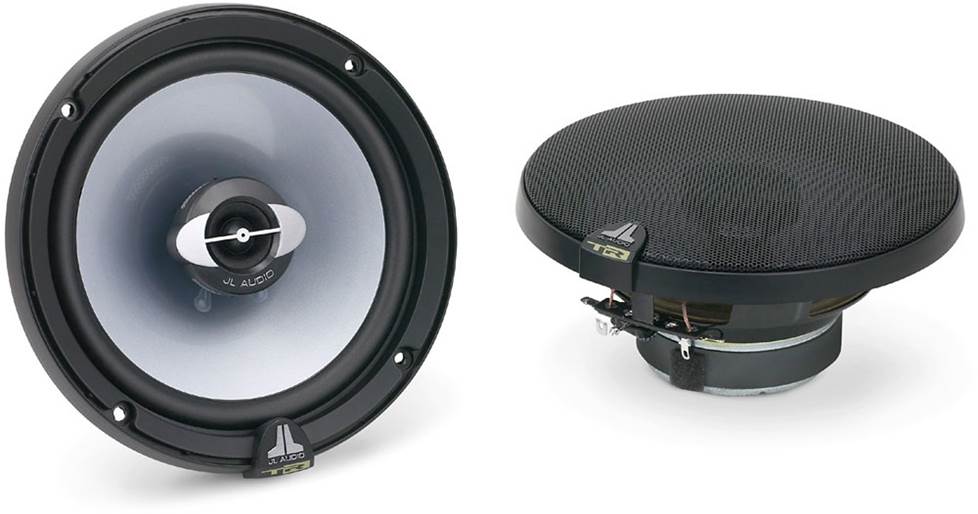
It's better to overpower a speaker than to underpower it — the distortion caused when you push a low-powered amp or receiver to its limit is much more likely to harm a speaker than too much power.
Q: Will my factory radio power a set of aftermarket speakers?
A: In most cases, yes. Aftermarket speakers will certainly sound better with a little more juice, but most of our speakers will sound just fine with factory power. The exceptions are matched component sets, and any speaker with a minimum RMS power rating of 8 watts or more.
Q: Do speakers with a higher efficiency rating sound better?
A: Efficiency ratings don't tell you how good a speaker "sounds." They simply indicate how well the speaker uses power. If you're using a low-powered factory system, you'll want to choose a speaker with a higher efficiency rating (90 db and up). Low-efficiency speakers can sound great, but they'll need a high-powered receiver or amplifier for energy.
Q: Does the type of tweeter make a difference in the sound I hear?
A: Speaker manufacturers use a variety of materials in their tweeters, such as paper, silk, ceramic, titanium, polyetherimide, and so on. One type of meterial is not necessarily superior to another, because they all have different characteristics and reproduce sound in slightly different ways. As a rule, paper is responsive because it is so light, while composites are more durable. You'll find that silk and silk/polymer blends sound very smooth and even.
In general, a dome tweeter provides better dispersion and off-axis imaging than a cone tweeter. A balanced dome tweeter combines the two designs with a dome mounted within a cone. You might want to listen to a variety of tweeter materials and designs to find the one that suits your musical taste.
Read our article about tweeter design for a more in-depth discussion.
Q: What difference do cone materials make?
A: As with tweeters, woofer cones come in a variety of materials. They can be made of treated paper, synthetics, or composites. Woofer cones need to be more rigid because their task is to reproduce strong bass notes. Again, paper tends to be less durable, but responds quicker than other materials. All of these can sound great; you just need to experiment with different sounds and materials to find what's right for you.
Q: What innovations in aftermarket speakers can help improve the sound of my system?
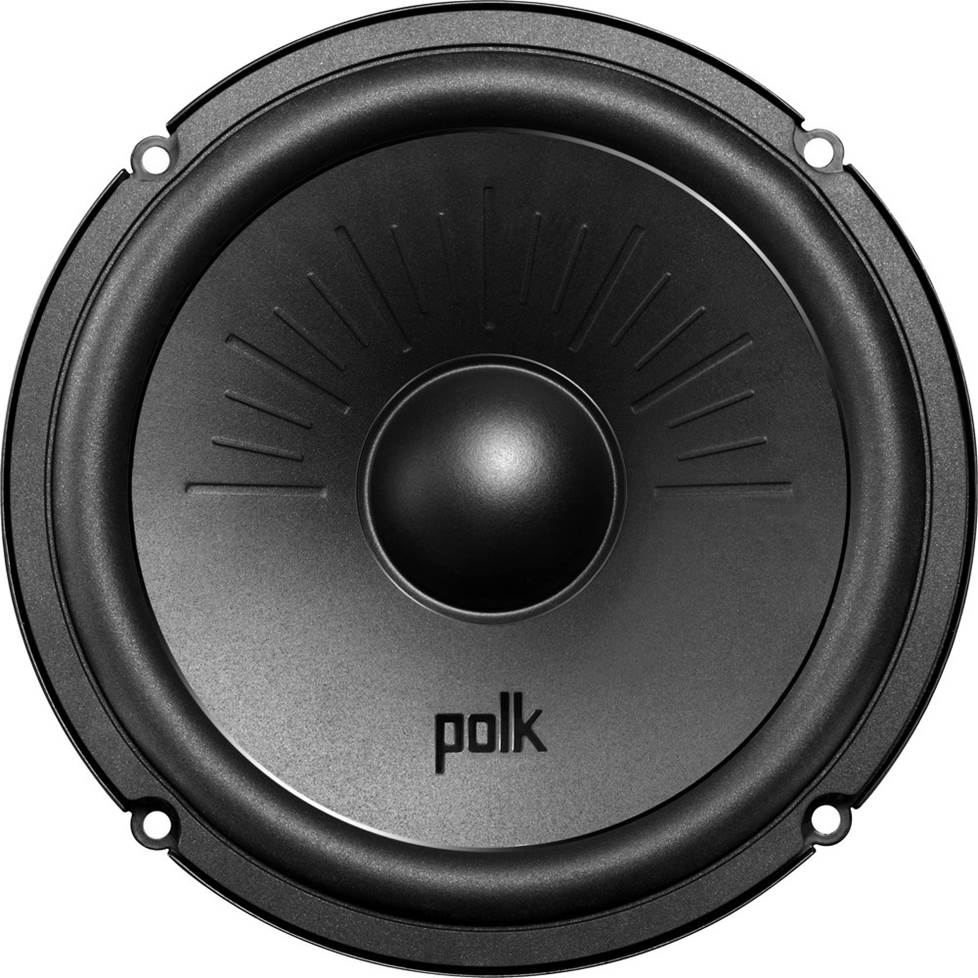
A: If you're looking to "tweak" your system for optimal performance, you should be aware of some of the great features that several speaker manufacturers offer. For improved imaging, many tweeters come in adjustable mounts that let you focus high frequencies more precisely to your listening position.
Some speakers have bi-amp inputs, so you can power the woofer and tweeter from separate amplifiers for more powerful sound.
Q: My new front speakers sound distorted when I crank up my system. Is there any way to improve their performance?
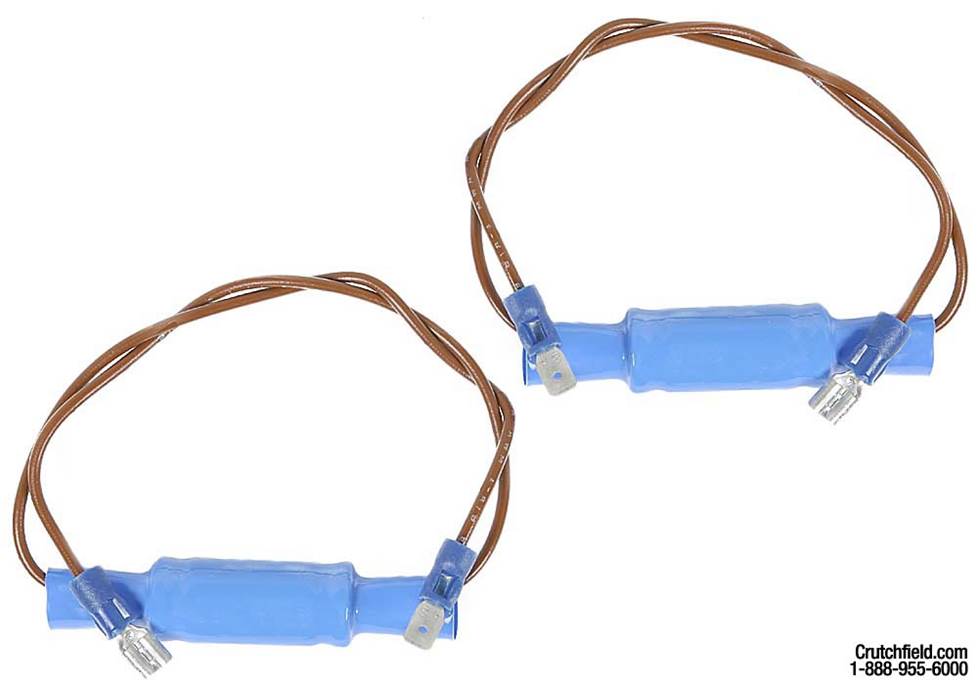
A: Try a set of Bass Blockers. These act as high-pass crossovers to guard against distortion, especially when you turn up the volume. Remember, the smaller the speaker, the more difficulty it has reproducing low notes at high volume. Eliminating low frequencies from a smaller coaxial speaker means you'll get cleaner, louder performance. And, since the bass coming from your back speakers (or subs) is omnidirectional, you'll never know the bass blockers are there!
Q: What's the advantage of choosing component speakers for my car?
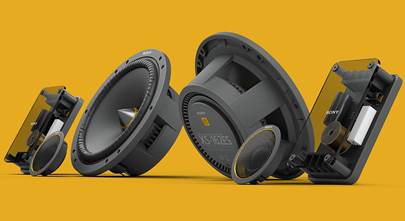
A: With a properly powered set of matched components, you'll get better imaging and a much more detailed and dynamic sound than you could expect from conventional speakers.
Mounting the separate tweeter closer to your ears optimizes your speakers' imaging and brings out a level of detail you may have never heard before. The premium-quality woofers deliver forceful, dynamic bass and midrange, while the separate crossover networks will properly routing your highs and lows to protect your tweeters and make your system sound its best. As a rule, component speakers generally require an external amplifier to really come alive.
Q: My new component speakers aren't living up to my expectations. What's wrong?
A: Here are a few tips to get your component speakers sounding their best:
- Check the crossover setting — many think that a flat setting for the tweeters is the way to go, but you'll often find that you need to attenuate the highs to counteract too much brightness
- Are you feeding them enough power? With most sets of components running them off your receiver just can't give them enough power to operate properly. Remember, underpowering your speakers is more dangerous than overpowering them.
- Like a good sub, speakers need time to break in.
- Are you getting rattles and vibrations? Check your mountings — you may benefit from installing foam baffles and Dynamat in your doors. Keep in mind, you've created new openings for the tweeters as well.
Q: What's the most affordable way to get crisper highs and better stereo imaging in my car?
A: If you often find yourself reaching for the tone control to "sharpen" your stereo sound, you're likely to notice a big improvement when you install a pair of add-on tweeters to your system. Most factory speakers are "dual-cone" models — they use paper whizzer cones to reproduce high frequencies. The result is sound that's dull and lifeless. You'd be stunned at the number of "premium" or "name brand" factory systems we've seen that rely on these little paper megaphones to handle the highs.
What makes tweeters so important? It's true that they reproduce the high notes, but there's more to the story. Besides being responsible for recreating the very highest frequencies in your music, tweeters impact the realism of the overall sound as well. This is because the ultra-high frequency information that tweeters handle helps render the specific timbre of each instrument in your music.
Timbre is a word used to describe an individual instrument's sonic fingerprint or voice. A good pair of tweeters will help you distinguish an overdriven guitar sound from a saxophone, and a saxophone from a trumpet. High-quality tweeters also add crispness to your music for a more realistic listening experience. They can ensure that the sound of a snare drum comes across as a satisfying crack instead of a muted thud, and they help you hear the rattle and click of strings plucked on an upright bass. You'll feel like you're right there in the studio with your favorite musicians.
Add-on tweeters also give you placement flexibility. They'll help you achieve realistic stereo imaging — that sense of the precise physical location of each of the musicians in the recording.
Installation questions
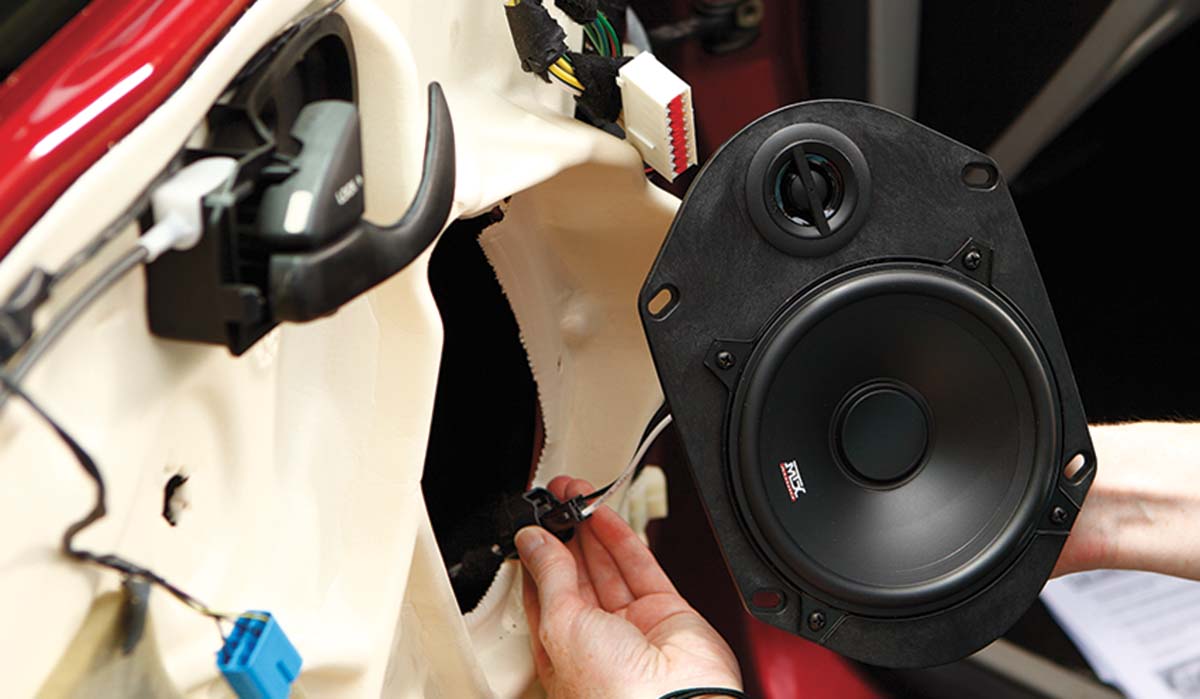
Q: I have 6"x9" speakers in my car. Why doesn’t your website show that any 6"x9" speakers fit?
A: Even though speakers are classified by cone size, it’s not the only factor in determining if a speaker fits your car. Sometimes speakers are too tall or too deep for the locations they’re meant to go in. In addition to measuring every speaker model we carry, we also measure thousands of vehicles. That's how we know that we're recommending the right stuff for your car or truck. If a speaker you’re interested in isn’t listed as fitting, give us a call. Sometimes minor modifications can make it work.
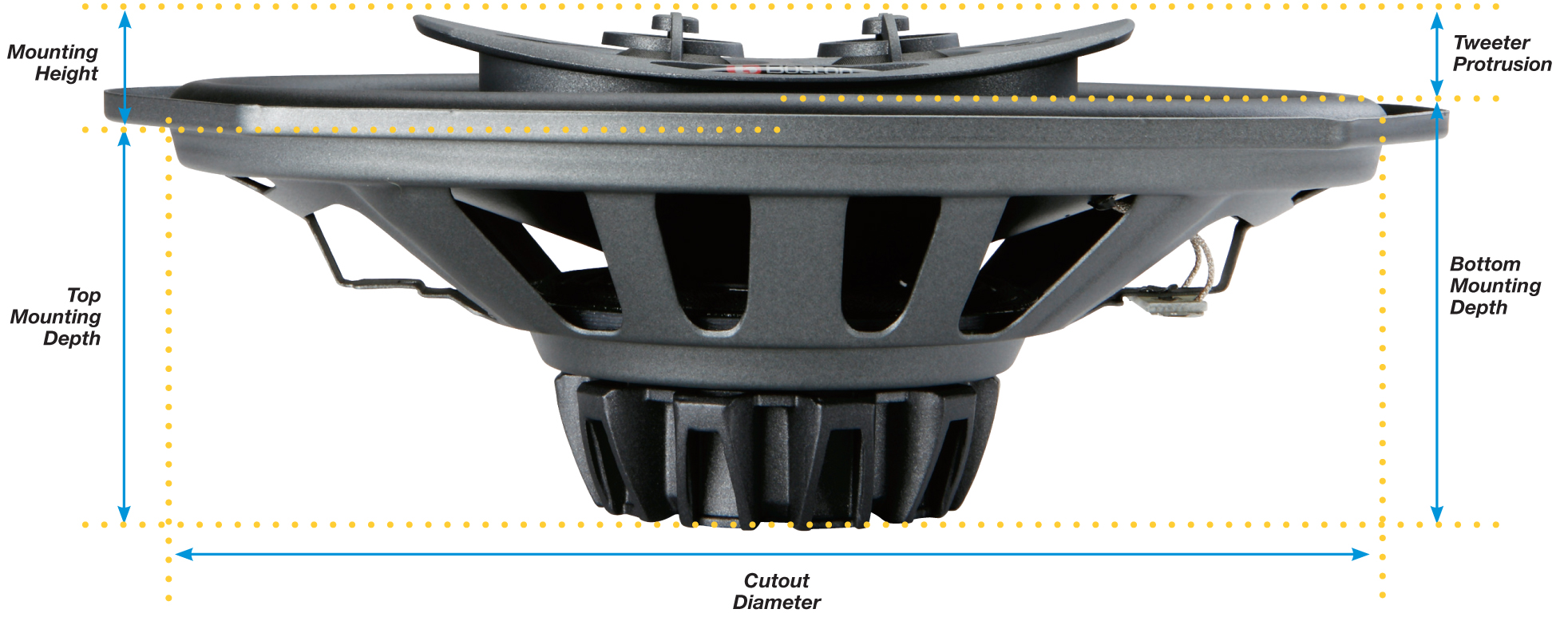
Mounting height and depth, along with tweeter protrusion, are major factors in determining whether or not a speaker fits your car. (Click the photo for a larger view.)
Q: How difficult will it be to install my new speakers?
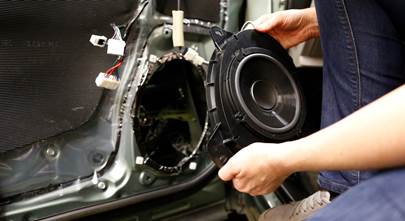
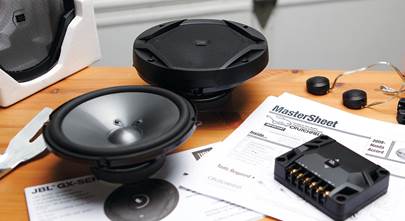
A: You can count on a simple installation with any of our "Easy-Fit" speakers. And in most cases, a new pair of speakers is about the easiest car audio component to install in your vehicle. As a Crutchfield customer, you'll benefit from the free, vehicle-specific instructions found in our MasterSheet™, free wiring harnesses that eliminate splicing, and our friendly, toll-free technical support. For a more detailed look at what's involved, check out our car speaker installation page.
Q: Do I need new wire to replace my factory speakers?
A: Factory speaker wire is fine if you're powering your new speakers with a factory or aftermarket stereo. But if you plan to install an external amplifier that's rated at 100 watts RMS or more per channel, then we recommend that you run new speaker wire.
Q: Can I use my factory grilles for installation?
A: You certainly can. In many cases, aftermarket speakers come with manufacturer grilles (usually sporting the speaker-maker's logo), which you can use if you prefer. Some manufacturers are shipping speakers with radical-looking grilles that are designed for excellent cosmetics and minimal sound obstruction.





Destiny
Posted on 4/30/2025
I'm looking to put in just door speakers on my 2019 Honda civic sport. Would I have to get a new receiver or adapter for my steering wheel controls cause it has buttons to mess with it on there? Or would the buttons still work with it since it's just the door speakers?
Richard Guerra from San Jose
Posted on 2/2/2022
I did not realize how much is involved in choosing the right tweeters for your car stereo, my self I am looking for a sharp crisp clean sound, I want the sound to remain clean no matter how much volume I put on it, no you have given me something to think about, I want the best, but I'm still subject to stay within a modest budget.
Jeffrey Wells from Rock Island
Posted on 8/8/2021
I have a 2022 trailblazer.....looking to upgrade door speakers....in the what fits ur vehicle I can't select trailblazer I assume 2021 n 2022 door speaker location will be the same?
Alexander H. from Crutchfield
on 8/9/2021
Kirk C Bonanny from Wilkes-Barre,Pa
Posted on 12/6/2020
I've found I get the best sound by mounting the tweeters as high as I possibly can in different vehicles as I find that tweeters mounted at dash level or lower sort of "get lost" and are far less efficient insofar as the ability to "pick them out" of the overall sound. My question stems from the materials I've read that come with many component speakers in that many want the tweeter mounted "X" far from the mid bass driver, mid range etc... Is there any rule to how close (or far) from other components a tweeter should be mounted in a vehicle?
Jimmie Adams from Lawrence
Posted on 2/4/2020
Which one will provide the better bass a 6 and a 1/2 speaker with 200 rms or a 10" speaker with a 150 rms
Alexander H. from Crutchfield
on 2/5/2020
Paul Hubbell from Victoria
Posted on 12/13/2019
This question has probably been asked 1000x time over but here I go. I have an "ish" understanding of impedance but no idea if it makes a difference with door speakers. My amp is 2/4 ohm stable and I have 2ohm jbls in all my doors. All coaxial, and I plan to keep it that way for a while Will I need to flip a switch, or wire the speakers/amp any differently if I swap to 4ohm speakers in the future? And will 4ohm speakers be any louder than the 2ohm or will it be about the same and a waste of effort to swap?
Harris from Gainesville
Posted on 12/4/2018
So I'm getting new speakers for my truck. I found the speakers that I want but there is a bundle that comes with tweeters. Do I really need the bundle with the tweeters or can I just get the speakers without the tweeters?
Alexander H. from Crutchfield
on 12/5/2018
Alexander Hrabe from Crutchfield
Posted on 3/5/2018
Shoeb, the RMS rating should be per speaker. So, in your case, you should be able to give each speaker 75-150% of 70 watts and you should be fine.
Shoeb from New Delhi
Posted on 3/5/2018
got a Jbl CX-62SI pair of speakers. The rms of these speakers is 70 watt and peak output is 280 watt. Is this 70 watt means these both speakers have a combined rms of 70 watt(means each speaker has a rms of 35 watt) or the single speaker has a rms of 70 watt?
Alexander Hrabe from Crutchfield
Posted on 9/12/2016
David, Ohms are the units of measurement for impedance or resistance. This tells you how much a device will resist the flow of current given it. If you take two signals of exactly the same voltage strength and send one to a 4-ohm speaker and the other to an 2-ohm speaker, twice as much current will flow through the 2-ohm speaker. In other words, the 4-ohm speaker will require twice as much power (wattage) to play at the same volume. 4 ohms tends to be the standard impedance for car speakers. Outside the impedance question, I would assume the Bose speakers you're talking about, if not new, were part of another car's factory system. If your vehicle is not the same as the vehicle (year, make, model, and Bose sound package) from which the Bose speakers are coming, these speakers probably won't work with your vehicle. If your vehicle has a factory Bose sound package, and you're buying direct replacements from the dealer, you should rely on the dealer for the right match. Otherwise, give us a call and we can help you with aftermarket speakers for your vehicle.