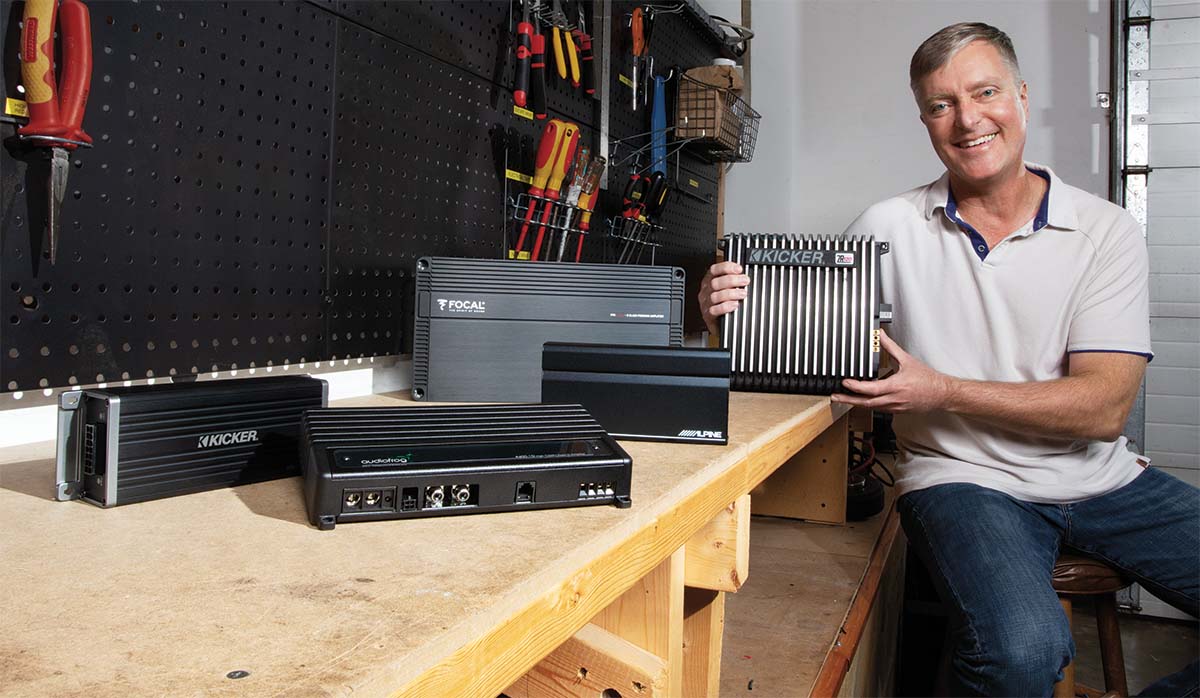
Car amplifier buying guide
What to look for to get the power you need.

When shopping for a car amplifier, there are a few basic questions that everyone has and a few use-cases that typically come up. This car amplifier buying guide will help answer those questions and get you started on the path to better car audio sound. We'll discuss:
Why add an amplifier?
If you want your music to be loud, amplifiers are definitely part of the picture. But whether you run your system wide open or softly enough for conversation, a power amplifier will breathe life into your music, bringing out all of its excitement and detail. Here are a few of the main benefits of adding a car audio amplifier:
- Better sound quality — Adding an amplifier gives you a clean power source that can drive your speakers without straining. Your music will sound cleaner and more defined at all volume levels.
- Power for upgraded speakers — High-quality aftermarket speakers or component systems may require more power for peak performance than your in-dash stereo can provide. An amplifier will give them the power they need for optimum sound.
- Powering a subwoofer — Subwoofers require significantly more power than a brand-name or factory in-dash receiver can provide. A separate amp is a necessity.
Video: How to choose a car amplifier
Let's start with a tutorial from Crutchfield's training manager. In this video, JR explains everything you need to know about choosing an amplifier for your car audio system. Be sure to read the rest of this article after you watch the video! We cover a few things in more detail below.
I want to add some oomph to a factory system
Standard factory stereos usually have no more than about 10 watts RMS maximum output power per channel, in spite of what the car dealers advertise. That's usually not enough power to overcome road noise without sounding shrill.

Our advisors, like Ivy here, can help you find the amp that's right for you.
An economical way to upgrade your sound system without changing the factory stereo or speakers is to get a compact 4-channel amp to boost the power for your front and rear speakers. The Alpine KTA-450 (shown above) is a good example of a small 4-channel amplifier that's tiny enough to be installed behind many dashboards and powerful enough to dramatically increase the quality and clarity of your sound.
How much power does my sound system need?
When building a system from scratch, one of the first questions you should ask yourself is, "How loud do I want this to be?" Car audio systems don't necessarily need massive amounts of amp wattage to sound loud, but having a lot of power available is good for the "headroom" of a system — the ability to deliver an emotionally impactful burst when the music asks for one. There's also the interior size of your vehicle to consider.
Small vehicles or factory speakers – 45-50 watts
If you drive a compact coupe or hatchback, a sports car, or a small-cab pickup, then an amp that's 50-watts RMS per channel or smaller will probably do fine, overcoming road noises and adding clarity to your music. If you still have the factory speakers, 45 or 50 watts is about as much power as you should use. When you're ready to upgrade, look for speakers with a top RMS rating of at least 50 watts RMS to go along with the amp.
Larger vehicles or you like it loud – 75 watts
For larger vehicles and for those who just want more volume, you should step up to at least 75 watts RMS per channel. A difference of 5 or 10 watts either way won't make any difference and probably can't even be heard. Matching speakers will need to each have a top RMS rating of 75 watts RMS or more.
Going where others fear to tread – 100 watts
Those of you who want even greater impact and eye-popping volume out of your audio system will want an amp with 100 watts RMS or more per channel. Get speakers or component sets that are each rated for at least the top RMS output power of each channel.
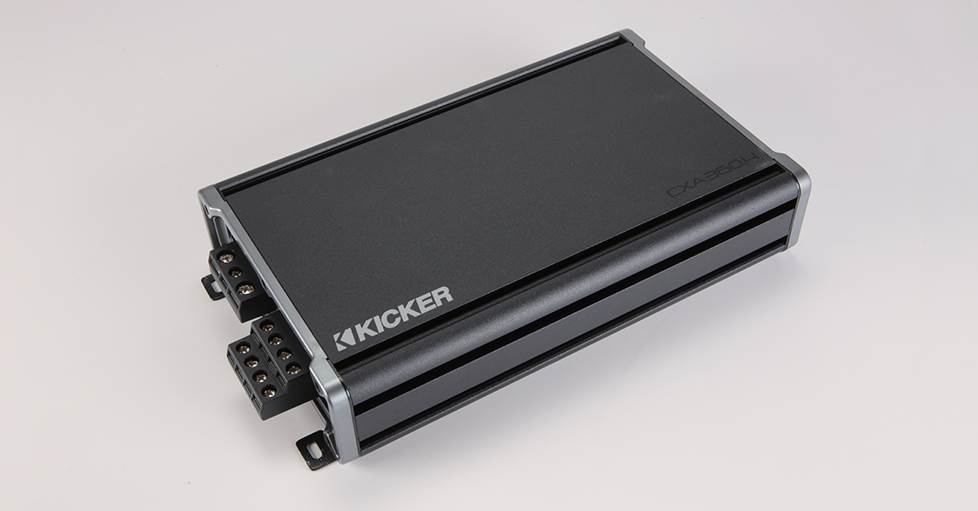
A Kicker CXA360.4T can power both front and rear speakers in most applications.
How much power can my aftermarket speakers handle?
All aftermarket speakers, especially component sets (separate woofers and tweeters), benefit from being fed more power than what a factory or even an aftermarket stereo can deliver.
Among a speaker's published specifications you will find its RMS (or "continuous") power rating, usually as a range — "5-60 watts RMS power range" for example. The higher number represents the approximate driving power at which the speaker will play at its fullest and best according to the manufacturer.
Do not exceed the RMS power ratings
We alluded to this rule in the section above, but it's important to not overpower your speakers.
- For your speakers, use an amplifier whose top RMS output per channel is no higher than each speaker's top RMS rating.
- For your amplifier, get speakers with top RMS ratings that are equal to or higher than each amp channel's top RMS output.
So, if you already have aftermarket speakers, find out their top RMS rating. If your front and rear pairs have slightly different power ratings, it's okay — use the lower rating.
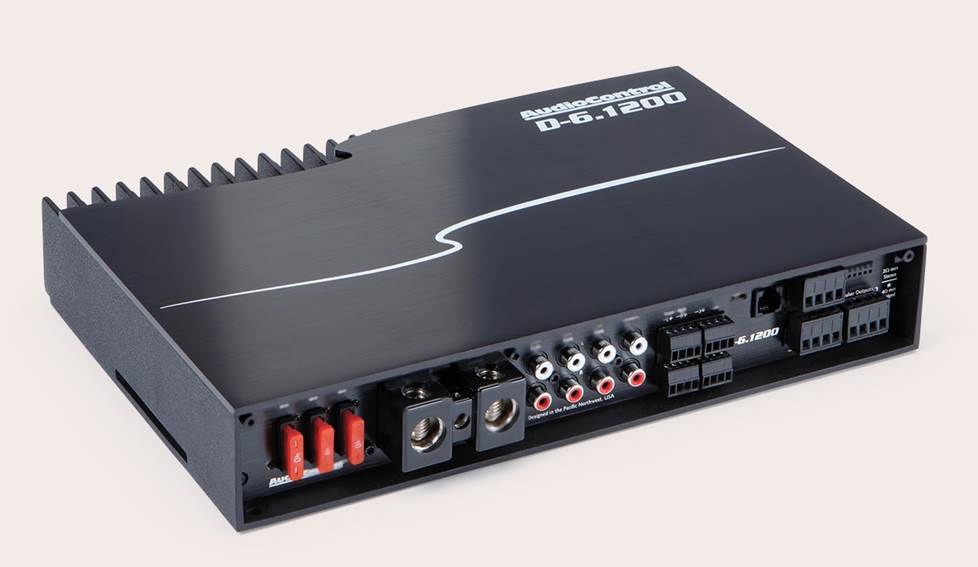
AudioControl's D6.1200 six-channel amp with digital signal processing can take care of a wide variety of system configurations.
How many channels should my amp have?
Each "channel" of an amplifier is a discrete source of power, intended to power one speaker. How many channels you need depends on your plans for your audio system now and in the future.
I'm only powering my speakers
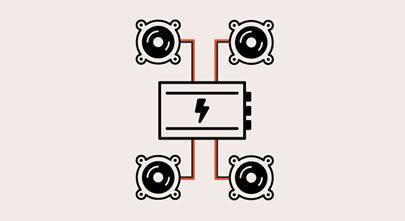
Many people like their music with a strong front stage and don't even use rear speakers. A 2-channel amplifier will be the practical solution when you only need to power a single pair of speakers. But if you like rear-fill sound in your car and want to retain front-to-rear fade control, get a 4-channel amp — one channel for each speaker.
I want to power speakers and a subwoofer
There are some other amp configurations to consider when you want to include a subwoofer in your system. A 3-channel amp can take care of a single pair of speakers plus a sub quite effectively.
Most people choose to use a 4-channel amp to run a pair of speakers and a sub — two channels to drive the speakers and the other two bridged together to run the sub. This gives you the option for future expansion of your system. Later on, you could use the 4-channel amp to run four speakers and add a separate amp for the subwoofer.
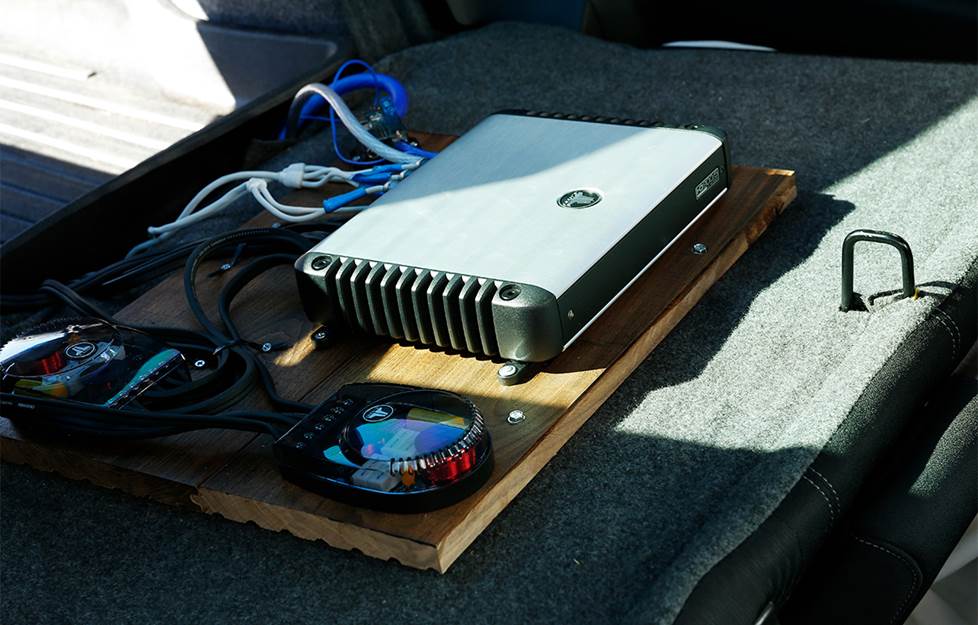
JL Audio's HD900/5 five-channel amp can power your front and rear speakers along with a subwoofer.
You may want to consider a 5-channel amplifier that can power your entire system from one convenient and compact package. It's four channels for your speakers, plus a fifth, higher-powered channel for your subwoofer. 6- and 8-channel amps take that all-in-one design and add even more system-building flexibility.
I only need an amp for a subwoofer
Bass is much harder to amplify than the rest of the spectrum of sound — that's why there are so many large and beefy subwoofer amplifiers out there dedicated solely to reproducing bass.
"Mono," or single-channel, amps are designed for subwoofers. They'll work with a wide range of impedances, and have tone controls and filters specifically made to help reproduce bass. Although many 2- and 4-channel amps can be bridged to increase their power enough to run a sub, they often then can't handle low-impedance subs and will overheat or go into protect mode.
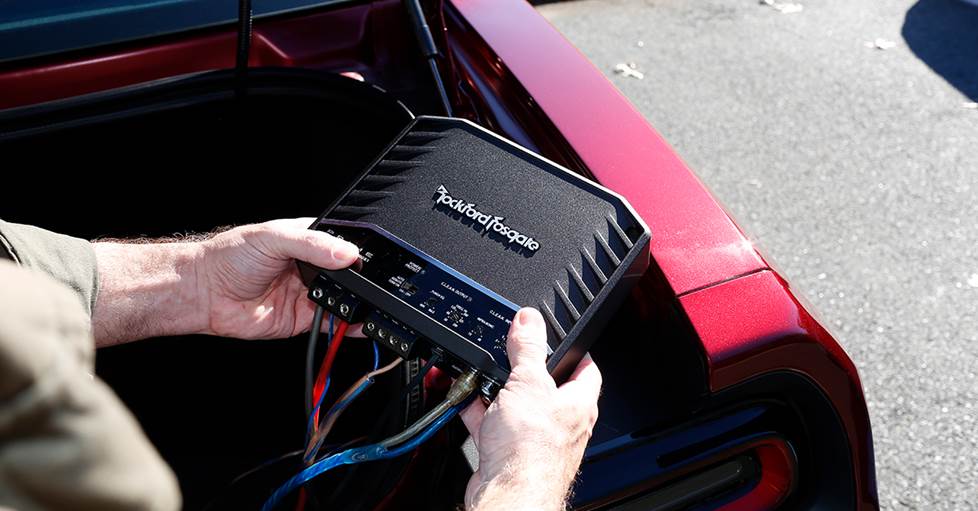
Rockford Fosgate's R2-500X1 Prime Series subwoofer amp can pump out 500 watts RMS of bass.
How much power do I need for a subwoofer?
You want the bass to musically blend and be well-balanced with the rest of your system. Here's a good rule-of-thumb guide to subwoofer power:
- If your speakers are powered by your car's factory stereo — 50 to 200 watts RMS of power for the bass will do nicely.
- An aftermarket receiver — you might want 200 to 300 watts RMS of power for your sub.
- Amplified speakers with around 50 watts RMS per channel — plan on 250 to 500 watts RMS for bass.
- A 100 watts RMS or higher per channel system — you'll want at least 1,000 watts RMS for your subs.
As with speakers, you'll need to make sure your subwoofer's top RMS rating is equal to or greater than the amp's top RMS output.
You'll also need to "impedance match" your subwoofer and amplifier. It would be a shame and a waste of money to buy a couple of subs and an amp only to find out that the amp can't run the subs because wired together, their impedance would be too low for the amp to run without overheating. Read our article about Matching Subs and Amps for a detailed explanation about this topic.
Expert tip: If you're adding a sub to a factory system, get a subwoofer amp with speaker-level inputs, so it can get its signal from the factory speaker wires.
Installing an amplifier
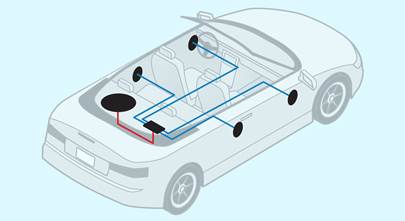
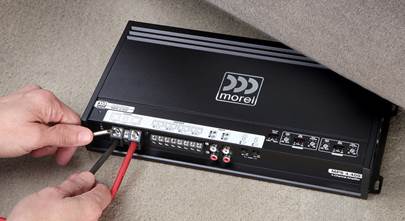
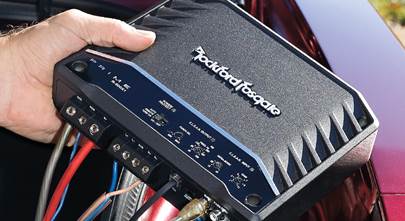
Two common questions are, "Will this work in my car? And if so, how do I wire it in?" If you already have an aftermarket receiver, adding an amplifier is a pretty straight-forward process. You use RCA cables from the receiver to the amp, speaker wire from the amp outputs to the car's speaker wiring, and amplifier power and ground cables to the car's battery and chassis.
However, many cars today have built-in multi-function stereos that are impossible to replace, or factory amplifiers that may or may not be able to be bypassed or replaced. What's often needed is some sort of interface device, like a line output converter or digital signal processor, to reduce powered factory signals down to manageable levels, and process factory EQ'd signals to achieve the over-all tone and impact you want in your music.
Some amplifiers feature high-level inputs with signal mixing and digital processing built in, to help integrate the amp into almost any kind of car stereo system.
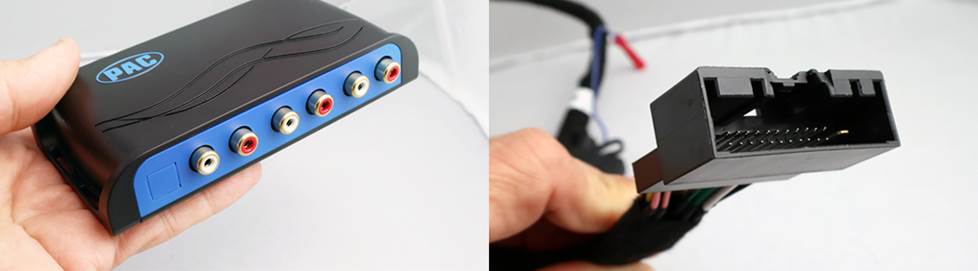
PAC's AmpPRO AP4-FD21 interface module and T-harness lets you add an aftermarket amplifier to select Ford vehicles.
But for some vehicles, that's still not enough, and an amplifier replacement interface module and vehicle-specific T-harness will be necessary in order to add an aftermarket amplifier and retain your vehicle's system controls and other functions.

Crutchfield Advisor, Danny, says “The high-res capabilities of this Kenwood Excelon XR901-5 amp really make my speakers sound fantastic.”
Give us a call before you buy your amplifier so one of our Advisors can help you figure out what you'll need to install the amp in your vehicle.
For more on system integration, see Adding an amp to a premium factory system.
DIY Amplifier Installation Gear
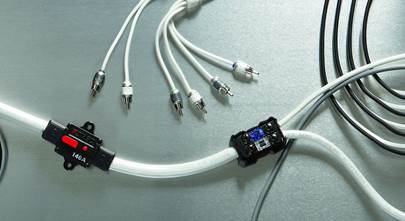
Amplifiers don't come with the wiring you need to connect them to your stereo. Be sure to get the following gear for a successful installation.
- Wiring kits provide everything you need to send signal and power to your amp.
- You'll also need speaker wire to send signal from your amp to your speakers.
- A capacitor stores reserve power and delivers it when your amp needs it most. Usually, capacitors are only needed for big bass systems.
- And don't forget the extra hardware you might need for a truly professional installation: battery terminals, power distribution hardware, fuses, etc.
Need more help?
Browse our entire selection of car amplifiers or check out our lists of the best car amplifiers. If you need more help, contact our Advisors. They have the knowledge and experience to help you find an amp that will meet your needs.


_mobile.jpg)



Steve from Worc
Posted on 3/11/2026
Hi , This vehicle does not have an "acc" or key on switch point for the amp switch -on signal wire. Is there a device or sensor that can work off the head unit +12v when it is switched on please? If i use a toggle switch the problem is it may not always be turned off. Thank you
Alejandro N
Posted on 11/3/2025
If I want to install two tweeters for the A-pillars, two woofers for the front doors, and two woofers for the rear decks, with no sub, how many channels should my amp have?
Suraj from Kollam District
Posted on 3/6/2025
Which amp is good for Ground Zero GZRW 300X 500 watt rms 4ohms sub
Buck Pomerantz from Crutchfield
on 3/7/2025
De Ve from Cibolo
Posted on 8/28/2023
Of the last three vehicles I've owned, I had a system installed from Crutchfield. One of the vehicles already came with a system. To say that I am a satisfied customer is an understatement.
Adrion from Aberdeen Maryland
Posted on 7/4/2023
Hey. I have a 2018 VW Passat GT without the Fender radio. 6.5 in speaker in each door and 2 tweeters on the dash. What type of amp should I use? Planning to replace those speakers with something in the 2 way 50 RMS range. Not looking for super loud. Just better sound.
Buck Pomerantz from Crutchfield
on 7/5/2023
Alex Jaggers from Lillington
Posted on 7/3/2023
Hey I want to do 4 door speakers and 2 10" subs. Should I do a 6 channel amp so there is 1 channel for each speaker and subwoofer? or should i do a 4 channel for the speakers and a 2 channel or another 4 channel for the subs? trying to to break the bank here either. speakers will be around 75 watt rms and the subs will be 200 watt rms. door speakers are 4 ohm and the subs say they can be 2 or 4 ohm. i'll be using an aftermarket head unit as well. thanks!
Buck Pomerantz from Crutchfield
on 7/3/2023
Alejandro Esquivel from Hesperia
Posted on 5/10/2023
I have front speakers 100rms and rear speakers pods 60rms . What type of amp should I purchased. Also I plan in the future installing a subwoofer 350rms. All marine applications. 4 ohms speakers and subwoofer
Buck Pomerantz from Crutchfield
on 5/11/2023
Austin
Posted on 3/13/2023
Hi, I have a 2014 ford escape with the 8" non Sony screen. I have already replaced 4 speakers but have noticed they are underwhelming. I have done some research and noticed that an amplifier could help with making these better. So my question is, what amplifier would have the be suitable for my nine speaker setup and a dual 12" sub that I'll be adding. Or will I need to get 2 amplifiers to make this possible
Buck Pomerantz from Crutchfield
on 3/15/2023
shanw from brick
Posted on 2/25/2023
I have a 21 Gladiator. I want to install Focal 6.5's in knee pods and 3.5's in top dash as well as replicating same set up in the sound bar on each side. Should i be shopping for an 8 channel amp?
Buck Pomerantz from Crutchfield
on 2/27/2023
Jay Garrison from Dearborn
Posted on 1/18/2023
I bought a halfer 10" sub of Craigslist for 10$. I can't find any specs online. Do you know anything about old Rockford/Halfer subs?
Buck Pomerantz from Crutchfield
on 1/18/2023