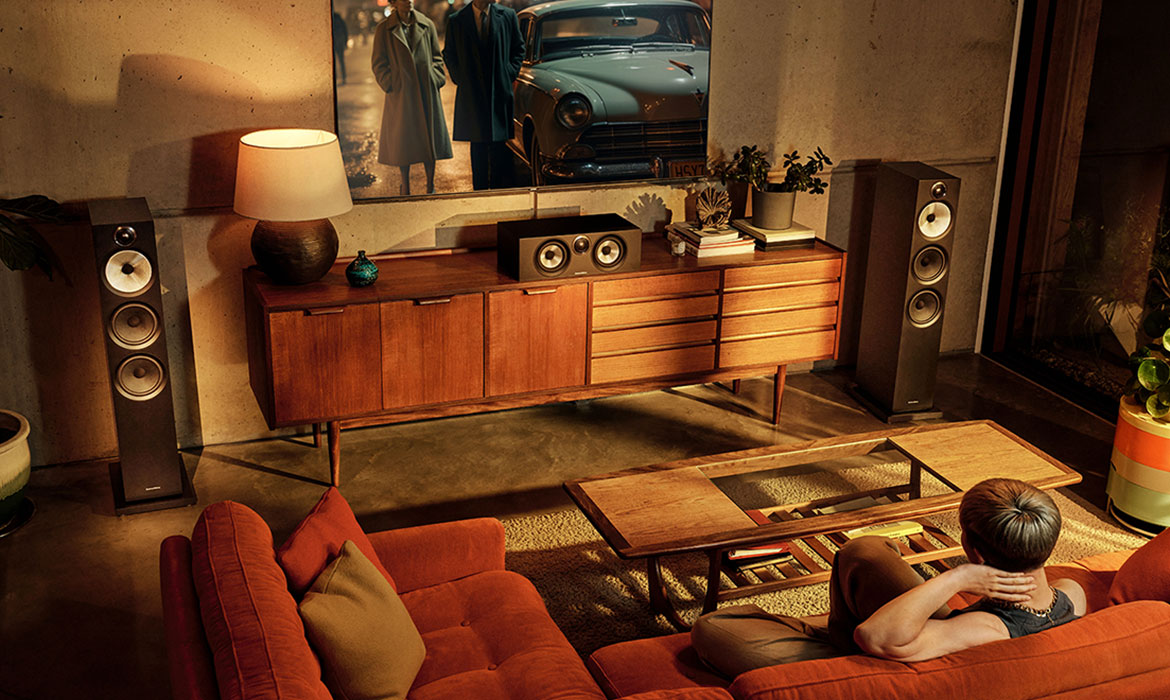
Intro to home theater speakers
How to build an awesome surround sound system

In this article: We'll cover all the basics about home theater speaker systems, including...
- Types of home theater speakers
- How many speakers make up a home theater system?
- How to match home theater speakers to your room
- The importance of voice matching speakers
...and we'll cover what you need to get everything working.
I
'm a proud movie buff. Put on anything Tarantino, Ridley Scott, or Satoshi Kon and I'm glad to share my enthusiasm about the film (sometimes to the extreme). But working at Crutchfield has spoiled me a little. I'm used to impactful explosions, crystal-clear dialogue, and immersive surround sound effects. If the movie doesn't sound fantastic, it puts a damper on my enjoyment.
Setting up a home theater system can seem intimidating, but it's not that bad once you get started. I'll walk you through some important considerations and help you get a head start on planning your new home theater system.
Types of home theater speakers
You might have heard the terms "bookshelf speaker" and "Atmos topper" thrown around online before. But what do those terms actually refer to? Let's break down each kind of home theater speaker to give you a good foothold.
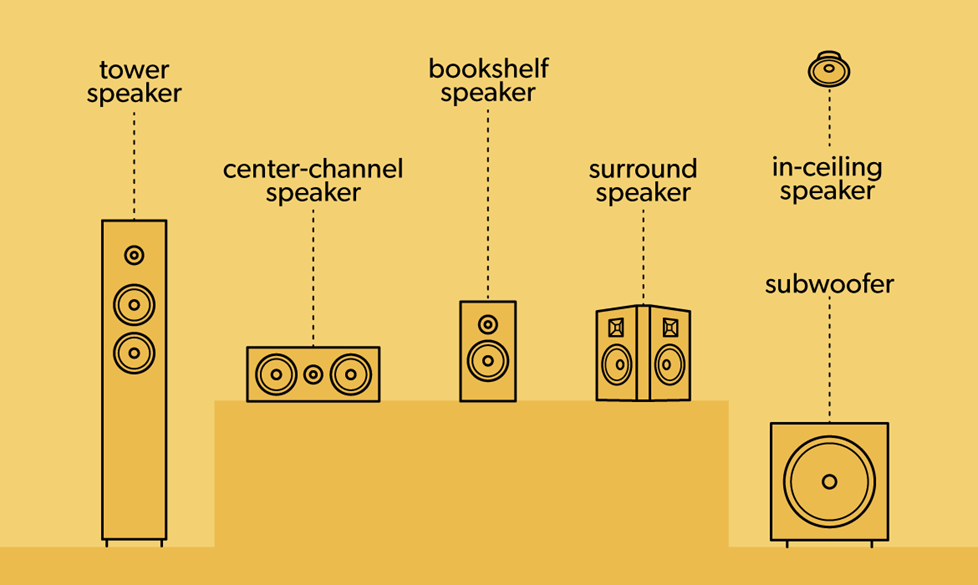
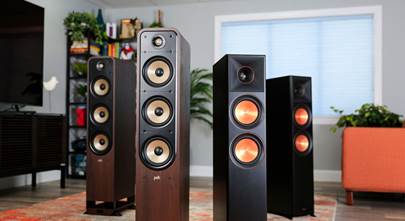
Tower speakers, also known as floor-standing speakers, are usually used as your front left and right speakers. These speakers can be large and tall, so make sure you've got adequate space to accommodate a pair.
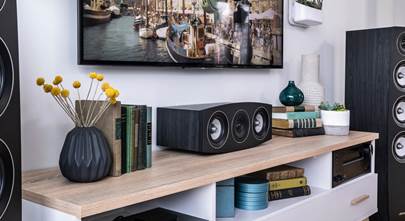
The center-channel speaker is the most important speaker of all, as it's what reproduces dialogue and center effects. Without it, movies can sound very thin.
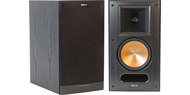
Bookshelf speakers are versatile and can serve as your front speakers, your side surround speakers, or your rear speakers. These speakers don't take up as much space as towers, and can be compact or a little on the large side.
Surround speakers go behind and/or beside your listening position. These speakers often have two sets of drivers that fire in opposite directions to give your sound plenty of dispersion. They reproduce surround sound effects like rain, explosions, or anything that's not front and center.
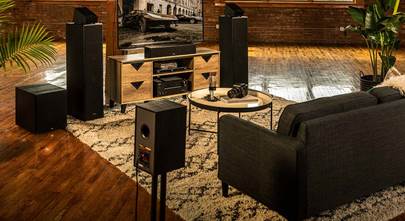
Height speakers, (or Atmos speakers), come in two flavors. You can go the custom-installed route of in-ceiling speakers, or you can add Atmos enabled speakers. These come in the form of toppers that sit on your front speakers and reflect sound down onto your listening position. Some bookshelf and floor-standing speakers have Atmos toppers built in.
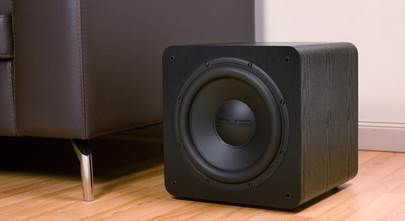
Powered subwoofers are what deal out bass and add thump to effects.
5-point what?
Unlike stereo systems, which use two speakers, home theater setups often use multiple speakers throughout the room. As long as you have the receiver to support them, you can add a ton of speakers to your home theater system.
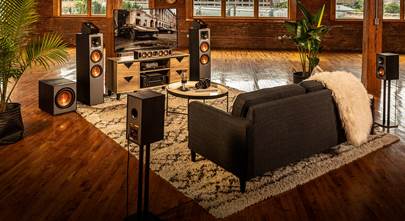
The most basic home theater system uses five speakers and one subwoofer. This is referred to as a 5.1 system. A larger system with side surrounds is 7.1.
If you're into 3D surround sound formats like Dolby Atmos® or DTS:X, you can go all out and add in-ceiling or "height" speakers to make a 5.1.2 system (the "2" is the number of height channels) all the way up to a 7.1.4 system or higher.
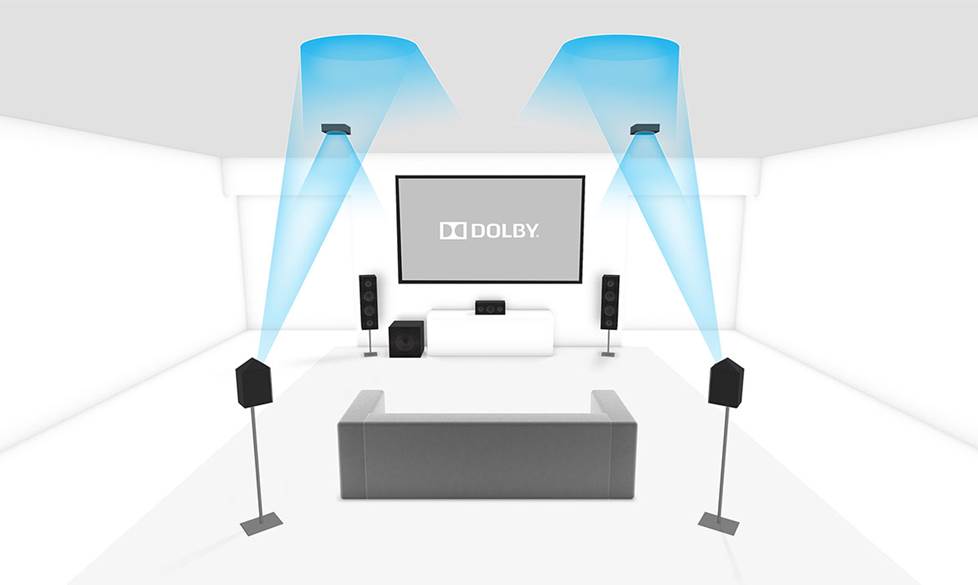
A Dolby Atmos system starts with a conventional 5.1 or 7.1-channel surround sound system. Then you add two or four upward-firing or in-ceiling speakers for overhead effects.
How to match speakers to your room
When I was a Sales Advisor, I often heard customers saying that their system sounded a little small or shallow. My best advice to those folks is to consider your room's size and get speakers that'll fill it out.
To put it another way, you wouldn't get tiny bookshelf speakers for a large, open concept room with vaulted ceilings.
If you've got a room like that, you'll want to go with floor-standing models as your fronts to get the best sound quality. Likewise, if you have a smaller room, there's nothing wrong with using stand-or-wall-mounted bookshelf speakers for your fronts.
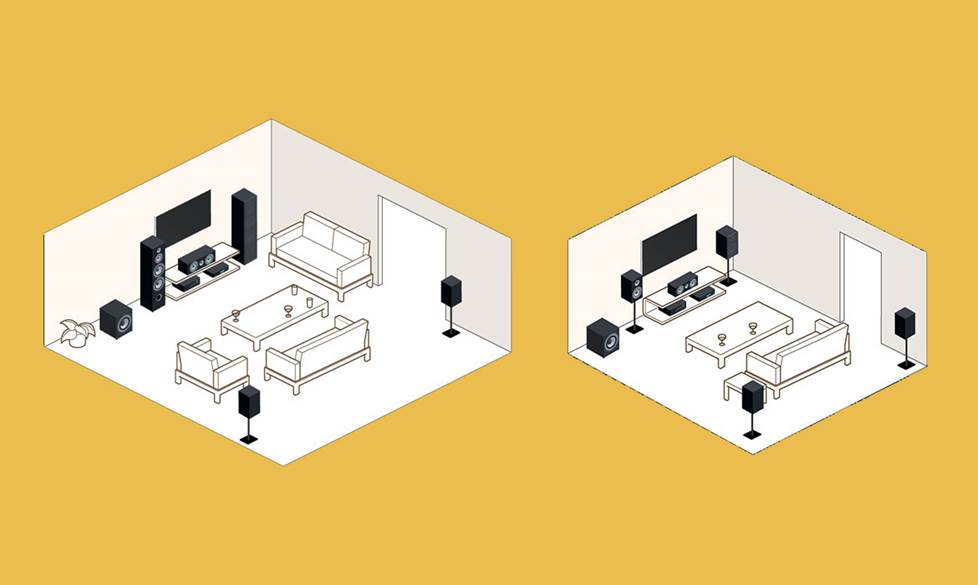
Floor-standing speakers are ideal for large, open spaces, while stand-mounted bookshelf speakers are well-suited for smaller rooms.
You'll also want to consider how much foot traffic the room gets. Have kiddos or pets? You'll likely want to keep bookshelf speakers up and out of the way with wall mounts, or go with in-ceiling or in-wall models. But if the room is a dedicated theater room, you'll likely be fine with traditional speakers.
Where will your speakers sound their best?
While you can place speakers almost anywhere, putting them where they both look and sound the best is ideal. You can read our home theater speaker placement guide for a head start.
Voice match if at all possible
Voice matching ties an entire system together. Voice matching means getting the same brand and line of speakers throughout your system. It ensures even sound across all your speakers. Mixing can work in some cases, but doing so can leave the system feeling skewed in one way or another.
To put it another way, how would you feel listening to a quintet where everyone was singing well but couldn't harmonize with one another?
speakers.jpg)
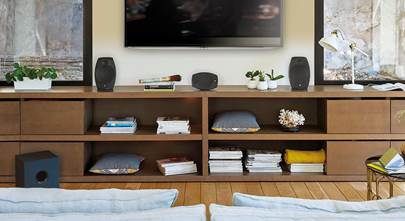
If you want a low-profile system, consider in-wall or in-ceiling speakers.
Incognito surround sound systems
We get that not everyone enjoys actually seeing where their sound is coming from. That's why in-wall and in-ceiling speaker options are popular alternatives. There are even in-wall subwoofers! Once they're installed, they're hidden behind a grille, giving you a clean look across the board. You can check out our article on in-wall and in-ceiling speaker installation to learn more about what’s involved.
Everything you need to get started
To get the best sound you’ll need to pair your new speaker system with a good home theater receiver. This guide will help you choose the right one.
Are you wondering how to fit a home theater system into a small room? Read our small home theater ideas article.
You'll connect your system together with speaker wire and a subwoofer cable. We also recommend good power protection for your receiver, TV, A/V components, and powered sub.
We can help you choose
Have questions about choosing the right equipment for your surround system? Our expert Advisors know the gear inside and out.
Free lifetime tech support is included with your Crutchfield purchase.



Craig Schumpert from Washington, DC
Posted on 12/18/2024
I was just looking for help with large stereo speakers, not home theater.
Don Feyereisen from Aurora
Posted on 10/11/2023
source sight. Thank you for the very well defined guidance. I just need music and videos around me. Not looking for top quality. at 72 my hearing is off . A 14 year old Sony plug and play 5 .1 speaker system I was using died. All this techo is driving me up a wall. bought new components but some not picking up network. Being anti techno I asked friends what might work in my 700 sq. ft house. Same friends said speakers todayare wireless. nothing is wired any more. Dumb me gave away the 6 speakers from the Sony. I bet those speakers would have worked just fine Stress inexpensive. What should I target? thankyou
Archer A. from Crutchfield
on 10/17/2023
RC from fremont
Posted on 9/16/2021
Hello Kramer, thanks for a good start on the introduction to home theater. I have a dedicated standalone room to be made into a home theater. The size is 15'x 16'x 9'. Is that a small or medium room? Any pros-cons to having the center speaker at the "listening height" vs. from the ceiling? Best wishes..
Kramer Crane from Crutchfield
on 9/16/2021
First, I recommend going with two subwoofers if you can. Adding a second sub helps smooth out bass distribution, and should make a noticeable improvement in the quality of the listening experience (it did for me when I added a second sub behind my main seat).
As for the center channel, ideally the tweeter would be at ear level when seated to ensure that dialogue sounds natural. The risk we run with center channels that are too high is that spoken word can sound like it's coming from above the characters on the screen.
That said, if you need to mount the center channel higher you can still get excellent sound. There are specialty speakers available that are well-suited that sort of placement. At very least I recommend choosing a speaker that has an aimable tweeter so you can direct those high frequencies toward you.
I hope that helps! Feel free to give us a shout if you'd like any help picking out gear. You'll be watching movies in there before you know it!
Courtney from NYC
Posted on 3/3/2021
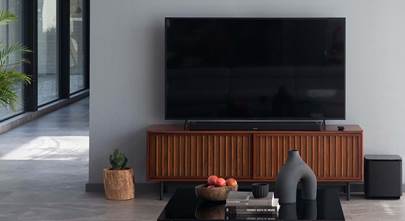
I like the equipment stand. It's elegant and appears sturdy. Can you provide information on make, price etc.? Thanks.
Kramer Crane from Crutchfield
on 3/15/2021
Bharath from PEMBROKE PINES
Posted on 2/17/2021
Hi, Nice article, what do you consider as a small , medium and large room? a 11 *14*8 room is considered as small or medium? I am thinking of a book self vs tower speakers for this room. What do you recommend? It is mostly for movies and it is a dedicated home theatre room.
Kramer Crane from Crutchfield
on 2/23/2021
In your shoes I'd go with floor-standing speakers for at least the front left and right channels. On-wall, in-wall, or stand-mount speakers are all great options for the surround channels.
Karina Young from Tamworth, Australia
Posted on 2/5/2021
I need some nerdy help please! I recently bought speakers without an amp, and a projector - dolceacoustic.com - SPEAKERS - DA-2600W (2 back, 2 front, 1 centre) with no AMP or subwoofer included. Projector - VPL-HW55ES Projector. No idea where to go next with extra equipment I need to get set up with sound!
Kramer Crane from Crutchfield
on 2/5/2021
CJ Handwerk from Orrville
Posted on 11/28/2020
Kramer, great article outlining the key components of a classic 5.1 system. I have recently moved to an LG soundbar and picked up some LG surround sound wireless speakers. I am sure your laughing right now but I tried to move to the newer more popular systems. As I am sure you already know I am not impressed and the old Vega RE38's and my B&W 220 watt sub are coming back from storage. I was looking for some advise on updating my receiver to something with the power to drive the big boys upfront but also some clear highs and great surround. I will also be looking to add a large center and a pair of surround speakers that I will hardwire. I have been less than impressed with the "wired-wireless" surround systems. I hope to hear from you!
Kramer Crane from Crutchfield
on 11/30/2020
Patricia Hassan from STRATFORD
Posted on 9/27/2020
Hi Kramer, My friend has raved about your speakers. I have a Samsung 44 inch wide TV. I want to get a surround system for it. Something no more than 500.00. What do you recommend. Thanks. Look forward to hearing from you.
Kramer Crane from Crutchfield
on 9/29/2020
Manish from San Jose
Posted on 8/7/2020
HI, I have Pioneer Andrew jones 5.0 setup paired with SVS PB1000. I crossover all the speakers at 80Hz. I wonder why do we need big floor standing speakers if we are not using there low end? We can simple get small satellite speakers ( svs prime satellite) and still get good quality home theatre sound. What am I missing?
Kramer Crane from Crutchfield
on 8/7/2020
I have a 5.1-channel home theater setup, with floor-standing speakers and a large SVS sub. When space isn't an issue, I prefer tower speakers over satellite speakers for a few reasons. Floor-standing speakers move significantly more air than equivalent bookshelf or satellite speakers can, giving you a wider soundstage and (generally speaking) improved imaging. They can also handle more power and are usually more efficient.
It's also worth mentioning that 80Hz might be too high of a crossover setting for many tower speakers. I run mine full-range, in part because I don't always use my external sub, and also because they would indeed sound "incomplete" if I wasn't properly putting their woofers to work.
Getting your system dialed-in can take some tinkering to see what sounds best for your room. If your shoes, I'd experiment with a lower crossover point for your speakers and see how things sound. As long as you're not hearing distortion, you're in good shape.
Cosmos from Abu Dhabi
Posted on 7/22/2020
Amazing explanation, am impressed to read that. Well done keep it up. l love to read more from you.