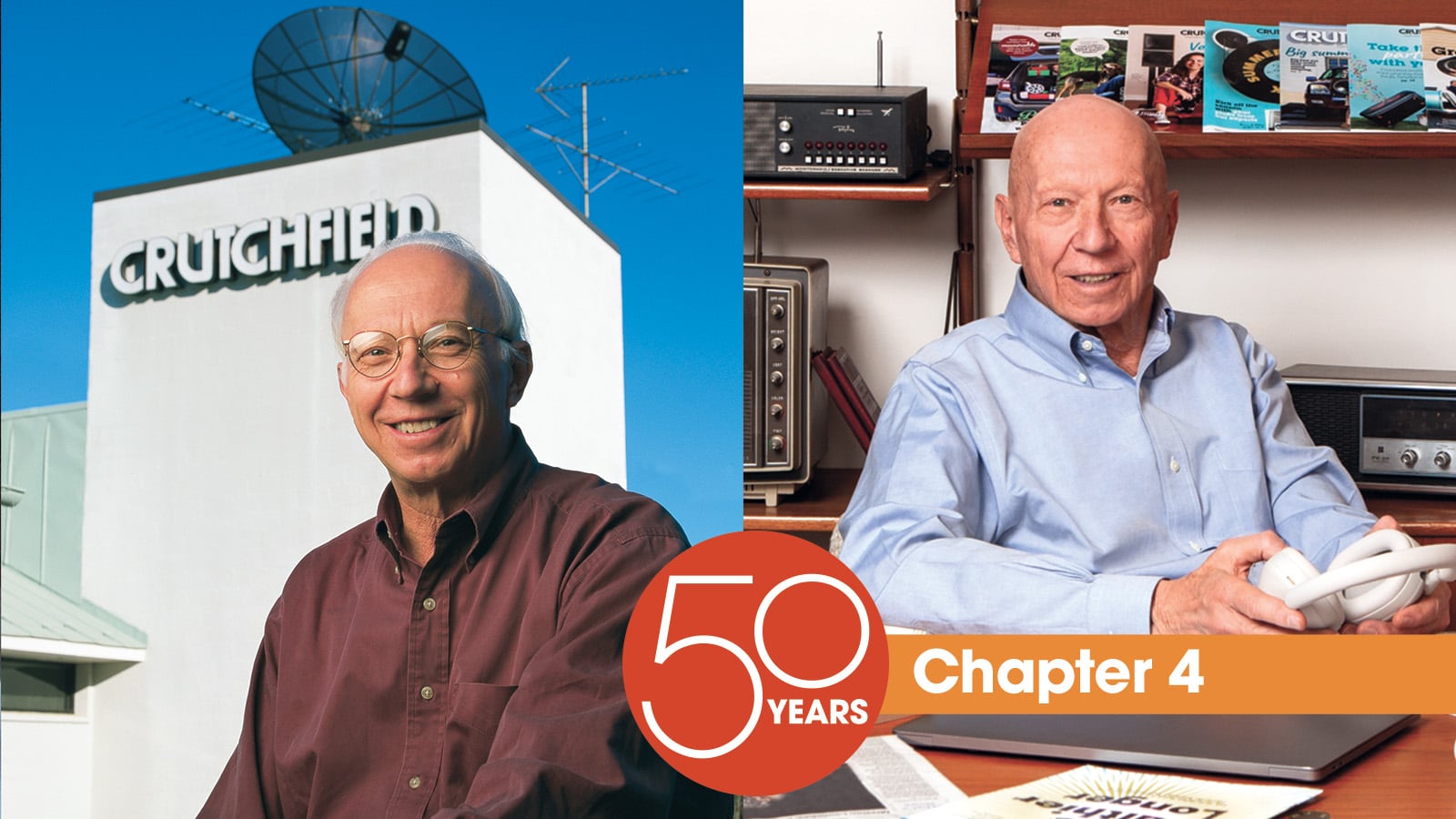
The Crutchfield story: the 2000s
Traversing the digital era

In Chapter 3, I discussed how the 1990s were a transformative period for Crutchfield. The company evolved into the digital age, paving the way for other consumer electronics retailers. We also built a second call center to keep up with the needs of our growing business.
The year 2000 started with two important changes for our customers. When our Winter/Spring 2000 catalog was published, we introduced two new benefits of buying from Crutchfield.
First, we offered two-day shipping for a small fee. This was before most online retailers even offered two-day shipping. Those that did often charged dearly for it. Today, we offer two-day shipping free of charge except for heavy products like televisions and large home speakers.
Second, in 2000, Crutchfield also introduced lifetime technical support (for the life of the product) for our customers. We felt that our products were becoming more technologically complex. As a result, when future products were connected to them, the integration could become challenging. To my knowledge, no other company offers lifetime support for the products it sells.
Reinventing our retail store model for the internet age
The 2000s was also a decade where I focused on reinventing our retail store model. For years, I wanted to expand our retail store operations. Local stores offer many advantages, including installation services. They also provide shoppers with instant gratification. Rather than waiting one or two days to receive their purchases, customers can walk out of a store with them.
More importantly, our local stores demonstrate Crutchfield’s highly respected organizational culture. Our store employees are very caring people who are extremely well trained.
However, my instincts told me that the traditional retail store model was going to be threatened by online retail. Therefore, if we were to expand by opening more retail stores, I believed that it was necessary to reinvent the business model of retail stores.
The limitation of physical retail space
In 2002, we sold around 10,000 distinct products. Today we sell almost 18,000. If we were to display all these products, the store would need to be tremendous. The operating expenses of such a large store would make it financially unsustainable. Furthermore, a huge store would overwhelm our shoppers with its vast selection.
As a solution, I had the idea of inventing a "virtual" store. It would consist of intelligent fixtures which would present our products on high-definition computer displays (uncommon at the time). These displays would also be able to access our vast databases of technical information. Our Sales Advisors could use these intelligent fixtures and their HD displays to provide our shoppers with a carefully curated assortment of products along with professional, in-person consultations.
Creating Crutchfield's SpeakerCompare™ tool
Early in my strategizing, I asked one of our buyers for his impressions of the virtual store concept. He liked the idea for all of our products except speakers. He correctly maintained that speakers are best matched to a shopper’s needs based on subjective evaluations centered around individual taste, in addition to quantitative data like specifications. Therefore, speakers need to be heard.
Crutchfield now has the best-possible virtual tool for evaluating speakers. We call it SpeakerCompare. Creating this tool took many years and lots of research.
The problem we faced was that we offered almost 1,000 different speakers (700 home and 300 car speaker models). It would be impossible to offer physical listening displays for all these speakers. And the acoustics of our store would not match a shopper’s individual car or home listening environment.
My idea was to use digital signal processing (DSP) to simulate our considerable number of speakers in a limited number of listening rooms in our retail stores. We would record multiple characteristics of our speakers in anechoic chambers (acoustically controlled rooms) and play them back in anechoic listening rooms in our stores. Also, we could simulate different conditions like a car at idle and at driving speed.
We could simulate the acoustic nature of the vehicle. Large vehicles like vans produce more bass response than small, compact cars. For home speakers, we could simulate the acoustical environments of the rooms in which they were to be installed. Again, room acoustics can vary depending on size, floor and wall coverings, furniture type, etc. Developing this simulation technology would provide shoppers with the absolute best speaker auditioning environments.
I had an initial problem with this potential invention. Although I understood this technology conceptually, I did not have the engineering skills to develop it.
Research and development
At the time, I was on the senior board of the University of Virginia and had excellent working relationships with our school’s leaders. I called the dean of our prestigious engineering school and asked how I could contract with his school to develop the technology. He admitted that acoustics engineering was not one of his school’s core strengths. However, he recommended nearby Virginia Tech. Its School of Mechanical Engineering has one of the top programs in the nation.
After several visits to Virginia Tech over the next year, I finalized a research agreement. Then, it took approximately two years of work to prove that the technology was viable. That allowed us to start the U.S. and international patent application process.
Protecting our creation
Since the concept was so unique, my patent attorney, the lead Virginia Tech engineer, and I personally attended a meeting with a senior examiner at the U.S. Patent and Trademark Office in Washington, D.C. Our presentation was based on both the unique consumer need and the originality of the technology. The examiner was extremely receptive and provided some good guidance on enhancing our patent’s applications.
One element which I added to the patent applications was using this technology to allow headphones to audition speakers through a special link on our website. This is the technology behind the SpeakerCompare app currently on Crutchfield’s website. It is the only way that shoppers can audition speakers remotely. And it has led to customers making better online speaker purchases.
Virtual listening becomes a reality
By 2005, our virtual listening technology had evolved from the research phase to the implementation phase. The Virginia Tech lead engineer during the research phase was completing his PhD at the time. When he completed it in 2005, I hired him to head up a Crutchfield lab in Blacksburg, Virginia, which is where Virginia Tech is located.
We rented a space near the university. In that building, we constructed our own anechoic chamber. We later hired a second PhD engineer to assist with the complex research, along with a technician who did the actual speaker measurements. This process continues today.
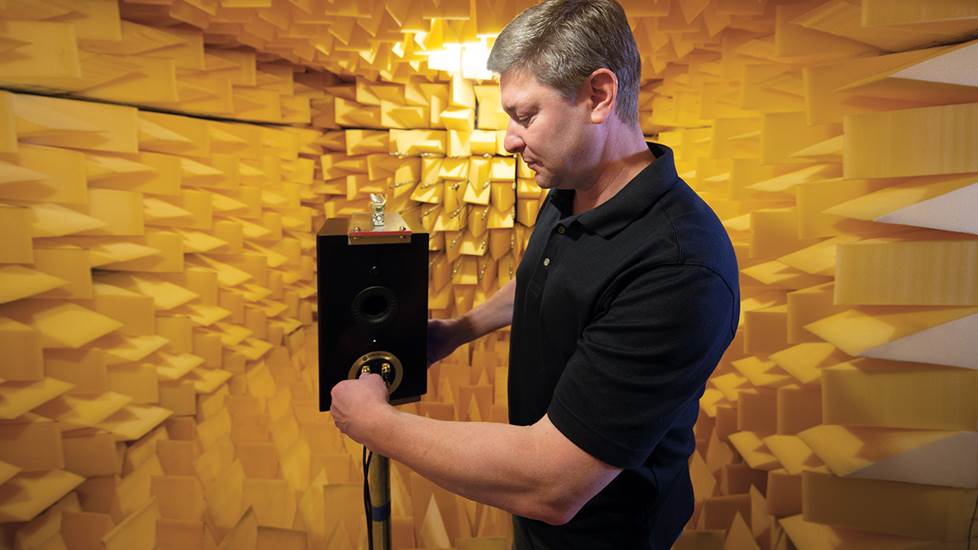
Dr. Rick Wright of Virginia Tech measures a speaker in one of their anechoic chambers.
We have incorporated this exciting technology into our two retail stores. As of now, we have 17 U.S. and international patents issued or pending. They provide Crutchfield with a unique competitive advantage for our online and retail store businesses.
The flat-screen TV boom
Now, allow me to jump back to 2002. This was the beginning of the biggest revolution in television since its invention in the 1930s and its commercial deployment in the late 1940s. Two important developments were occurring.
First, flat panels were being commercialized for consumer use. They had been developed initially for computer displays. Second, the plans were underway for the nation’s transition from analog to digital television broadcasting. That would usher in the high-definition TV formats that would evolve into the 4K/8K HDR formats that we enjoy today.
We introduced our first flat-panel TVs with our Summer 2002 catalog and corresponding website content. These early flat-panel TVs were still analog and standard definition. Like with most new technologies, they were very expensive. For example, we sold a 22” Panasonic flat-panel TV for $2,999.99 in 2002. Today, for that approximate price, one can buy a premier 65” 4K HDR television. Considering inflation since 2002, that comparison is even more striking.
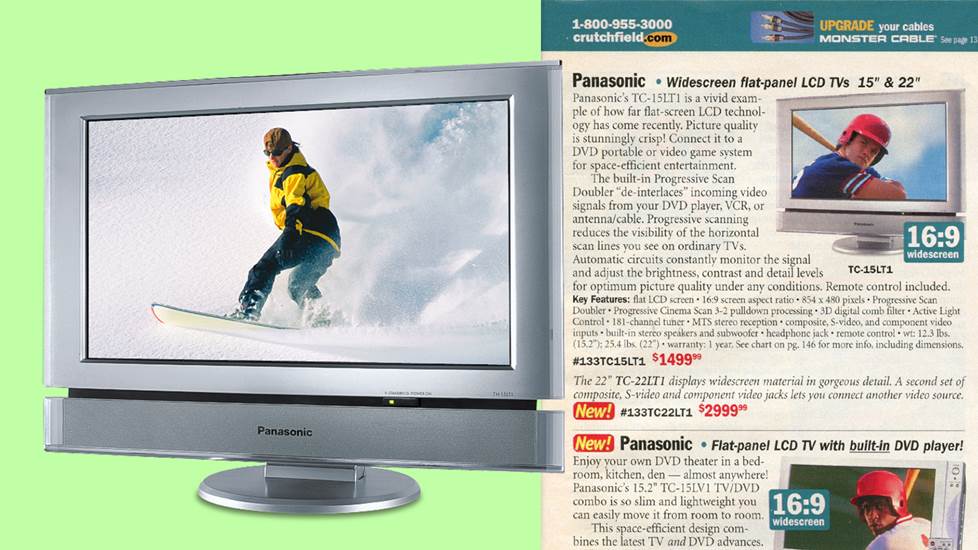
A 15" LCD TV in 2002 — LCDs have come a long way in 20 years.
The transition from analog to digital television broadcasting was first mandated in the Telecommunications Act of 1996. Originally, the law stated that it was to be completed by December 31, 2006. However, that date was set back several times until it was finally required by June 12, 2009.
Both TV manufacturers and broadcasters started to prepare consumers for this transition long before the date on which it would be mandated. Television manufacturers were excited about the adoption of digital television since it would allow for the sale of millions of new, high-definition TVs. Broadcasters were excited about it because it allowed them to add subchannels to use for additional programing.
By 2003, we started marketing televisions that were HDTV (high-definition TV) ready. Although these analog TVs did not have digital tuners, we promoted them as being compatible with the needed digital tuners when they became available and when digital broadcasting began to air.
The arrival of high-definition TVs
By 2004, we started selling our first true HDTV televisions. The three main screen technologies were DLP, LCD, and plasma. DLP (Digital Light Processing) was a system that used special chips for rear projection. The TVs were large, heavy, and deep. However, they provided excellent picture quality and large picture sizes. I still have one in our grandchildren’s playroom.
The LCD (Liquid Crystal Display) technology was an early version of what we have today. However, screen sizes were limited, the picture quality was marginal, and the prices were very high.
Plasma was the only technology at the time that allowed for large displays. The problem with some early plasma TVs was that they could easily burn a picture into the screen. And they were relatively thick and heavy.
By 2006, Crutchfield had stopped selling conventional CRT (Cathode Ray Tube) televisions, also known as "tube" televisions. Although the digital transition did not end for another three years, we were all in on the new generation of televisions. The transition to digital TV led to a boomtime in TV sales for Crutchfield, our competitors, and our manufacturers.
The "Operation Bravo" initiative
Now, I need to jump back to 2003. During that year, Crutchfield launched "Operation Bravo." We developed this program with generous support from some of our business partners who provided products for our soldiers serving in the wars in Iraq and Afghanistan. Over the course of several years, we donated portable DVD players, DVDs, MP3 players and digital cameras to thousands of our soldiers. Being a veteran myself, I felt particularly proud of this initiative.
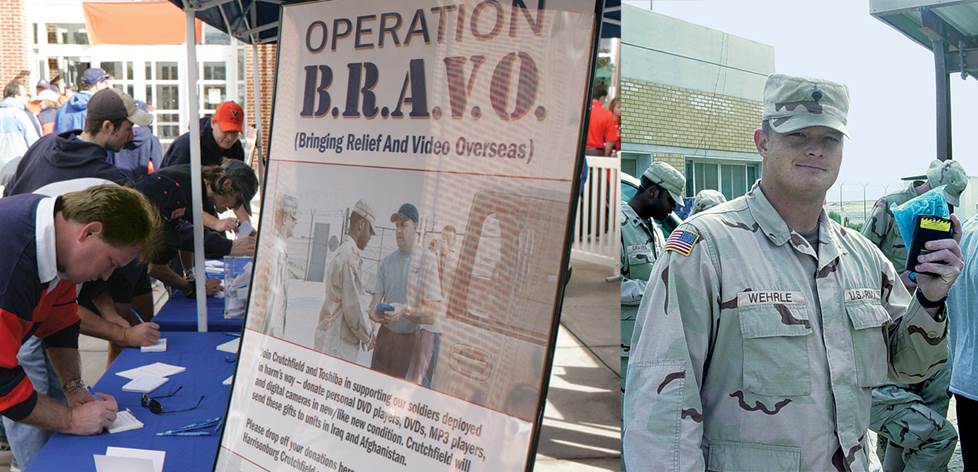
Operation Bravo was our way of showing support to our troops overseas.
Drifting into the car "tuning" scene
In 2003, I had the idea that Crutchfield could attract more young shoppers if we added a line of custom car accessories which were especially popular with this demographic. In our Spring 2003 catalog, we added an insert which offered a complete line of light lenses, shift knobs, pedals, gauges, accent lights, headlights, under-car neon lights, and more. We also added a section on our website promoting these products.
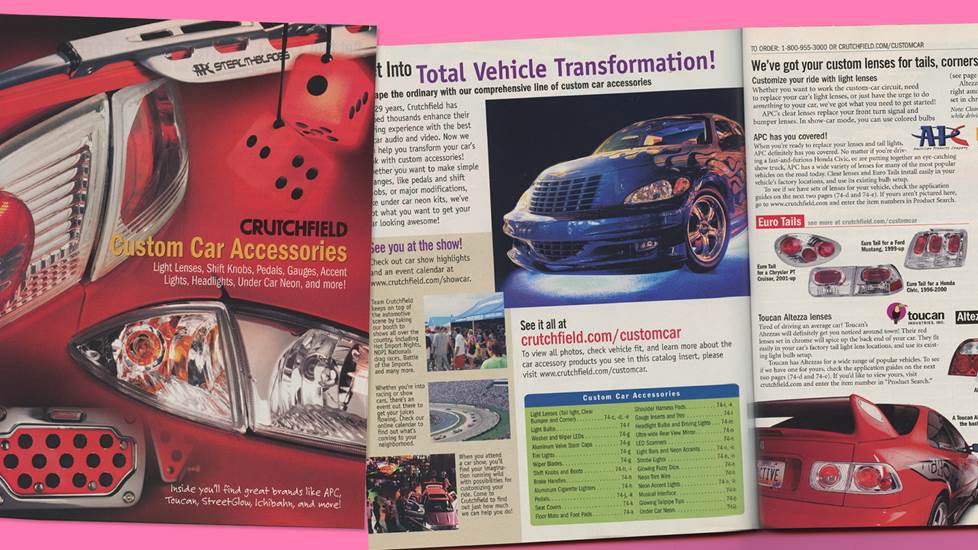
Our 2003 Custom Car Accessories catalog insert promised a "total vehicle transformation."
Although this was a profitable business, it was not consistent with our brand. After a few years, we reduced the selection to more mainstream accessory products which better appeal to our broader shopper demographic.
Maintaining our brand identity
Brand consistency is a very important factor in building a quality business. Over the years, Crutchfield has built our brand around providing high-quality consumer electronics products.
As a supporting service, we have created valuable print and online content for our customers to use while shopping for the consumer electronics products best suited for their tastes and needs. We also recruited and trained many enthusiasts who could talk to our shoppers over the telephone about these specialized products.
Over the years, we have continually experimented with new products, trying out new categories to see if they fit our brand. That particular automobile accessory market did not seem to be consistent with our core brand.
Crutchfield’s “Live Longer, Live Better” employee health and wellness program
Also in 2003, I was becoming increasingly concerned about the health of our employees. My father and grandfather were physicians, and I realized that even young people need to act responsibly regarding their health if they are to live long, productive, and enjoyable lives.
Like most companies, we had too many employees still smoking cigarettes and becoming obese. Collaborating with the Dean of the University of Virginia’s School of Medicine, I produced our “Live Longer, Live Better” program.
As a result of this program, we reduced our company-wide smoking rate from a high of 19% to a low of 9%. Over the years, our employees have practiced healthier dietary and exercise habits. As a result, many have been spared potentially life-threatening diseases.
By taking these creative actions to demonstrate our care for the health of our employees, we have boosted employee morale and retention. Genuine care for our employees’ wellbeing is consistent with our core values and partially explains why Crutchfield has been repeatedly recognized by Virginia Business magazine as one of the best places to work in our state.
Crutchfield’s B2B team
In the Fall of 2005, we launched our Corporate and Education business. It focused on serving the needs of a wide range of businesses, educational institutions, and government agencies. For years, these entities had been buying products through our consumer business. As its volume grew, we decided that these professional customers needed specialized products and specialized support.
To accomplish this objective, we created a separate business with specially trained Sales Advisors and System Designers. We also built a separate section within our website offering products and information appropriate to this market. Crutchfield Business has grown into a significant business today.
Offering our products and services in Canada
In 2006, we started taking steps to expand our business into Canada. I first began thinking about this after taking a family vacation to Maritime Canada (the eastern provinces) in 1999. However, it was not until 2002 that I started the due diligence process.
I learned that Canada is an interesting market. Its land mass is slightly larger than that of the United States, yet Canada only has approximately 12% of our population. Most Canadians live within a hundred miles of our northern border.
After taking more trips to Canada and conferring with Canadians, I learned a tremendous amount about their perception of buying from an American online retailer. They did not want to be treated as if they lived in our 51st state. They wanted the business to have a Canadian feel, and they wanted products distributed from a Canadian location.
The dealer agreements we have with our manufacturers restrict our sales to the United States, our territories, and government installations in foreign countries (e.g., military bases and embassies). Most do not permit us to sell in Canada. Therefore, we had to establish relations with the Canadian counterparts of our U.S. manufacturers.
During that process, I learned about merchandise differences. While our owners’ guides are written in English and Spanish, in Canada they are required to be written in English and French. Furthermore, there may be differences in appearance between products sold in these two countries.
Our new Canadian website and catalog
CrutchfieldCanada.com launched in 2007 with a catalog and website. Later we acquired crutchfield.ca as our URL. We put a great deal of thought and effort into both the catalog and website. It became one of the early online retail businesses owned by an American company which was designed for Canadians.
The products we featured were designed for the Canadian market, prices were in Canadian dollars, and city photos in the catalog showed Canadian cities. Instead of spelling certain words as we would in U.S. English, we used the spellings used in Canadian and British English (“catalogue” instead of “catalog,” “colour” instead of “color,” etc.).
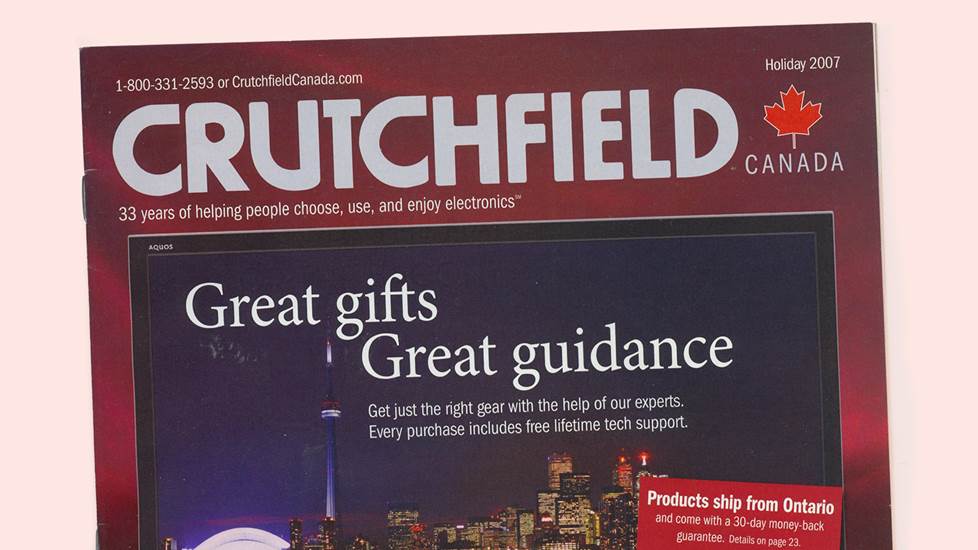
The Crutchfield Canada catalog featured products designed specifically for the Canadian market.
Although we support sales, customer service and technical support calls from our two Virginia call centers, we contracted with a third-party fulfillment provider to offer distribution from Mississauga, a city near Toronto. This provides faster distribution and removes the hassle of our Canadian customers having to pay duty on products imported from the U.S. Since many of our products are imported into North America, they are not subject to the tax-free benefits provided by the North American Free Trade Agreement (NAFTA).
Since Canadian postage was considerably more expensive than that in the U.S., we soon learned that mailing catalogs was not profitable. We stopped publication of the Canadian version of our catalog and concentrated on enhancing our Canadian website. Crutchfield Canada is still a very viable business to this day, and it provides a wonderful service for our friends north of our border.
Crutchfield dives into marine audio
In the summer of 2006, we got much more serious about selling and supporting marine audio products. Since 1977, we had been selling car stereo products for use on boats. In fact, the first product we manufactured was a simple, moisture-resistant FM antenna which could be placed behind the stereo. Automobile antennas installed externally on boats were not practicable since they were subject to serious corrosion issues.
By 2006, some of our car audio manufacturers had expanded into audio products designed specifically for boats. Although their features were almost identical to their automobile products, these marine derivatives were typically more moisture resistant, and they were offered in white, the color of most small boats’ fiberglass interiors.
We brought in marine-rated products from our vendors and added a new part of our website to support our boating customers. In the years since, we have added more products and informational content to help watersports enthusiasts find the gear they want and the know-how to properly use it on their boats.
Crutchfield’s online Vehicle Selector tool makes our wealth of information available to the public
As I mentioned in Chapter 2, we started developing the industry’s most comprehensive database of fit information for our car stereo products in 1992. Back then, for customers to benefit from it, they had to speak with a Sales Advisor. In turn, our Advisors would access the information through their computer terminals.
In 2006, we took the dramatic step of opening this information up to the public by launching our Vehicle Selector tool. When shopping for car stereo products on our website, visitors can enter their particular vehicle. Our computers then filter our vast selection of products to show only those which will fit our shoppers’ exact vehicles.
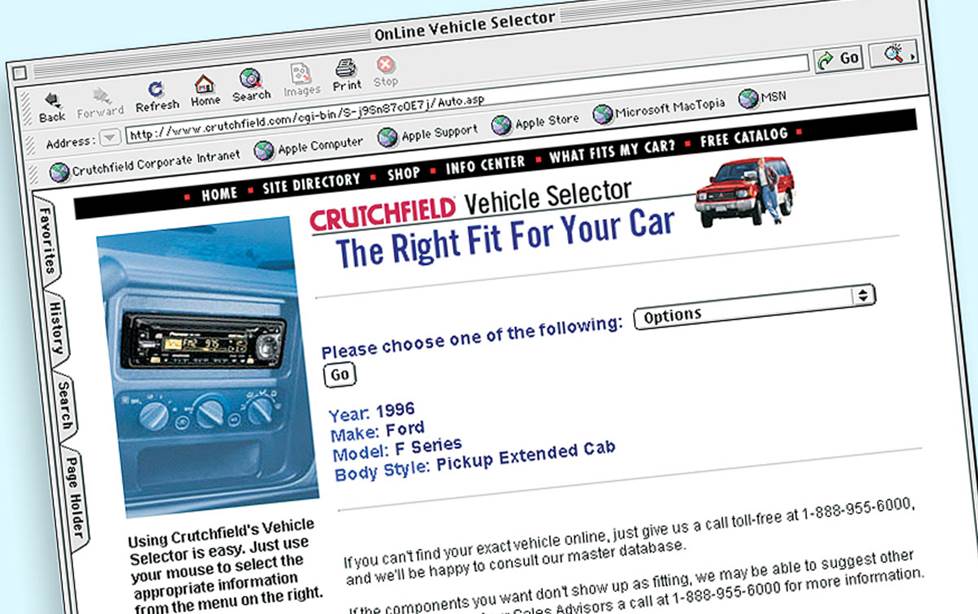
An early iteration of Crutchfield's online Vehicle Selector tool — we help you find the gear that fits best.
Crutchfield’s Vehicle Selector tool makes the shopping process much easier and dramatically reduces the chances of our customers making purchases which do not fit their vehicles.
Interrupted plans for further expansion
Our business kept growing during this period. We were running out of room for the additional call center people we needed to hire. Therefore, it was time to add our previously planned 20,000-square-foot second floor to a section of our distribution center.
As I mentioned in Chapter 2, I designed the first two modules of our new distribution center complex to accommodate a second floor. We did that by oversizing the footings and steel support structures. Also, we ensured that the roof slab was perfectly flat since it would eventually serve as a floor for the second story of the building.
In 2005, I hired an architect and engineer to start this process. As I previously mentioned, the permitting process in our county is extraordinarily complex and time-consuming. It was not until 2007 that we were ready to start construction. However, my instincts were beginning to make me feel troubled. It was not about the building. It was about the economy.
Navigating the 2008 financial crisis
By 2007, bubbles were beginning to appear around the irresponsible accumulation of debt in our country. There were two developments in particular which concerned me. First, people were buying rapidly appreciating condominiums in Las Vegas and other resort cities sight unseen with no money down. Second, our bank, Wachovia, was offering “pick and pay” mortgage plans. This allowed borrowers to select the most accommodating payment methods.
Feeling that the debt market was being fueled with irrational exuberance, I stopped our plan to construct a new call center. The bubble popped the following year, leading to the 2008 global financial crisis.
Many of the root causes of the crisis started in 2006 when home prices started to fall. Since there had been so much highly leveraged, speculative purchasing, many homeowners and investors owed more on some of these houses than they were worth. By early 2008, foreclosures started to soar.
From the late winter through the summer of 2008, the Federal Reserve and other government agencies took some dramatic steps to shore up the troubled housing market and certain stressed financial institutions. The catalyst which turned a troubled market into a crisis was the bankruptcy of Lehman Brothers, a major investment bank, in September 2008.
The crisis hits close to home
For the next two months, more financial institutions failed, and the stock market crashed. This situation became very personal since it looked like our bank would fail.
Although Crutchfield had no debt, we did have a large amount of cash and cash equivalents in our bank. At the time, the FDIC (Federal Deposit Insurance Corporation) only insured commercial bank accounts up to $200,000. Therefore, if our bank failed, most of our cash would be lost leaving us with no reserves to survive what some thought would be a catastrophic financial crisis.
As Yogi Berra once said, "It's déjà vu all over again." This is what really scared me. I had a great-grandfather who was an extraordinarily successful New York City businessman. He owned many different real estate properties and businesses. He also had a large portfolio of liquid assets in a leading New York City bank where he served on its board of directors.
When the Great Depression hit, my great-grandfather lost his real estate and his businesses. Even worse, President Roosevelt closed all the banks in the country during the “bank holiday” of March 1933. The strong ones reopened after a week. Unfortunately, his bank never reopened. It failed and his liquid assets evaporated. As a result, he lost almost everything.
While my business was debt-free, I feared that, if our bank failed and our cash reserves were lost, the same fate could come to me and my company that came to my great-grandfather. Fortunately, Wells Fargo soon bought our bank. The crisis passed and I could begin to sleep soundly at night.
Surviving despite plummeting sales
Once this crisis passed, another one developed. Like with virtually all businesses in late 2008 and early 2009, our sales plummeted. The company started to operate at a loss. Since Crutchfield had never had a layoff, I was willing to subsidize our employees through the crisis. That was assuming that the crisis did not last too long. Our senior-level leaders, supervisors, and I all took pay reductions. Our line employees were unaffected.
Once our shoppers realized that the sky was not going to fall and the economy was not going to collapse, they started to buy from us again. After several months, profitability returned, and we were able to restore full pay for everyone. Of the seven recessions we have experienced over the past 50 years, this was the worst. I am proud to say that, as a result of our conservative management, Crutchfield maintained profitability through each of these seven recessions.
Our new, biodegradable packing peanuts
Another positive milestone of 2008 was the introduction of Crutchfield’s biodegradable packing “peanuts.” Some states were passing tough regulations regarding the disposal of the traditional polystyrene foam packing material. It was becoming a big problem for our customers living in those states. Our solution was to manufacture our own packing material from organic starch.
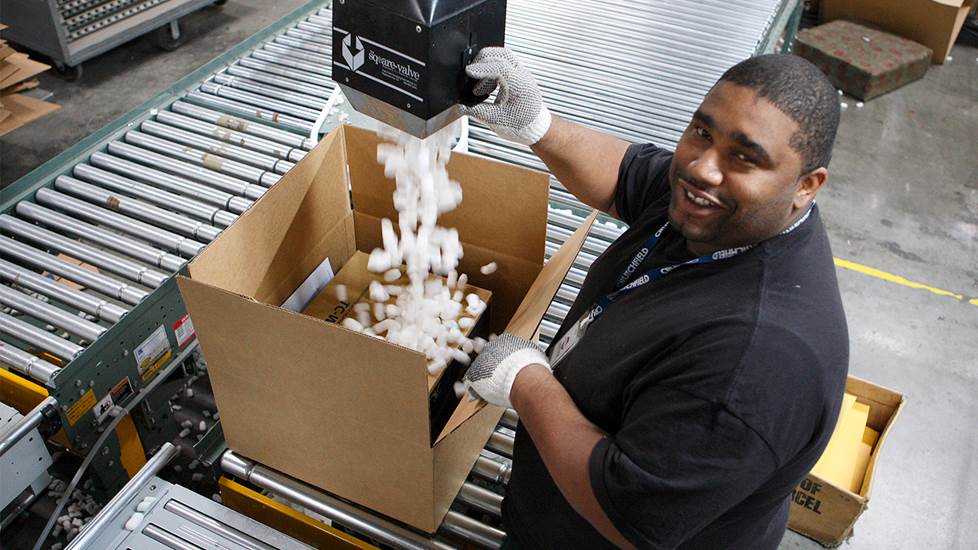
Making our own packing peanuts was one more way to better serve our customers.
We purchased an extrusion machine (like ones used to make potato chips). It combines pressurized air and heat to turn small nuggets of starch into packing materials that look and work like polystyrene “peanuts.” Our biodegradable version can be disposed of by placing them in normal trash or by dissolving them in a sink or toilet. They simply dissolve into a harmless liquid.
Bringing back high-quality audio: Crutchfield's "Hi-fi 2.0" initiative
During the midst of the 2008 financial crisis, we published our largest catalog. Crutchfield’s Fall 2008/Winter 2009 Big Book contained 196 pages. By this time, Crutchfield had truly shifted from a catalog to an online retailer. Mailing large catalogs to large numbers of people was becoming uneconomical. Interestingly, three years earlier our catalog circulation peaked with total mailings of 36 million.
For many years, I had been concerned about a decline in people's appreciation for quality sound. As I mentioned in Chapter 1, I started my audio journey as a child by listening to my father’s 78 rpm records. This low-fi technology was replaced in the late 1940s by the vastly superior, 33 rpm record system.
As its technology improved, the hi-fi industry was created and rapidly evolved. Then, came stereo in the 1950s. That created an even greater appreciation for recorded music. People invested in higher-performance components.
In the 1980s people's appreciation for music changed from quality sound to convenience. Early CDs and their players did not have the sound quality of 33 rpm records when played on quality sound systems. Portable cassette players were introduced and supplied with headphones of marginal audio quality.
Probably the biggest setback was the online streaming of music over the early personal computers. Those computers were typically accessorized with low-quality sound cards and small speakers. Another setback was the small internal speakers found in the early flat-panel televisions. There was no room for the larger, higher-quality speakers which were typically incorporated into the previous generation of tube-type televisions.
Educating our customers about sound quality
To help reverse this downward trend in audio appreciation, I instigated an initiative in 2009 which we called "Hi-Fi 2.0". Beginning with the Winter/Spring 2009 catalog and corresponding website content, we launched an aggressive educational program.

We introduced our Hi-Fi 2.0 initiative in our Winter/Spring 2009 catalog.
Throughout our media, we emphasized the enhanced benefit of true hi-fi over the lower fidelity of many new products on the market. We also expanded our offerings of high-end audio components and upgraded our sales training so our Advisors could provide the best service for our customers who were becoming interested in genuinely great sound systems.
Accolades for Crutchfield during the 2000s
- In 2002, the Commonwealth of Virginia honored us with the Governor’s Technology Award for using technology to improve the welfare of Virginians — mainly the Virginians employed at our Southwest Virginia call center.
- In 2004, I was presented with an American Heart Association award in recognition of our "Live Longer, Live Better" program.
- By the end of 2004, Crutchfield had won a total of 15 Catalog Age magazine design awards for our catalogs and website.
- Our Charlottesville and Wise County call centers earned the J.D. Powers and Associates Certified Call Center designations.
- In October 2007, I was inducted into the Consumer Electronics Association’s Hall of Fame, along with the founders of Best Buy and Bose, and the co-founder of Microsoft.
- In early 2008, Samsung invited me to carry the Beijing 2008 Olympic Torch in Hangzhou, China.
- In late 2008, the leading consumer organization rated Crutchfield in its widely read magazine as the top online consumer electronics retailer for the fourth year in a row. This fine organization does not like its name used in what can be regarded as a promotion. Naturally, we honor that concern.
- For each year of the 2000s, Crutchfield earned Bizrate Insights’ Platinum Circle of Excellence award. This market research firm provides the most comprehensive analysis of the customer experiences received through leading online retailers. Crutchfield is the only online retailer that has now earned it for 24 consecutive years.
Chapter 5 — the 2010s
This concludes the fourth chapter of The Crutchfield Story. In Chapter 5, I chronicle the decade of the 2010s. It was highlighted by Crutchfield’s continued growth and our constant innovation.
Table of contents
Chapter 1: the 1970s — The origin of legendary car audio retail
Chapter 2: the 1980s — Growing pains and the consumer electronics boom
Chapter 3: the 1990s — A decade of growth and expansion
Chapter 4: the 2000s — Traversing the digital era
Chapter 5: the 2010s — The continuing evolution of consumer electronics
Chapter 6: the 2020s — Handling the pandemic and hitting a major milestone
Copyright© 2024 by Crutchfield Corporation


