Why bi-amp your speakers?
A beginner's guide to getting better sound from bi-amp capable speakers

T
he world of home audio is deep and complex, and often confusing. Bi-amping speakers is one of the most often misunderstood and misrepresented concepts. Some say bi-amping speakers has no audible benefits, while others say they're impressed by the improvement in their speakers' sound quality.
Even I was skeptical about bi-amping speakers until I did it myself and had my mind blown by how much my speakers opened up. But what is it and how does it work? Read on to find out.
What is bi-amping?
Most speakers have one set of speaker wire terminals. When you connect your speakers to your amplifier, power and signal come from your amplifier and go into your speakers, which then makes the drivers move and produce sound.
The wiring inside your speakers goes from their binding posts to an internal crossover, and then from the crossover to each driver. This means the power and signal flow in and get distributed across the drivers.
Higher-end speakers often have two sets of binding posts. Each pair of binding posts are like power and signal input points for each driver set on the speaker. There's one for low frequencies, often routed to woofers and other larger drivers, and one for higher frequencies, which go to the tweeter. That important distinction is what makes bi-amping so impactful.
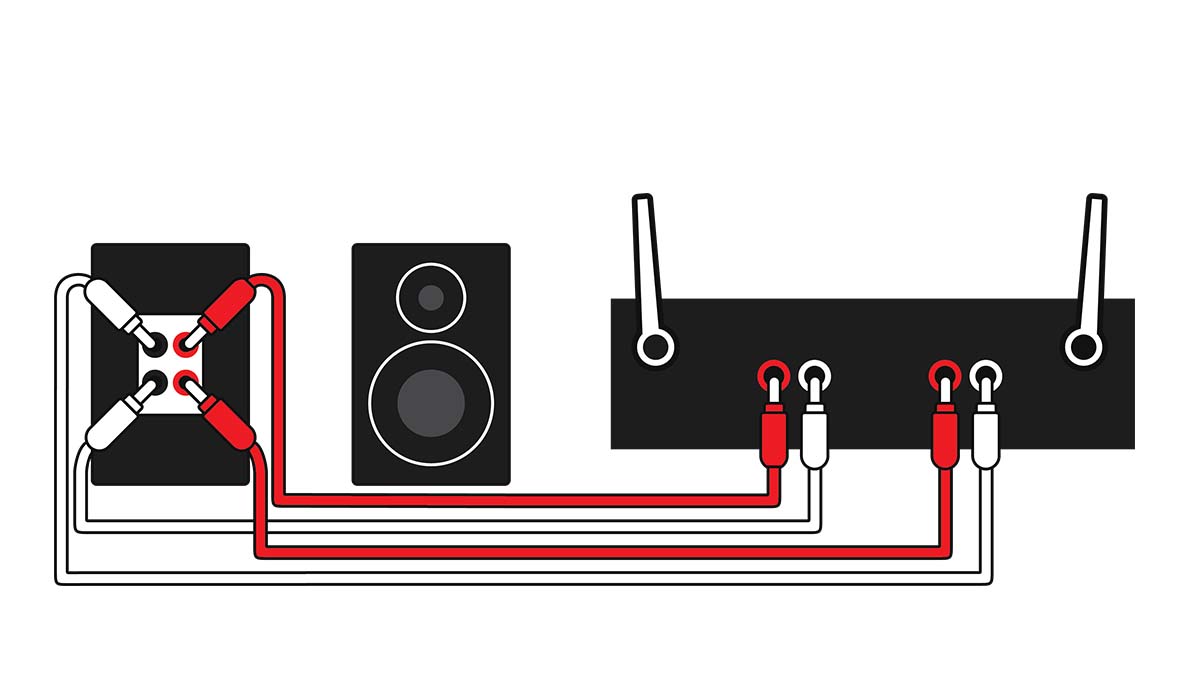
When you bi-amp a speaker, you're using two amplifier channels to drive a single speaker. Doing so gives the woofer and tweeter their own source of power. That helps keep the drivers from under-performing and gives each driver enough juice on tap to perform its best. Bi-amping is done with the front left and front right speakers in higher-end home theater systems, or in dedicated stereo listening setups.
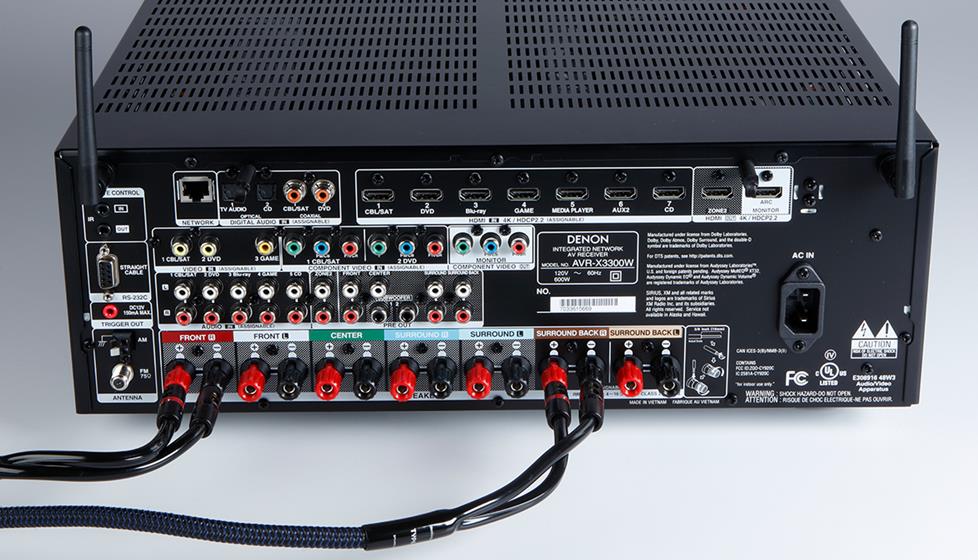
Each bi-amped speaker connects to two channels on the back of your home theater receiver.
Passive vs. active bi-amping
This article covers the process of passive bi-amping. There's another kind of bi-amping procedure called "active bi-amping." It's a whole 'nother can of worms that exceeds the scope of our product selection and this article.
Passive bi-amping doesn't change anything signal-wise. It only increases the amount of available power that's sent to each part of the speaker. Active bi-amping uses external crossovers and multiple amplifiers and does change the signal. It can give you better sound, but requires a lot of know-how and specialized equipment to pull off.
Can any speaker be bi-amped?
Not every speaker can be bi-amped. A bi-amp capable speaker has to have two sets of binding posts. This feature is often found on higher-end speakers. Speakers with only one pair of speaker wire terminals cannot be bi-amped.
What's the difference between bi-amping and bi-wiring?
Something I was often asked as an Advisor is how bi-amping and bi-wiring compare. Bi-wiring involves connecting one amplifier channel to both sets of terminals on a speaker. Bi-wiring gives you a subtle improvement in sound and can help with bass and treble response, but it's important to note that, unlike with bi-amping, the speaker's drivers are sharing a power source. We carry special speaker wire from AudioQuest made for bi-wiring if you're interested.
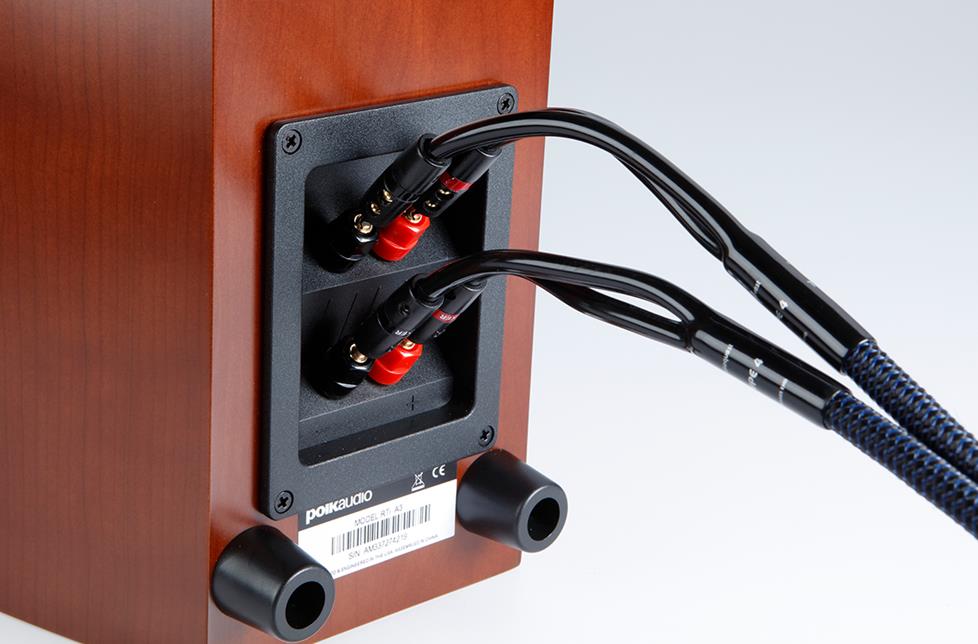
A bi-amp capable speaker has two sets of input terminals for connecting to two separate receiver channels.
Does bi-amping make a difference?
I use a pair of Klipsch RP-8000F tower speakers as my fronts in my home theater system. For years, I ran those bi-ampable speakers with individual channels on my Yamaha Aventage receiver, and I was happy with the sound, but felt something was missing.
I decided to step up my game a little and test to see if bi-amping them would make a difference, since nothing else I'd done previously seemed to make any noticeable improvements. I picked up some high-quality AudioQuest Rocket Series speaker cables and hooked them up to my speakers and my receiver, making sure to bi-amp them. My jaw dropped when I started playing some tracks from Scott Bradlee's Postmodern Jukebox.
The soundstage was way wider, and my Klipsch speakers sounded cleaner and clearer than I'd ever heard them. There was a considerable difference in sound quality and control. The low notes had more impact with a quicker attack and decay, and the high notes sounded lifelike and full. I was forever sold on what bi-amping could achieve.
But, that's only my experience. Your mileage may vary, depending on your room, layout, amplifier, and other considerations. At its core, bi-amping gives your speakers more usable power rather than a single channel’s worth of power divvied up between the woofer and tweeter. Increasing the total amplifier power to each speaker provides more headroom and greater control, which can yield better sound.
At the end of the day, it's all about what your ears like and what you perceive. Bi-amping is a common feature among modern home theater receivers, and it never hurts to give it a shot. Do it and see for yourself if there's an improvement in your sound. Experimenting is fun!
When should you use bi-amped speakers?
I recommend bi-amping your speakers whenever possible. The benefits are worthwhile and it's an easy thing to do. You can use bi-amped speakers in your home theater system or your music setup. I only recommend not bi-amping if you don't have spare channels on your receiver, especially if they're taken up by other speakers in your system. If that's the case, consider grabbing a home theater receiver with more channels to support bi-amped speakers.
How to bi-amp your speakers
Bi-amping your speakers is easy, though there are a few things you'll need before you begin. First, you'll need at least a 7.1-channel home theater receiver that has a pair of assignable amp channels. Make sure those channels aren't connected to other speakers. The next thing you'll need is a pair of bi-ampable speakers — that is, a pair of floor-standing speakers or bookshelf speakers with two sets of input terminals. The last thing you'll need are four sets of speaker cables. You'll use two sets for each speaker.
Once you've got all that together and ready to roll, you can start the process by removing the metal jumpers installed between the terminals on your speakers. That'll let you connect two pairs of speaker cables to each of your speakers.
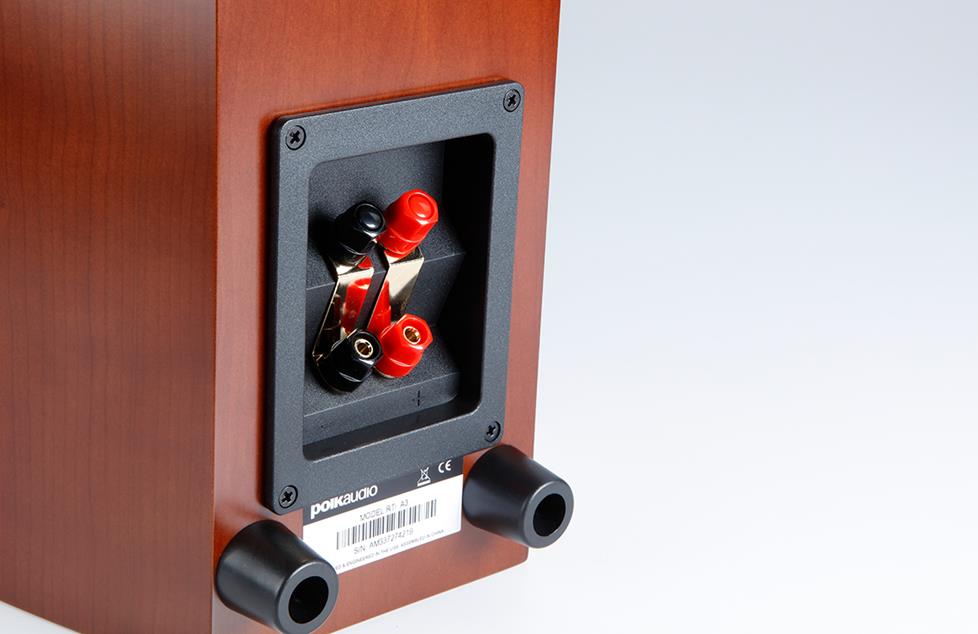
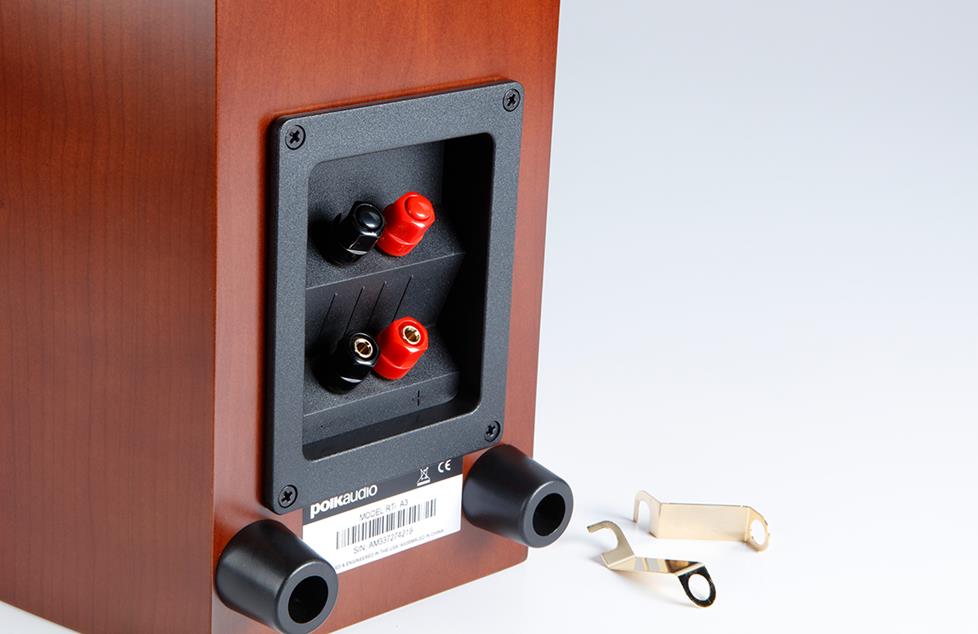
The first step to bi-amping your front speakers is removing the brass jumpers that link the top and bottom speaker terminals together. This lets you connect separate receiver channels to each set of terminals.
After that, you'll want to head into your receiver's settings and enable the bi-amp feature. If you have trouble finding it, it's often in the "speaker setup" section of the menus. Doing this tells your amplifier that the assignable channels aren't acting as surround channels and that you're using them to bi-amp speakers.
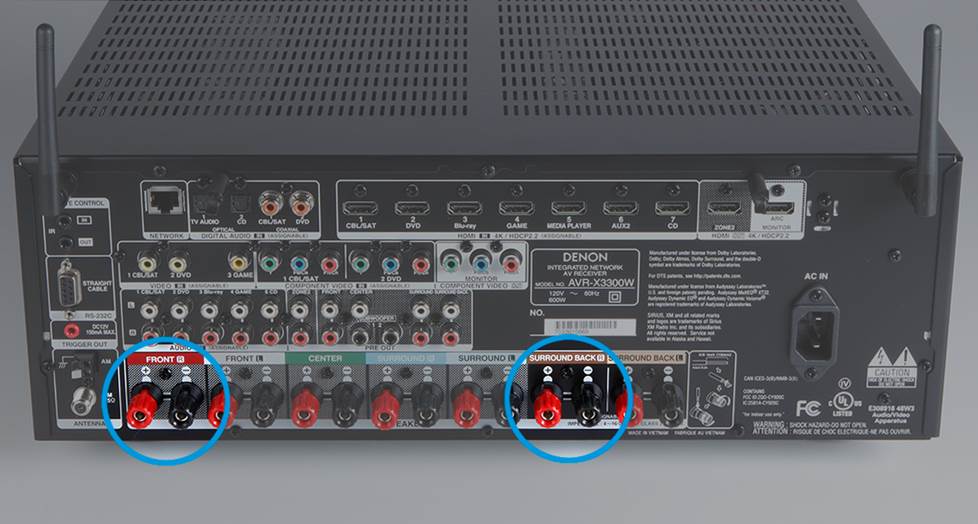
On this Denon receiver, the surround back outputs are assignable as bi-amp channels. Each one pairs with a front channel to increase power to your speakers.
Okay, hard part's over. The last thing you need to do is connect your speakers to your receiver. Connect speaker wire from the front left and right channels on your receiver to either the top or bottom terminals on your speakers. Your receiver is going to send a full-range signal out, so it's not picky about which set you use.
Once that's done, use your last two speaker cables to go from the left and right assignable amp channels on your receiver to the other pair of binding posts on your speakers. Your speakers are now bi-amped!
Personalized advice from our team of experts
Have questions about planning your new bi-amped system? Our expert Advisors know the gear inside and out. Contact us today.
Free lifetime tech support is included with every Crutchfield purchase.


Jacob T
Posted on 10/7/2026
In the graphic on top of the page, the top and bottom speaker terminals are connected across the two channels, rather than, say, the top two terminals connecting to the left +/- amp outputs, and the bottom two terminals connecting to the secondary +/- amp outputs, wouldn't this produce like a series connection? I'm under the impression that the top two STs are for the tweeter / top driver, to be connected to a single amplifier channel's posi/nega, while the bottom two STs are for the woofer/bottom driver to be connected to the amps assigned secondary channel's posi/nega. It's not mentioned in the article whether the graphic was just mistaken, or if there's any benefit to doing it like illustrated instead, with both channels bridged across the four terminals? I would try it and see but I don't want to blow my speakers if I'm wrong
Frank Piccirillo from Brooklyn
Posted on 5/21/2026
Thank You this was very informative. I've been an audiophile for more than 50 years and I've never BI wired any system I've ever had. This is a real improvement. I'm using a Parasound two channel amp and a pair of Klipsch RP600two. With a Parasound 200 preamp.
Don E Ward from Laguna Niguel Ca 92677
Posted on 2/24/2026
That was a great instruction doc and I'll have my skilled tech from Reel Time Audio here in Dana Point Ca come do the needful tasks. I have a separate Q for you on an over perorming AudioSource VS 310 amp I'm using here After a could years of sitting idle on trying to implement all components to perform well? I love your co by the way, the products and services offered are really top notch of the industry?!! Thx for all! Don E Ward Laguna Niguel Ca 92677
Anthony from Export
Posted on 1/7/2026
Excellent clear simple instructions. Thanks!
Steven from Twentynine Palms
Posted on 10/9/2024
Can I bi-wire speakers using the A & B outputs? Does it cut power in half?
Howard
Posted on 7/8/2024
Perfect and clear explanation, could not be any simpler explained. I just love crutchfield.
knotscott from Rochester
Posted on 11/26/2023
"Deepak from San Jose Posted on 11/23/2023 Can you use the B speakers output from the receiver to bi-amp front speakers?" Most receivers that offer "A" and "B" speaker options end up running the A and B channels in parallel, which really just draws from the same amplifier output (which is why you need to be mindful of the speaker impedance if running two pairs of speakers from those). The scenario you described really ends up as "bi-wiring" vs "bi-amping". It's still a step in the right direction IMO, but is likely to offer only very subtle improvements. To bi-amp you'd need to add a second amp somehow (there are several ways). What improvements you can actually hear is always a variable that depends on the system resolution, setup, listening habits, source music, etc.
knotscott from Rochester
Posted on 11/26/2023
"Deepak from San Jose Posted on 11/23/2023 Can you use the B speakers output from the receiver to bi-amp front speakers?" Most receivers that offer "A" and "B" speaker options end up running the A and B channels in parallel, which really just draws from the same amplifier output (which is why you need to be mindful of the speaker impedance if running two pairs of speakers from those). The scenario you described really ends up as "bi-wiring" vs "bi-amping". It's still a step in the right direction IMO, but is likely to offer only very subtle improvements. To bi-amp you'd need to add a second amp somehow (there are several ways). What improvements you can actually hear is always a variable that depends on the system resolution, setup, listening habits, source music, etc.
Deepak from San Jose
Posted on 11/23/2023
Can you use the B speakers output from the receiver to bi-amp front speakers?
timothy powers from Hampton NH
Posted on 8/8/2023
Hello, This is more of a question and hopefully an educated one. I am an electrical engineer specifically a power conversion design engineer which although not audio amplifiers they are amplifiers. I dabble in audio but this concept although I understand it is new to me. One question I have is the terminology of the output power of the amplifier. I have a Denon AVR-X2700H which is rated at 95W/channel "2 channels driven"?? The 2 channels driven is my question. Are all outputs of the amplifier capable of the 95 watts per channel independently? If that is the case I am effectively (I'll use the word offering as the impedance determines the current used), 95w/channel to each side of my tower speakers (RP-8000II). So to sum it up would the power available be balanced using the main speaker output and the extreme rear speaker outputs to drive my speakers in bi amp mode