Podcast Ep 71: Which projector type is right for you?
Ultra-Short Throw Projector vs. TV: Which Big-Screen Experience is Right for You?

In this episode:
JR and Huffy go head-to-head in a debate to answer one of the biggest questions in home entertainment: should you buy an ultra-short throw projector or a large TV? Spoiler alert: there's no loser here, only the right choice for your room, your budget, and how big you want to go.
They examine the 98-to-120-inch sweet spot where these two technologies collide, covering everything from installation complexity and sound system placement to screen selection, ambient light performance, and real-world 4K considerations. JR brings the customer reviews; Huffy brings the firsthand experience. Together they'll help you figure out which big-screen setup belongs in your living room.
Want more info to help you decide between a projector and a TV? Check out our How to choose a home theater projector article.
[Speaker 1]
Hello and welcome to another episode of Crutchfield, the podcast. I'm your host, JR. And this is Huffy. Oh, we're going with Huffy this time.
[Speaker 2]
Yeah. I love it.
[Speaker 1]
We're going with Huffy, right? I love it when you remember your name.
[Speaker 2]
That's what my mom named me.
[Speaker 1]
Now, that's not the case. We've got a good episode for you here today. We have a pretty narrow focus.
We're going to discuss one thing, and that one thing is what's better, an ultra short throw projector or a TV? I'm going to shed some light on that subject. We're going to, yes.
We're going to bring it into focus for you right now. I had that one written down. You've been looking at my notes?
What the heck? That was just low-hanging fruit in the pun world there, buddy. So, we're going to do a sort of a point-counterpoint debate-style thing, and I don't know if either of us are going to change the other's mind, and really the point is to give you enough information to know whether you should get an ultra short throw projector or a TV, if in fact you are on the fence about that thing, right?
What we're not going to talk about today is long throw projectors, the ones that you mount on your ceiling, you run cables through your walls and your ceilings. That is a very different animal, right? And for a very different application, if you're building a theater room and a purpose-built room for watching movies, a long throw projector can go bigger and more awesome and really feel more like a movie theater than either a TV or a short throw projector.
Can we at least agree on that point? Yes.
[Speaker 2]
Yeah, we can. I love those long throw projectors though.
[Speaker 1]
They're awesome. Yeah. So that's not what we're here to talk about because long throw projectors have been around for a long time.
Short throw or ultra short throw has not been around all that long. I remember going to CES in the late 20-teens and seeing them for the first time there and being kind of impressed with what I saw and had never seen a projector that close to the wall before. And I immediately thought of all of the benefits of putting a projector there instead of putting it up on the ceiling.
And I thought, well, you could maybe get a bigger picture and it would look pretty awesome and probably bigger than you can get a TV. Now is that true? Is that really a thing?
Can ultra short throws be bigger than TVs? And that line is kind of blurry right now.
[Speaker 2]
Yeah, there's all kinds of caveats there, right? Where do we draw a line in the sand based off of just economics, right? You can get a huge television, hypothetically, and you're going to spend huge money for said huge television.
[Speaker 1]
Yeah, where there's money, there's a way, right? You can get an entire wall that's a TV if you have hundreds of thousands of dollars, right? We're trying not to live in fantasy land here.
[Speaker 2]
That's not what we're talking about today. And that doesn't do anybody good. Yeah.
[Speaker 1]
No, we're talking about the, I'd like to narrowly focus this on the... You already said that one. Yeah, I wasn't actually going for the pun that time.
But let's focus on like a hundred to 120 inch size picture.
[Speaker 2]
How about if we focus on like 98 to...
[Speaker 1]
No, I think 98 is too small.
[Speaker 2]
That's a tiny little screen. Well, we'll agree to disagree.
[Speaker 1]
If you want to bring 90, okay, 98 to 120 inch screen. We live there, right?
[Speaker 2]
Yeah, we live there.
[Speaker 1]
I mean, most of the TVs we sell are 65s and 75s, whatever that size, like that's the...
[Speaker 2]
That's our bread and butter. The most popular sets are usually around there. You start getting large, people start thinking like 83 for OLED and then 85 is becoming a fairly popular size.
We've got a lot of models around that size and then we do a branch up close to a hundred inches as well.
[Speaker 1]
But 98 is not like we're not selling a hundred of those a day, right? No, that'd be nice. That would be great.
Yeah. But why not? Is it because of price?
Is it because people don't really need that big of a TV or what? I mean, there's plenty of people that want a big image for watching movies. Sure.
Yeah. We should get into that. Yeah.
Yeah. Yeah. And so a large TV is a very valid way to do that.
And it's become way more accessible in recent years.
[Speaker 2]
What I find interesting is in the past, our industry or the TV selling industry, if you will, has always tried to find whatever the next great thing is, right? I think we can remember back when it was 3D, you know, that was a number of years ago and then it was- Even 8K. Oh yeah.
Well, then it was curved TVs. Curved TVs. That kind of came and left, right?
[Speaker 1]
Sure.
[Speaker 2]
And right now what the consumers are telling us that they want is bigger. Bigger. Bigger.
So- Bigger is oftentimes more important than better. I would argue that sometimes bigger is better.
[Speaker 1]
Right. Bigger is part of that equation.
[Speaker 2]
We're saying the same thing.
[Speaker 1]
Yeah. So I think people are focused on, or I'm going to keep saying focused on, that's just going to happen.
[Speaker 2]
Yeah.
[Speaker 1]
But a lot of people gravitate towards a huge image, as long as it looks okay.
[Speaker 2]
Right.
[Speaker 1]
Right? It can't look horrible.
[Speaker 2]
Yeah. And today with the higher resolution of our signals and most of these TVs we're talking about, I mean, 4K is a lot of information. We're talking about that many lines of resolution.
You can sit ridiculously close to a huge television, and as long as it's not overwhelming to you, it can be fine. You're not getting that ... I remember growing up and my grandmother would fuss at me for sitting too close to the TV.
She said I might go cross-eyed, right? Yeah. Watching my Saturday morning cartoons.
Well, it didn't look that good when I was up close to those, because there wasn't enough lines of resolution. Nowadays, and we're all ... I mean, heck, right now I've got computer monitors 15 inches away from my face, and they look great.
[Speaker 1]
Yeah. So with more higher definition you can be closer, which makes it easier to get a movie theater-like experience. Yeah.
[Speaker 2]
And that stays the same, whether or not we're talking about TV or we're talking about projections. Just really that whole how far back are you from the set, and we've got charts on our website that can help people discover whether or not a TV they're considering is too big for their space. I think you're going to find out, in most cases, the answer's no, based off of 4K resolution, which is what we usually are watching these days, whether or not it's YouTube or from Netflix or cable or whatever our primary way of consuming video content is.
It's getting easier and easier to get high-resolution content, and with that we can go big.
[Speaker 1]
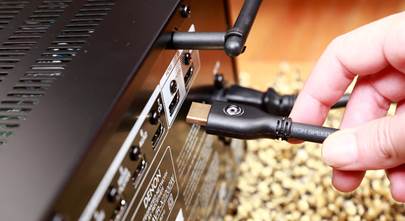
And another way to do that is with an ultra short throw projector, and that has made the idea of a projector significantly more accessible and affordable for people, right? Not having to put the projector on the ceiling and go through the installation of that, just being able to take a short throw projector, put it right where basically you would put a TV, which makes its connectivity to your home theater receiver or your sound bar or whatever else your sound system might be much easier. Your HDMI cables don't need to be 30-feet active cables running through the wall.
They can just be a normal 6-foot HDMI 2.1 cable and you're good, right? It's like hooking up a TV.
[Speaker 2]
Yeah, often they are made to be able to sit right where you would imagine a sound bar would sit, right underneath the screen, project directly up against the wall at a really sharp angle and still give you a wonderful image.
[Speaker 1]
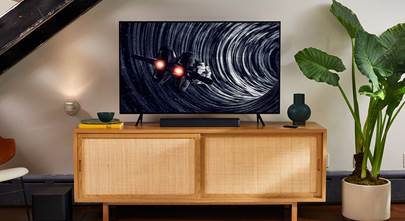
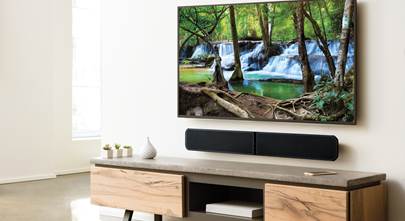
That does bring up one of the challenges with an ultra short throw projector that I will give the nod to TVs on this one. It's how, where do you put either a center channel if you're doing like a discrete home theater system or your sound bar if you're putting an ultra short throw projector on a piece of furniture right there underneath the screen that's going to go on the wall. That's kind of where you would put your center channel in an ideal world.
[Speaker 2]
Yeah, and I think something that you and I will both agree on is that in any case, whether or not you're going with a big honking television or a short throw projector, we're talking about huge image potential here. We like big sound to match up with big picture and TVs will handle it one way, and some short throw projectors actually have built-in speaker systems that are decent, but when I hear people going 100, 120 and even larger potentially with screen sizes these days, I'm really hoping they're doing something separate than TV audio or...
[Speaker 1]
Otherwise, why do such a large screen, right? Don't you want sort of an immersive movie and TV watching experience and sound is at least 50% of that. You think it's not until you realize it and you see what's missing.
And yes, ultra short throw projectors, some of them have, I would call it like an okay sound bar level of sound built into them. So acceptable, better than most TVs' built-in speakers, but still not as good and not as immersive as a high-end surround sound type sound bar or obviously a home theater receiver and a bunch of speakers. And whether you're doing the sound bar or the center channel, where do you put it since you had to put the ultra short throw projector right there where you wanted to put your sound bar or your center channel?
And I think the answer is you got to pick the right piece of furniture. It needs to be deep enough maybe to put the projector on it and a sound bar or center channel in front of it or have a compartment just below the projector that's large enough for your center channel, probably not good for a sound bar, even a nice high-end one because it's going to be inside a piece of furniture, not recommended, especially if it has upward firing speakers for Atmos, right? So the placement of that speaker, I give it to you.
It's easier with a TV.
[Speaker 2]
Yeah, I think we should come up with a column. So we're giving that one to, that checkbox to TVs for, what do you call it, flexibility of installation or incorporating with sound?
[Speaker 1]
Yeah.
[Speaker 2]
Okay. So then flexibility for installation, that could be another check we can get into that. You're keeping score over there?
I thought we weren't keeping score. Well, I mean, sure.
[Speaker 1]
Is there going to be a winner at the end of this?
[Speaker 2]
I mean, if you're keeping score, there will be.
[Speaker 1]
But, you know. So where I think ultra short throw projectors have an advantage is in the right room and at a certain size screen, you can't beat it with a TV for the money. Like the combination of all that does have to make sense.
And I think you can find a TV for anybody, but an ultra short throw projector in the right situation, I think will outperform the TV. If we've already agreed that bigger is generally better, even if the image isn't technically as high resolution or as perfect, the fact that it's ginormous really makes a big difference to what we perceive as, hey, I really liked that. And with an ultra short throw projector, anywhere in that 100 to 120 inch is kind of the sweet spot.
Right. You can go bigger. We have them bigger.
We have bigger screens. But the cost really goes up when you get past 120 inch.
[Speaker 2]
Yeah. And there are models out there, just to be fair, models of TVs that reach some of those sizes. Like you can, if you're shopping for 120 inch TV these days, you know, currently Crutchfield might not be the best option, but it's also, you know, we carry some of the better brands, right.
With the better motion processors and whatnot. So, you know, if you're willing to make compromises on some, quite frankly, some pretty important parts of a television, you can get TVs up around that size and a comparable price range as your higher end short throw projectors, but you're going to have to make a compromise. So I'll give it to you that bang for the buck for, you know, North of a hundred inches.
Yeah. I, I'm going to give that to the short throw projectors. It's just going to come with a lot of caveats, right?
You're going to have a lot of considerations, you know, the room, the brightness, the placement and those types of things.
[Speaker 1]
Yeah. With the TV, you just get the size you can fit in, put it up there and turn it on and it's probably going to look pretty darn good.
[Speaker 2]
You can put it on a piece of furniture. You can hang it on the wall and yeah, you're hooking everything directly into it and you're ready to rock.
[Speaker 1]
Right. With a higher tolerance for some setup and maybe a tougher installation, the reward is bigger screen for probably less money.
[Speaker 2]
Yeah.
[Speaker 1]
At least it can be. Yeah.
[Speaker 2]
Let's talk about that setup real quick. Cause I, I mean, clearly hanging a, if we're going to hang a TV, that's 98 inches. That's a, I'm going to say a three person job.
I don't think that's a two person job. That's, that's a beast. And if it's my money, I'm trying to hang on the wall.
I want an extra set of hands to make sure I don't drop the thing. So I'm going to say, you know, that, that is there, there's labor associated with that. But it's that being said, it could be a fairly quick process.
Once you have it hung, you're, you're kind of, you're done, right?
[Speaker 1]
Yeah.
[Speaker 2]
That's the, you did the thing with a projector. Um, you know, they, you really got to, you got to dial it in. Right.
And especially those short throw projectors. There's just not a lot of tolerance because you're literally projecting a laser beam in most cases up against the wall at a really sharp angle. You know, if somebody bumps that piece of furniture, now things get out of whack.
[Speaker 1]
Really easy. It's always better when things are in whack.
[Speaker 2]
Yeah. We want them in whack, not out of whack.
[Speaker 1]
Yeah. So yeah. Although I will say, I was looking through some of the reviews of our projectors and this one specifically on the Epson Epic Vision Ultra LS650, one of our lower priced ultra short throw projectors.
And Jason from Charlotte, North Carolina said, very easy setup, was quickly able to adjust corners to the screen and was ready to go out of the box in less than 10 minutes. That's awesome. Picture is great on a dedicated ultra short throw screen, which we're going to talk about in more detail here in a minute.
[Speaker 2]
Good point.
[Speaker 1]
Glad with the purchase and the switch from a regular TV.
[Speaker 2]
Awesome. So he went bigger. He had the right space for it.
I'm super excited to hear that the setup process wasn't super labor intensive. I have set up a couple of short throw projectors over the years, going way back to when I used to work at Crutchfield's retail store. We got one of the first ones in and it came with its own furniture, you know, it came with its own screen.
It was kind of an all-in-one solution. And I can be honest, that took a little while to set up. And every now and then I'd walk by it and, you know, the corners would be off a little bit and, you know, we had a lot of traffic in there, right?
It's a retail space. So I'm sure that was part of it. But you know, those TVs just kind of looked good when we hung them on the wall.
But I'm really happy to hear that he's had such a positive experience with those.
[Speaker 1]
I want to read another review, which is going to segue into the next part of what we need to talk about, which is the screen. A different review, Mark from Everett, Pennsylvania, says, This projector has changed the way I look at TV. Although I am presently displaying this on a bare wall, I bought an ALR, also known as ambient light reduction screen, or rejection, ambient light rejection screen, to put in my theater.
Amazing visuals. Now, that's the whole review. Okay.
But there's a lot going on.
[Speaker 2]
Yeah.
[Speaker 1]
Definitely. Can you? And this is a question whether it's a long throw or a short throw projector.
Many people want to just throw that image right onto a bare wall. And for many reasons, that's just not the best way to do it. Now, can you?
Absolutely. You certainly can. And can you be happy?
I know people who have been happy with that. Mark was happy with it, but not happy enough to not then go buy a screen that will make it look better. So let's agree that a screen is a necessary part of a projector system.
Whether it's a long throw or an ultra short throw, we got to factor in the screen.
[Speaker 2]
100%. It is so important. I always talk about screens when I would talk to customers or when we're talking to folks that were training on projector technology.
If you picture yourself driving down the road at night and the street signs from 200 yards away are illuminated, that's the gain of that sign. And that is making that sign stand out in its environment.
[Speaker 1]
In a similar fashion, I think of old license plates versus new license plates. Old license plates were dull and dark and hard to see at night at all. And newer ones, so bright, so reflective, easy to read.
100%. And the police out there will know exactly what I'm talking about. Yes, they will.
And I would even argue that with an ultra short throw projector, a screen is more important than ... I think you might be successful with a long throw projector angled at a good wall, a well-built wall, a well-painted wall, with projector screen paint on it. I think the chances of that result being acceptable with an ultra short throw projector go way down.
I 100% agree.
[Speaker 2]
That angle is really going to highlight any imperfections. And on top of that, by imperfections, I mean in the wall, right?
[Speaker 1]
Yeah, like a nail is popping out a little bit or a little nub of paint or anything like that. Right.
[Speaker 2]
Yeah. And so there's that. And then on top of that, because of that extreme angle, light bounces.
It's going to bounce off the wall that you're trying to reflect it off of. And if you're at an extreme angle, it's going to reflect off your ceiling or the surround wall. Often that's referred to as halo effect.
And it's really common with those short throw projectors.
[Speaker 1]
And so you're losing valuable light because it's not getting sent back to your eyeballs, which is where that light needs to go if that picture is going to pop. Correct.
[Speaker 2]
Which is why you need not just any projector screen, but one specialized for ultra short throw projectors, because it actually angles that light from that extreme angle, which let's be honest, most projector screens are trying to block out light from extreme angles. Right? Yeah.
But in this case, it wants to take that extreme angle and reflect it right back to your eyes.
[Speaker 1]
And a screen is made up of little tiny particles that is their job is to reflect that light. And they need to know, as if they were smart, where the light is coming from. And that is in the makeup of the screen.
And so when it's made for ultra short throw, it literally, it knows the light is coming from straight down and it needs to come from straight down and shoot it straight out.
[Speaker 2]
Yeah. So consumer advice there is if you're thinking about a short throw and you had already had a long throw projector and you're redoing things, your old screen, unfortunately, is not going to end up being the right screen for your new application. The good news is, to point things back to the fact that we work for a consumer electronics company.
So we have a filter on that on our website where you can go through all the tons of screen options we have and the specific ones for ultra short throw. You can just click right on there and sort by that. So you're not looking at the wrong one.
[Speaker 1]
There's a couple other considerations. I'm literally looking at that page right now. And there's a couple things to think about with picking out a screen for your ultra short throw projector.
You probably want to go with a fixed screen, right? The list, there's a filter for this. You can get rid of all the ones that are not fixed, but the chances of a motorized screen that comes down or a manual pull-down screen, the chances of that moving in your room when the HVAC comes on, when somebody opens a door, windows are open and the wind blows in, somebody walks by, your screen's going to move a little bit.
[Speaker 2]
We just talked about dialing it in and if it constantly has a chance to move, it's not going to stay dialed in and that's going to be noticeable. So that's definitely not that we're keeping score, but I know who gets that point.
[Speaker 1]
So if you go to that page on crushfield.com, you can find a fixed frame screen made for ultra short throw projectors, 120-inch screen for $2,300. As you know, if you've listened to this conversation, there's lots of things to think about, installation, but once it's up, if you pair that with the projector I mentioned earlier, the Epson, which is around just under $2,500, all these prices are as we record this podcast and subject to change, but we're right at under five grand for a projector and a screen at 120 inches. And again, if all of the other pieces of the puzzle fall into place for you, your room is the right room for it and you value bigger, I think the ultra short throw projector and the screen wins in that situation.
[Speaker 2]
Yeah. I just kind of always go back to light. So you talked about the room, but if you can really can control the light because you're going to get better black levels.
That's what it boils down to. If you're looking at your wall in your room during the daytime, and that's when you're picturing playing your ultra short throw projector, your black level is going to be the color of your wall, right? Like projectors, they don't project black.
They only project light. So whatever that color is, that's your new black. So if you can control the light, get that room dark, then man, they can be awesome.
They can be cinematic, very similar to the long throw projectors, and you can get up to 120 inches. You're just going to have a few more considerations, that's all.
[Speaker 1]
And I would put the performance of the ultra short throw with the projector screen somewhere in between long throw projectors and TVs. When it comes to how good does it look when the lights are on, the windows are open, daylight in those bright rooms, I think a long throw projector designed for movies is not going to pop as much when it's in a brightly lit room as an ultra short throw projector does. They're super bright.
They are brighter and they lose a lot when you are in a brightly lit room, right? They won't pop as well as they will when the lights are off. Well, they also don't have as far to shoot, right?
[Speaker 2]
Exactly. They're closer to the wall. Part of the equation is the brightness goes down the further the projector is away from the wall.
So yeah, that's certainly part of the equation.
[Speaker 1]
And neither one of those are going to be as bright as a well-built bright TV, especially like an LCD with many LEDs, lots of them. That is going to outperform any of these in that daylight, brightly lit room. Yep, for sure.
[Speaker 2]
Absolutely.
[Speaker 1]
I also want to, and I know I'm the guy who's promoting the ultra short throw in this discussion, but I'm going to give another nod to the TV, but it's a qualified nod. Okay. Well, all the nods that the short throw projectors have gotten so far have been qualified.
I'll give you that. I'll give you that. But if we're talking 4K, every TV you can buy from us or from just about anywhere is going to actually be native resolution of 4K.
There's enough pixels in there to give you actual 4K. And you can get 4K in a long throw projector if you have a lot of money, but every other projector that's not native 4K, including every ultra short throw projector, the resolution is less than 4K.
[Speaker 2]
It is. Even at those sizes, I think you're going to be hard-pressed to see huge difference.
[Speaker 1]
Right. That's why it's the qualified nod.
[Speaker 2]
Yeah, it's a technical, wins on a technicality.
[Speaker 1]
Yes.
[Speaker 2]
I'll still take it as a win.
[Speaker 1]
You can take it as a win, but I'm going to pull it back just a little bit because I'm going to go back to bigger is better. Okay. And I've watched movies and movie theaters that were not in 4K and I didn't know that until later because it looked fantastic.
And you sit in the middle of the movie theater. I sit in the sweet spot. Where the sound is the best, where the screen looks the best.
Yeah.
[Speaker 2]
I know you will wait a whole week to book those tickets for the spot that you want. We're lucky enough to have a movie theater here where you can pre-book your seats, right? Yeah.
You want that sweet spot. You will delay going to the movie to get that sweet spot. That's that important to you.
[Speaker 1]
Yep. I know exactly which chair at the Alamo Draft House here in Charlottesville is my chair if I'm going to go there.
[Speaker 2]
So my argument would be with a television, just scoot it a little closer, scoot your chair a little closer to the TV.
[Speaker 1]
Now I've got a big screen, right? And then so that's the equivalent of moving to the front row of the movie theater.
[Speaker 2]
I mean, to some extent.
[Speaker 1]
And then my girlfriend is going to be like, we're a little too close. Right.
[Speaker 2]
So then she can sit behind you. Because that's romantic. Yeah, right.
But I think you get what I mean. It all goes back to that, I think one of our first things we were talking about was the ratio of how far back you're sitting, right? So if your sweet spot in your room needs to be 12 feet back and you think that because of that you want 120 inches, if you can control the light, bigger is better in that case, right?
But if you're sitting 10 feet away or less, then really you're going to be probably better off with a 98 inch TV.
[Speaker 1]
So if you want to go smaller, I guess your TV wins. There you go. So as predicted, there's no winner or loser here.
There's only which one is right for you. And given all of what we just talked about, I'm not going to rehash it again here. You can decide which one makes more sense for you.
And if you have any trouble deciding, crutchfield.com's got stuff there to help you. And we have live people on the phones that are ready to help you figure out which one actually makes sense for you. Yep.
Let us help you. That's what we do. My other job when I'm not podcasting is to train all those advisors on all of these issues to ask you good questions and figure out what makes sense for you.
And Huffy's there sitting in the call center, making sure that that's what they're doing and that our website is looking good and supporting you on your journey to get movies and music and TV and all of that stuff. Heck yeah. To be an awesome part of your life.
Hey, that's it. That's the whole episode, Huffy. Yeah, I won.
Great. Sure, sure. You did come in with a bullet pointed list of stuff.
[Speaker 2]
I did. I did.
[Speaker 1]
An outline and all. You were prepared to make your case. I was focused.
You didn't have any customer reviews or anything like that, but you know. I've got firsthand experience.
[Speaker 2]
Yes, you do.
[Speaker 1]
Yeah. You've set up some ultra short throws. I've seen them up close and personal.
I've never personally set one up from the ground up. So yeah, there you go. So thank you so much for listening to Crutchfield, the podcast.
We don't have any sponsors or anything like that. We are completely as unbiased as a retailer can be. There you go.
Right. Both are good. Buy from Crutchfield.
[Speaker 2]
There you go.
[Speaker 1]
And you know who does sponsor us really, though? Bill, I believe. His name is Bill, and he's the guy in charge, and he continues to pay us to talk about the coolest stuff on the planet.
And we are forever grateful for this little aspect of our job doing Crutchfield, the podcast for you. We will be back next month. We don't know what we're going to talk about yet.
We'll figure it out. We'd love to know what you want us to talk about. Send us an email podcast at Crutchfield dot com.
Tag us in a post on Instagram with a comment there. Our social media team of Alexis and Abby will send those comments over to us. But, yeah, let us know what you would like to hear us debate or talk about or questions you'd like answered on a future episode of Crutchfield, the podcast.
And if it makes sense, we'll do it. Heck, yeah. Thank you so much for listening.
Huffy, any final words? Thanks, Bill. Peace out, everybody.
[Speaker 2]
I've got first world experience, though. Not first world. That's the wrong expression.
Cut that out. I've got firsthand experience.

Comments (0)