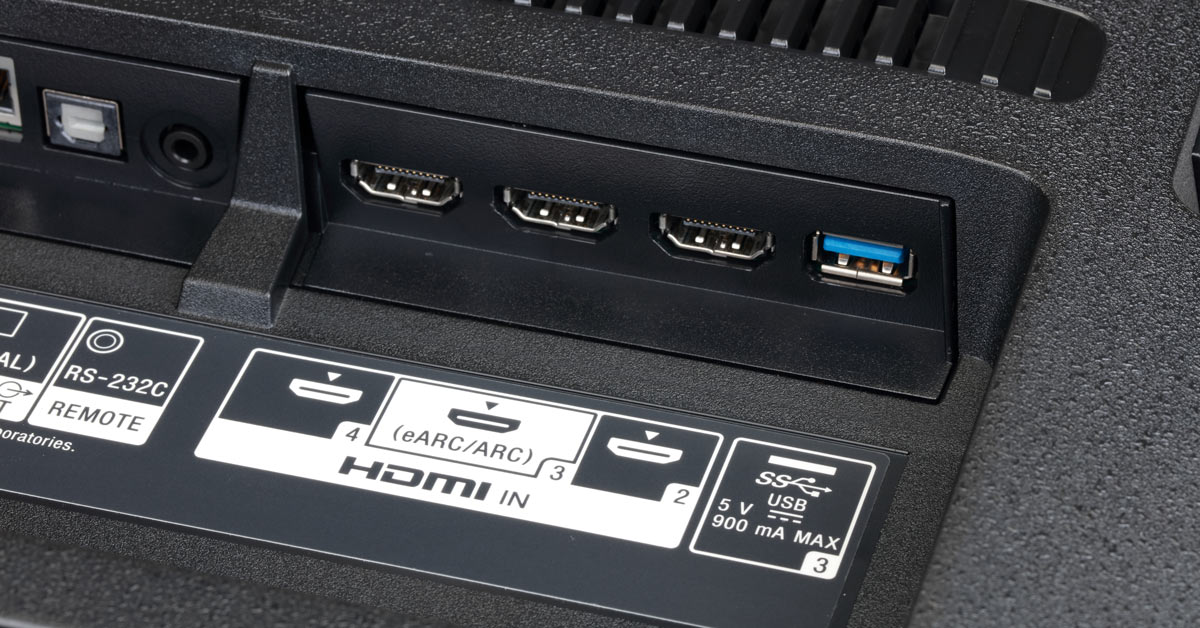
What you need to know about HDMI ARC and eARC
How to connect your TV to your receiver, sound bar, or surround sound speaker system

In this article: we'll provide a quick rundown on HDMI ARC and eARC...
...Along the way, we'll show you how to set up your system with ARC or eARC.
One of the easiest ways to hook up a home theater receiver or powered sound system to your 4K TV is HDMI. This is the type of connection that most sound bars and surround sound speaker systems use these days. But not all HDMI connections are created equally.
If you have a couple devices to hook up and want to avoid a mess of wires, you'll want to use a port labeled "ARC" or "eARC." But what do those labels mean and how do they make your setup simpler?
Let's dig in.
What is HDMI ARC?
ARC stands for "Audio Return Channel." This type of HDMI port was introduced way back in 2009 and has become an industry standard. Without ARC, HDMI is able to transmit both audio and video signals, but this transmission only goes one way.
If you're only connecting a single device like a sound bar, that might be fine. But if you have a source hooked up to your sound system or receiver, like a gaming console or Blu-ray player, you'll need an extra cable to carry the sound back out, too. (Usually, via an optical digital audio cable.)
With ARC, you're able to pass picture and sound to your TV from a connected source and send an audio signal back to your sound system or receiver from the TV. That means even if you have multiple sources hooked up to your receiver, you still only need the one HDMI cable going to your TV.
How does ARC make setup cleaner?
A one-cable ARC setup is great because you don't need as many cables dangling from your TV. You can connect to your receiver or sound system out of sight below your TV, then only worry about running the one cable up to the TV.
It's especially great if you have your TV wall-mounted. Cable management is a lot easier. You can install a simple cable track or raceway. Or, you could run a single in-wall rated HDMI cable totally out of sight behind the wall, for a super clean look.

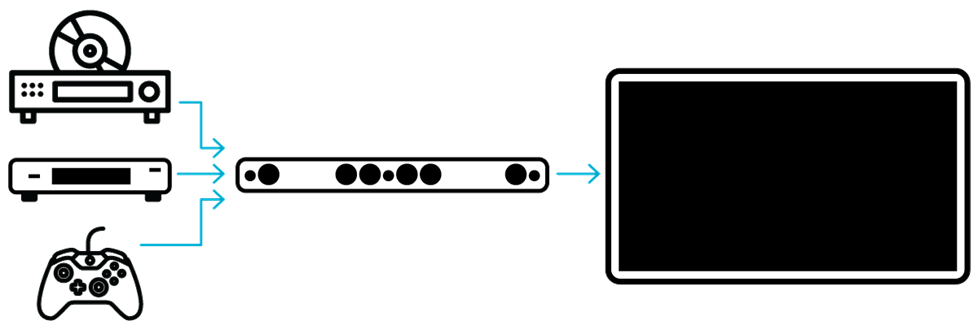
ARC lets you connect your sound bar to your TV with a single cable. Hook your other gear up to the bar or TV, but pick one. To avoid a headache, don't mix and match.
Do I need special HDMI cables for ARC?
ARC is compatible with HDMI versions 1.4 and above. Most HDMI cables available today are at least compatible with version 2.0. The latest version of HDMI is 2.1, which can pass the highest bandwidth yet. It also supports the enhanced version of ARC: eARC. More on that soon.
If you need help picking out the right HDMI cable, our buying guide has you covered.
HDMI ARC vs. an optical digital connection
A Toslink optical digital audio cable can only pass your sound. And it's always one-way. That means you can output audio from your TV to another device with this kind of cable, but that's it.
Optical digital also has a lower bandwidth than more recent versions of HDMI, which means there are some high-bandwidth audio formats, like Dolby Atmos or DTS:X, that you can't pass with it.
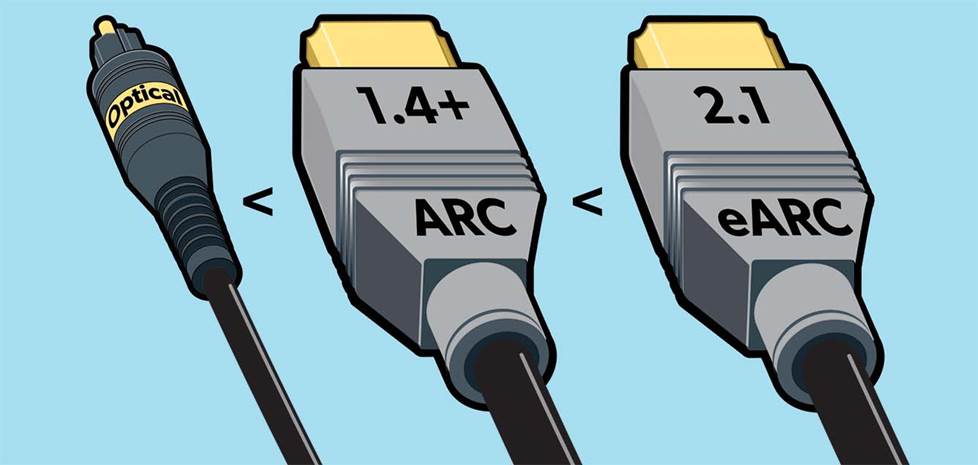
ARC works with HDMI versions 1.4 and up, while eARC requires 2.0 or higher. The latest and highest bandwidth version of HMDI is 2.1.
ARC vs. eARC
eARC stands for "enhanced Audio Return Channel," which begs the question: if ARC lets you hook up your receiver or sound system with a single HDMI cable, what exactly is being enhanced? The short answer is that eARC has a higher bandwidth and bitrate.
A higher bandwidth means eARC can send and receive more information than a standard ARC port. A higher bitrate means that data can also be passed faster. Both of these are key if you want to get the most out out of uncompressed surround sound audio formats like Dolby Atmos or DTS:X.
eARC also provides a more reliable "handshake" between devices. This keeps things like HDMI CEC working smoothly, so you don't need a bundle of remotes nearby. A built-in protocol for Lip Sync Correction keeps your picture and sound lined up, too.
Do I need eARC for Dolby Atmos?
Yes and no. ARC has a lower bandwidth, which prevents it from passing an uncompressed Dolby Atmos signal. But that doesn't mean you can't get Atmos at all. You'll just lose some of the data from Atmos or other high-quality audio formats.
Fortunately, most streaming services use a compressed or "lossy" version of Dolby Atmos, which ARC will work with. The lossless signal provided by a Blu-ray, however, will be more than a standard ARC port can fully take advantage of.
eARC will net you higher audio quality than ARC because it's retaining the full Atmos signal. And its support for a higher bitrate means that you're less likely to experience audio lag — which is a big deal for gamers like myself. Even a small delay can throw off your timing and cause you to miss key audio cues.
So, if you want to send the highest-quality Atmos signal to and from your TV, we recommend HDMI eARC.
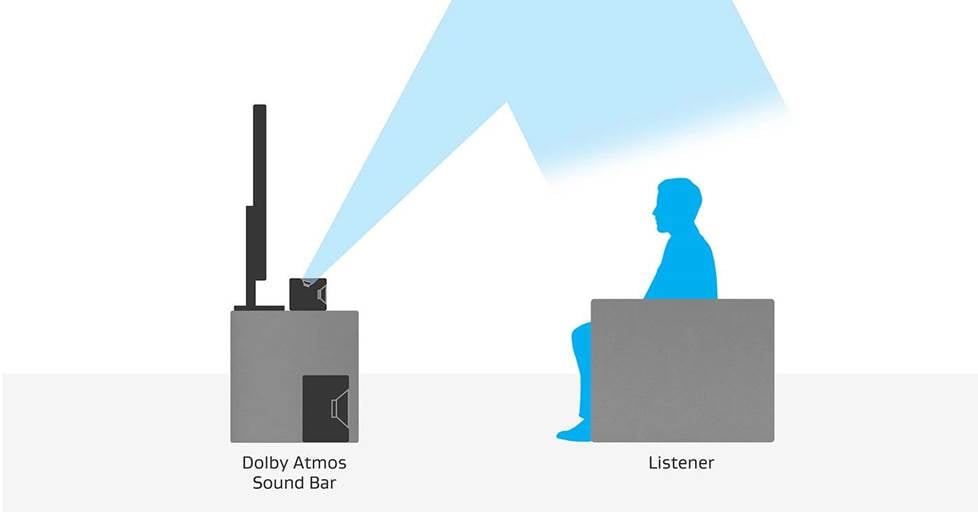
The higher bandwidth of eARC will let you pass a full, uncompressed Dolby Atmos signal for greater sonic detail and immersion.
Setting up with ARC or eARC
Getting started with an ARC or eARC connection is as easy as "1-2-3" and you only need the one HDMI cable.
- Make sure you've got the same type of HDMI port on both ends: ARC to ARC or eARC to eARC.
- Plug in your HDMI cable to your TV's ARC or eARC port.
- Plug that same HDMI cable's other end into your receiver, sound bar, or other device's ARC or eARC port.
Most devices automatically recognize when you're plugged into the ARC or eARC port. The story ends there. But if you have an older TV, you may need to hop into your settings and manually switch to ARC mode.
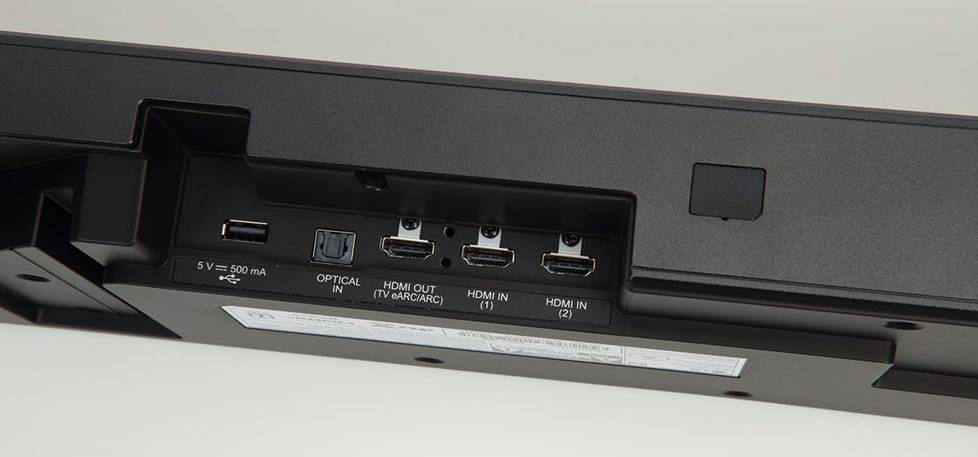
Plug in your HDMI cable to the HDMI ARC or eARC port on the back of your sound bar and match it with the same port on your TV or receiver. It's that easy!
Do I need a new HDMI cable?
That depends on what version cable you have. Version 1.4 or higher is good enough for ARC. But you'll need Version 2.1 for eARC.
We can help!
Still have questions or just need a little guidance finding exactly what you’re looking for? You can always get in touch with one of our friendly Advisors. And don't forget free lifetime tech support is included with your Crutchfield purchase.




Allan McConnell from Abingdon
Posted on 3/12/2026
I have a new Samsung 40" F6000FF SMARTTV. My wife is hard of hearing and NEEDS the TV EARS device that we use on all other TV sets. Except, Samsung tells me a convdntial HDMI Audio Extractor is incompatible with this tv model. Would an ARC HDMI Audio extractor be compatible and enable sound to our TV ears? Where can I buy one, I'd so?
Colin M. from Crutchfield
on 3/13/2026
Mark from Palm City
Posted on 10/4/2025
Extremely informative and helpful article.
Colin M. from Crutchfield
on 10/7/2025
Rodney May from Albuquerque
Posted on 11/9/2023
I recently reconfigured my A/V setup and have a question. I have all of my devices now connecting via HDMI to a Denon AVR-3313CI which then feeds my Sony XBR-55A8H TV. Something is triggering my system where the Xfinity Arris XG1v4 cable box, A/V receiver, and TV turn on randomly both day and night. Sometimes the systems stay on, sometimes they come on and turn off in a minute or two. I Googled the issue and found that there are similar reports, but I have tried all the "fixes" with no luck. Xfinity tech support leaves a lot to be desired, so I thought I would reach out to Crutchfield to see if you have some thoughts on how to fix the issue.
Colin M. from Crutchfield
on 11/11/2023
Kent from Citrus Springs
Posted on 9/18/2023
So will a directional HDMI cable work for ARC/eARC? I have an 8K/4K directional HDMI cable. If it is directional, then I'm thinking it won't support ARC/eARC???
Colin M. from Crutchfield
on 10/5/2023
Ryan from Redding
Posted on 9/13/2023
I have a December 2021 bought LG OLED 83" model# OLED83C1AUA TV. I have my cable box connected to the TV's HDMI #1 input using a HDMI 4K cable. My Sonos ARC sound bar is connected to the TV's HDMI #2 eARC/ARC IN input, my Roku is connected to the TV's HDMI #3 input, and my Firestick is connected to the TV's HDMI #4 input. I also have a Sonos One (gen2) and a Sonos One SL for my surrounds, and a Sonos Sub (gen 3) connected via a Wi-Fi connection. I am trying to figure out the best setup and why my TV's AI Sound Pro with Dolby Atmos settings are greyed out.
Colin M. from Crutchfield
on 10/5/2023
Charles
Posted on 7/26/2023
I strongly suggest you look for a certification label on your cable package. For 8K You want the ULTRA Certified Cable.
Adina Hirschmann from Bergenfield
Posted on 7/4/2023
I purchased a new Onkyo Tx-RZ50 from your Ebay store, got the speakers all set up with Dirac Live successfully, established my zones, usiing the preamp connection for one of them, but having ARC handshake problems with my Vizio D40-D1 HDTV, despite enabling CEC and Device Discovery showing AV Receiver, although faintly. Still, no TV audio coming through my receiver. I am using an active hybrid fiber-optic/metal cable I bought on Ebay. Could the cable have been too long? I overestimated slightly when measuring my room. Please help.
Colin M. from Crutchfield
on 7/5/2023
Jared Stein
Posted on 4/19/2023
Hello I have a question, I have a Sony BPD-S570 Blu-Ray player (old) hooked to a new Yamaha AVENTAGE RX-A6A receiver via HDMI and then the receiver hooked to a new LG 65QNED80 TV via eARC/ARC. The issue is I get a picture from the Blu-Ray player but no sound? I have tried every type of different settings on the TV/receiver/Blu-Ray player and noting works. On a side note, if I use the same setup and plug the reviewer into a different HDMI port on the TV (not eARC/ARC) everything works fine. Any ideas on this issue?
Colin M. from Crutchfield
on 4/20/2023
Jack from Atlanta
Posted on 4/9/2023
I was using eARC on my 58" Vizio to a sound bar but kept getting some flashing along the bottom of the screen lately so switched to using an optical connection and now the flashing is gone. Not sure if it was the ARC causing it or not.
Colin M. from Crutchfield
on 4/20/2023
Dave
Posted on 3/19/2023
Why wouldn't I just connect all of my sources into my receiver and run audio/video HDMI out from said receiver to the tv? I don't understand how eARC benefits when using a receiver, many with upwards of 8 HDMI inputs. Cable box, Blu-ray player, Apple TV, ps5, Xbox, Nvidia shield, home theater pc, etc.just connect every one of these into the receiver inputs and one output to the tv.
Colin M. from Crutchfield
on 3/21/2023