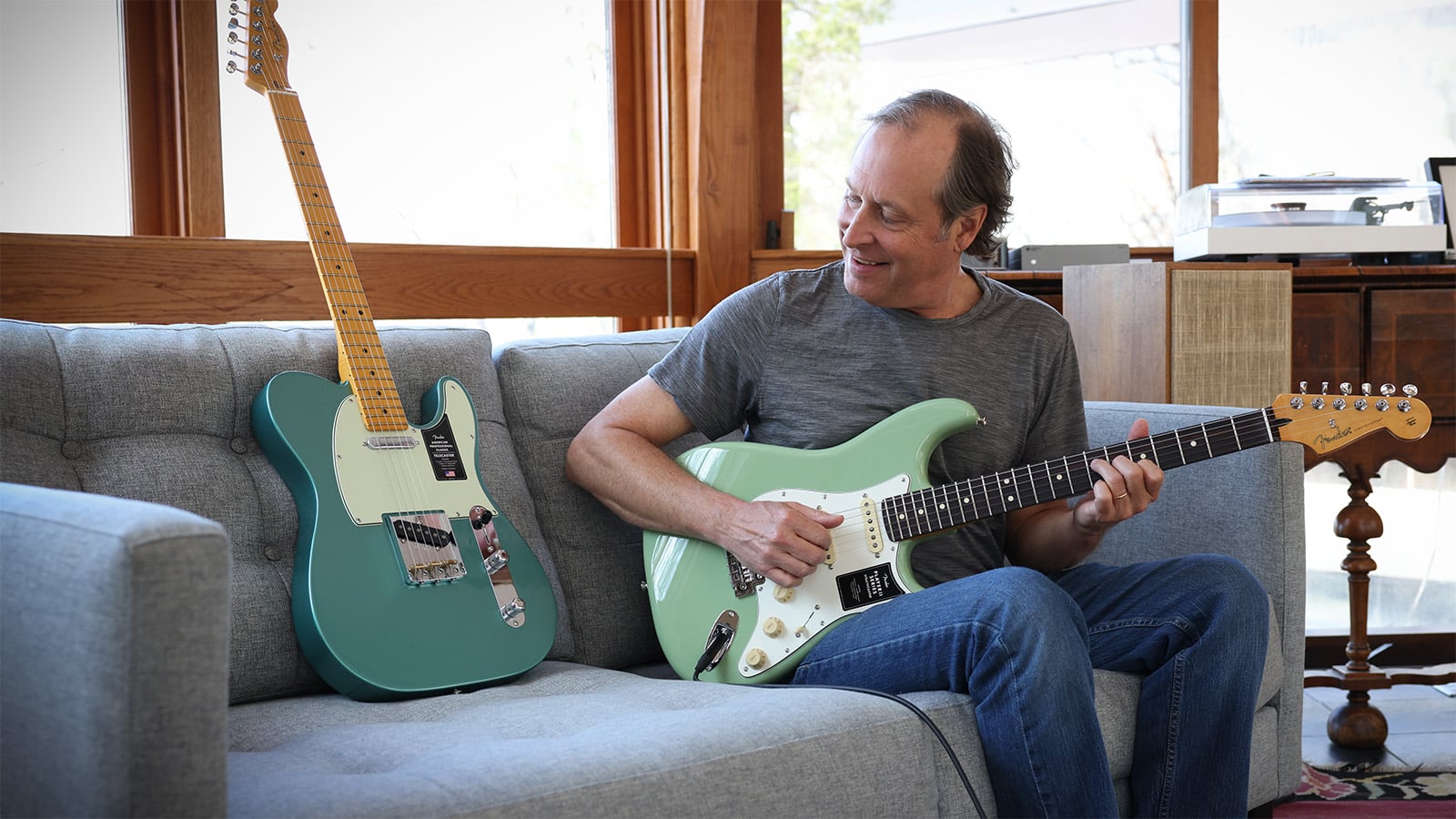
Fender Stratocaster vs Telecaster
How to choose between two of Fender's — and the world's — most popular electric guitar designs

Once you begin to recognize the characteristic sounds that Stratocasters and Telecasters can make, it's like turning on the light in a dark room. Both models played a huge role in so many classic recordings. But is one better than the other?
I'm not sure I can answer that question for anyone — not even for myself. But I can describe the essential qualities of each — and their chief differences — so that you can hopefully understand more than I did when I first ogled them in music store displays.
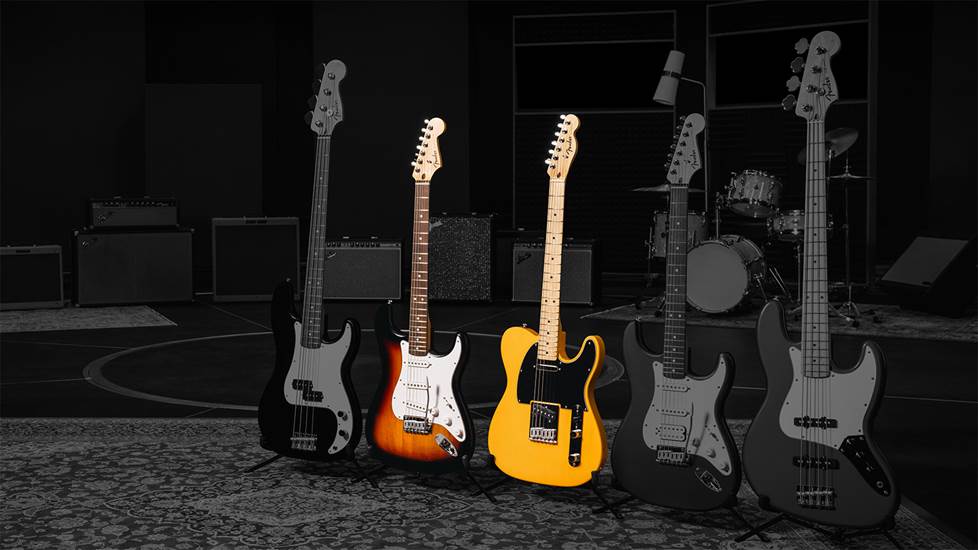
Once you learn to hear the subtle but distinct tones Strats and Teles produce, you'll recognize their sonic fingerprints all over vast swaths of recorded music.
Essential electric guitar tones
My first guitar hero was Jimi Hendrix. I was probably in fifth grade when I first heard his version of "The Star-Spangled Banner" on my parents' Woodstock album. Playing a white Fender Stratocaster, he dive-bombs, strangles, and coaxes tones that swing wildly between bell-like clarity and siren-like chaos, and — unbeknownst to me at the time — are always recognizable as coming from a Strat.
It wasn't until I was in college in the late '80s that I discovered a very different type of guitar hero, one who played a Telecaster. Danny Gatton's performance was full of showmanship — playing slide with a full beer bottle, pouring beer on his fretboard, playing guitar with the towel he used to dry the neck draped over his fret hand.
But it was his precise, polyphonic, rockabilly-rooted playing technique and his sparkling yet raw Fender Telecaster tone that blew my mind.
At that point I was mostly a bass player, but getting into electric guitar. I bought my first Fender electric — a '65 Mustang — around 1991. Since then, I've owned several Stratocasters and Telecasters on a quest to capture some of the tones that first turned me on to the electric guitar.
Leo Fender's timeless, revolutionary designs
It's no stretch to say that in the first half of the 1950s, Leo Fender — along with a strong team and plenty of trial and error — introduced two of the most innovative and enduring electric guitar models.
It was a time of great innovation, bred of American ingenuity applied to a problem that had plagued electric guitarists since the earliest hollow-body models of the '20s: feedback, the offensive howl produced when the guitar's amplified sound loops back into the microphonic pickups.
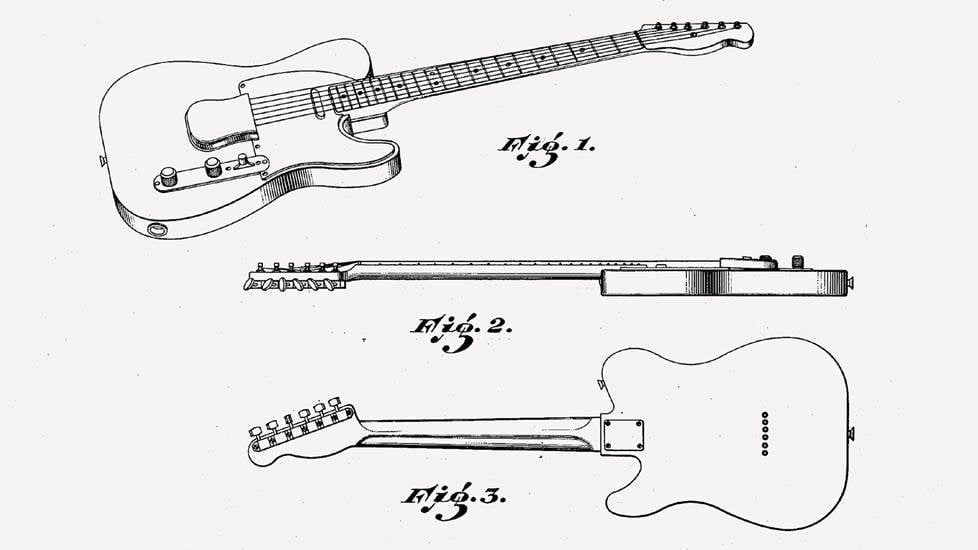
The release of the Telecaster in 1951 changed the sound of popular music.
Taking inspiration from Hawaiian-style, solid-body lap steel guitars, Fender developed single-pickup prototype Snakehead and Esquire models. Then came the Broadcaster, which added a second pickup in the neck position, and became the Telecaster we know and love in 1951.
The Tele was tough enough for the road and studio, with solid-body immunity to feedback, and a modular construction including the all-important bolt-on neck that made it easy to maintain and modify.
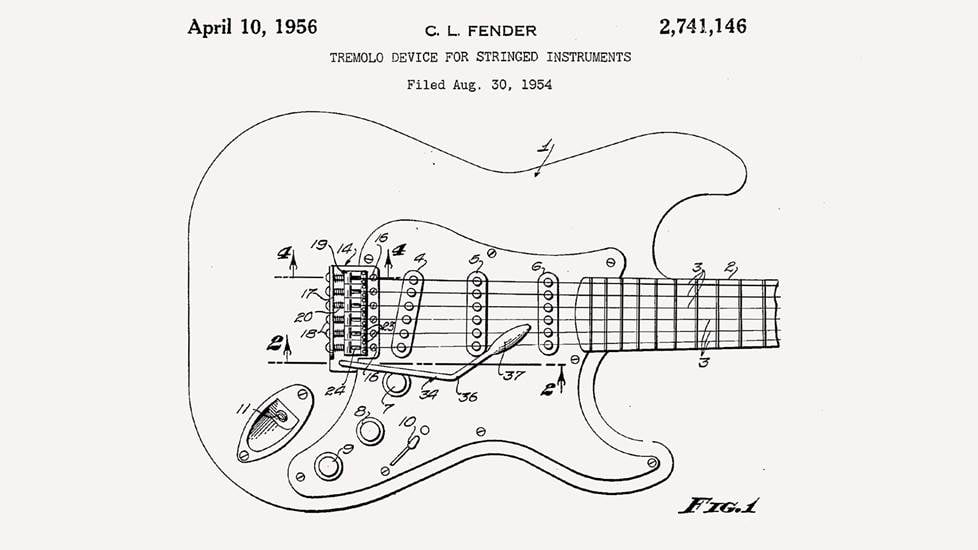
The Stratocaster's ergonomic form and innovative tremolo help make it a benchmark of electric guitar design.
Then in 1954, Fender introduced the Stratocaster. Its contoured body and three-pickup design made it more than just a refined Tele. And its revolutionary tremolo bridge put it in a class of its own.
It took a while for both models to catch on. But here we are over half a century later, and players all over the world still gravitate toward these classic designs — and still argue over which one is best.
Early examples of both models featured a one-piece maple neck. From the late '50s on, Fender also used maple necks with rosewood fretboards. Modern models use other woods like Indian laurel and pau ferro for the fingerboards.
And from the beginning, each model has retained its own signature headstock profile, though both have the six-in-line tuners on the top side of the headstock.
Telecaster or Stratocaster?
Fender has produced many versions of both models, some of them quite different from the traditional designs I'm talking about in this article. Whether you're an experienced player or a beginner, if you haven't tried a Stratocaster or a Telecaster, you've got a lot to look forward to. Read on to learn more about the defining characteristics of each of these iconic models.

Apples and oranges: different bridges and electronics help define each model's unique, iconic range of tones.
On guitar forums, I see players asking the community how they can get such and such a classic guitar tone. Often, the answer is "get a Telecaster (or Stratocaster) and plug directly into a cranked Fender tube amp."
That's also a great way to explore the essential tones of both of these iconic guitar models. There's a lot to work with just using the pickup switching, the volume and tone knobs
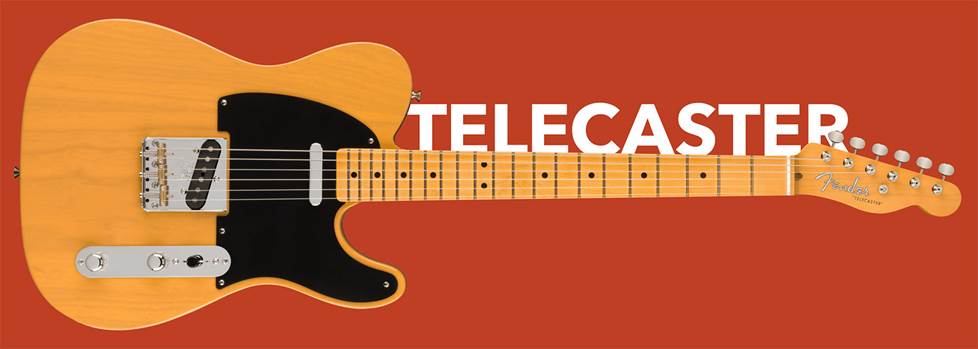
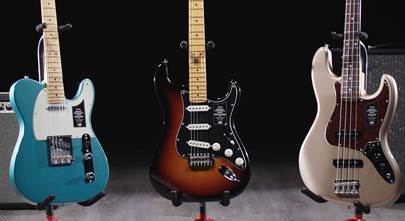
Telecaster
- single cutaway slab body with smaller headstock
- two pickups with 3-way switch for neck, bridge, and neck+bridge
- fixed bridge for tuning stability and easy setup
The Telecaster's body is a guitar-shaped slab of wood — usually ash, alder, or pine — with a single-cutaway that gives you easier access to the higher frets. It has two pickups with a three-way switch, master volume and tone knobs, and a fixed bridge.
The Telecaster's bridge is a metal plate screwed directly into the body. Except for some more rare "top-load" Tele bridges, the strings pass through holes in the back of the body before making a right-angle turn to pass over the string saddles. This gives the strings a solid feel and a more fundamental tone.
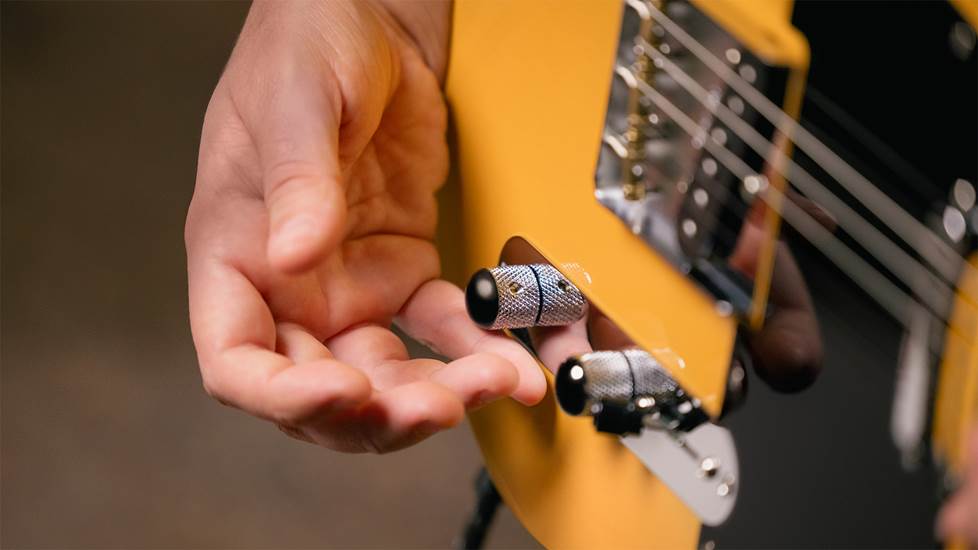
The Telecaster's streamlined electronics make it liberating in its simplicity.
A prototypical Telecaster has two single-coil pickups and a three-way switch. The neck pickup captures the string at a point where it vibrates more compared to the point where it passes over the bridge pickup. It delivers warmer, bassier tones.
The bridge pickup sounds twangier and more trebly, but retains some thickness due to the way it's mounted within the bridge.
With both pickups on, you get an ear-pleasing blend that sounds smooth and clear.
Setup tips
With its fixed bridge, the Telecaster is easy to set up. You'll find some that have three-saddle bridges like the original models and some with six saddles.
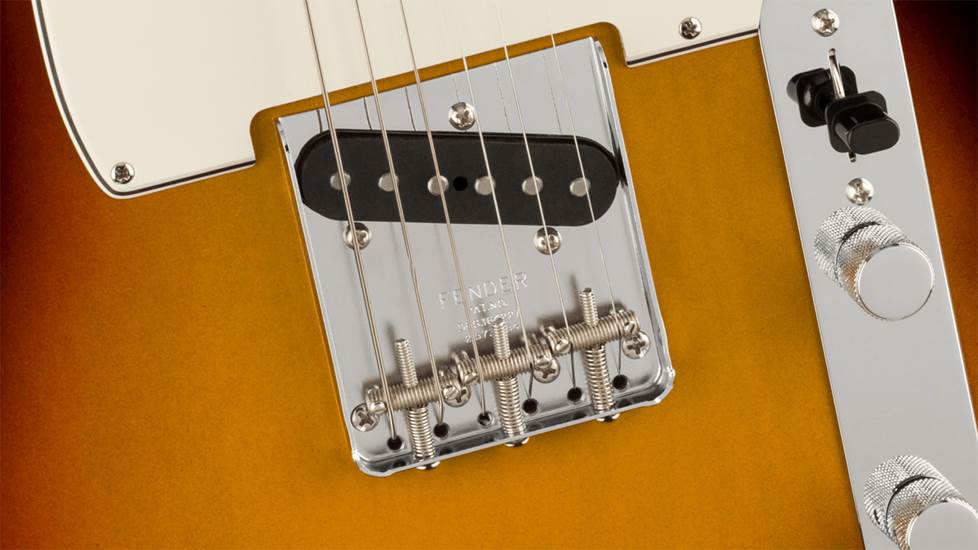
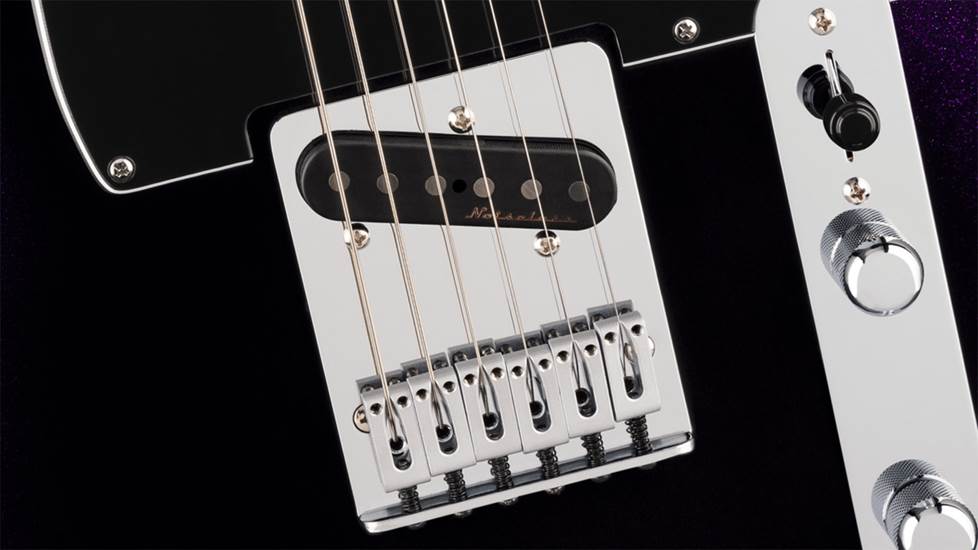
A three-saddle bridge is more traditional but some players prefer the precise intonation you can get from a six-saddle bridge.
You can change the height of the string saddles to raise or lower the action and change their length to fine-tune intonation with common allen wrenches — most new Fenders include them with your guitar — and a screwdriver. Just remember to loosen the string tension before you make any adjustments to avoid stripping any screws.
Six-saddle bridges intonate more perfectly than three-saddle models, since you can adjust the length of each string individually. Some three-saddle models use compensated saddles that improve intonation — that's what I use and I find it pretty easy to get mine close enough for rock 'n' roll.
In fact, I prefer the three-saddle for the way it transmits a solid, fundamental tone. I’ve never had trouble dialing in the intonation — after all, the finest acoustic guitars do it with just one saddle. Working with three is a walk in the park.
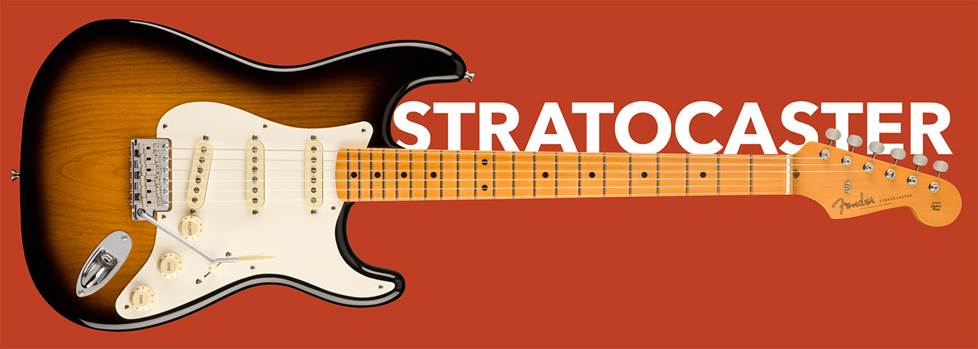
Stratocaster
- ergonomic contoured double cutaway body with larger headstock
- floating tremolo bridge lets you use whammy bar to raise and lower pitch
- three pickups with 5-way switch for neck, neck+middle, middle, bridge+middle, bridge
The Stratocaster has an ergonomic, contoured body with double cutaways for a really comfortable feel and excellent access to the higher frets. Strat bodies are usually made of ash, alder, or poplar wood.
The Stratocaster's bridge "floats," pivoting on either six or two fulcrum points that lets you use the tremolo bar (or whammy bar) to raise and lower the pitch. This makes the strings feel more dynamic and springy and gives the Strat a lively, airy tone.
A prototypical Strat has three pickups with a master volume knob and two tone knobs — one for the neck pickup and the other for the middle and bridge.
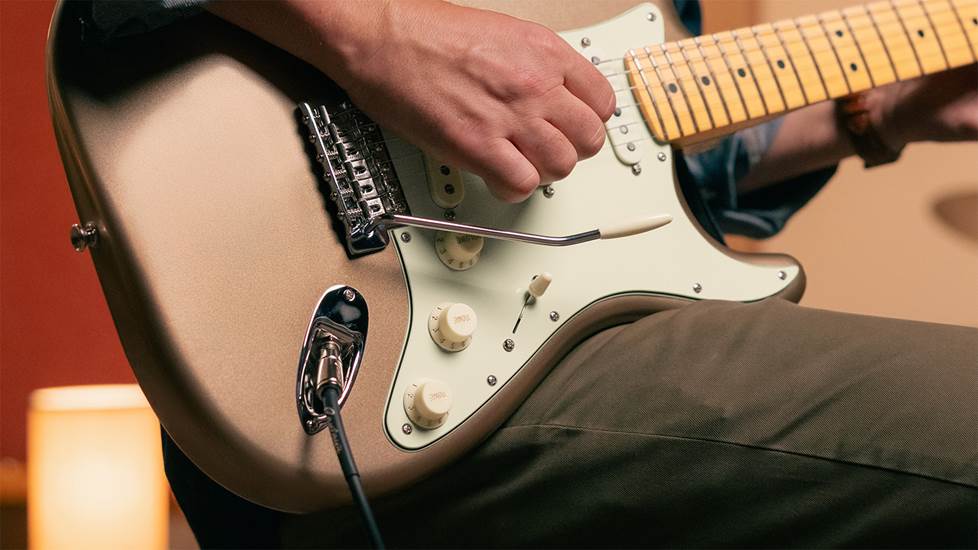
With three pickups and a floating tremolo system, the Stratocaster offers an exceptionally expressive range of tones.
The first Stratocasters had three-way switches with one position each for the bridge, middle, and neck pickups. Players figured out that they could get funky "quacky" tones if they wedged the switch between the middle+bridge or middle+neck settings.
Most Strats since the late '70s have five-way switches that integrate those tones. Mark Knopfler's tone on Dire Straits' "Sultans of Swing" is a great example.
On their own, the neck and bridge pickups on a Stratocaster sound similar to the ones on a Tele. Some players characterize the Strat neck pickup sound as glassy. The bridge pickup tone is trebly, with less thickness than a Tele's.
The middle pickup has its own sound — viola-like, balanced. Most Strats don't have a setting for neck and bridge pickups together like the Telecaster.
Stratocaster floating tremolo bridges
The Strat bridge assembly rests on fulcrum screws. It's kind of like a see-saw, balanced by the strings on one side, and a set of springs — hidden in the back cavity of the body — on the other.
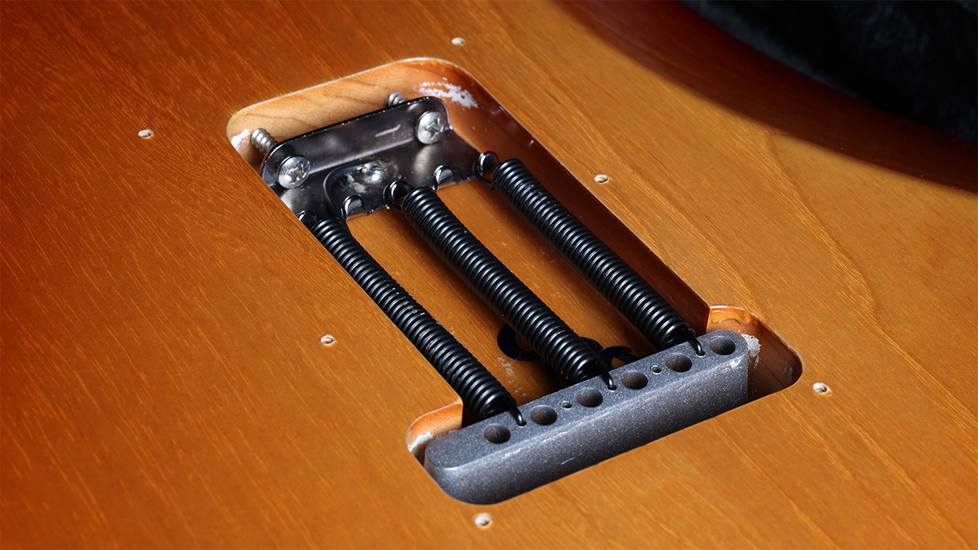
The Strat's adjustable floating tremolo system — shown with the back cover removed — helps define its tone.
The bridge assembly includes a metal tremolo block that extends into the back cavity. The tremolo springs stretch between the block and the claw, which is screwed into the top of the back cavity. You can tighten the claw screws to increase or decrease the vibrato tension.
Stratocaster setup tips
Fender ships most Stratocasters with the bridge "floating." If you look at it from the side, you'll see that the bridge sits at an angle, with the bottom edge 1/8" off the body. This lets you use the whammy bar to pull notes sharp or push them flat.
Some players fine-tune their tremolo to reach specific notes when the whammy bar is pulled all the way up. For example, studio veteran Carl Verheyen sets his Strats up to reach a minor-third upwards bend on the G string, a whole-step bend on the B string, and a half-step bend on the E string. That lets a player use the bar in a very musical way — listen to some Jeff Beck to hear what I'm talking about.
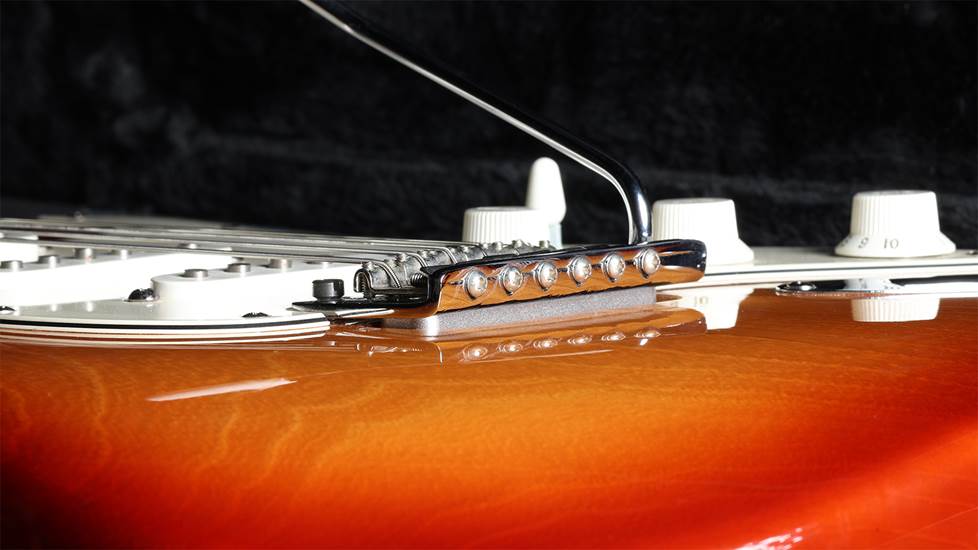
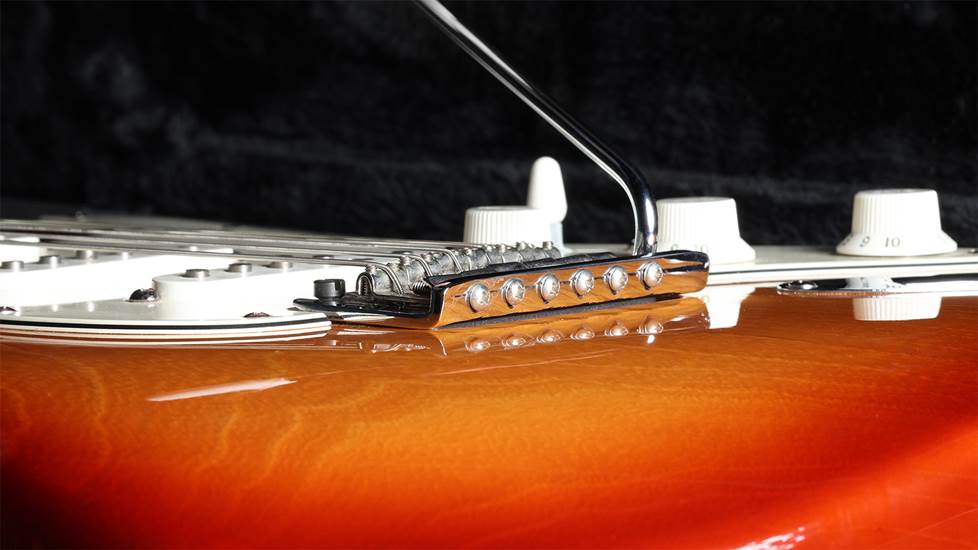
You can pull notes sharp or push them flat with a floating tremolo. With the spring claw screws tightened to "deck" the bridge, you can only push them flat.
I've got my Strat's bridge set to float about 1/16" off the body for a tighter feel — just a little wobble up and down — when I use the bar. Some players like to adjust the springs even more tightly, to "deck" the bridge flush with the body. This increases tuning stability and helps keep bends and double stops more in tune. With the bridge decked, you can only push notes flat with the tremolo bar.
Eric Clapton is famous for "blocking" his Stratocaster's tremolo — which involves decking the bridge and adding a wedge in the back cavity to completely immobilize the bridge, for maximum tuning stability.
Strats also use a six-saddle bridge, so you can get a very precise string action height and intonation length for each string. Loosen your string before adjusting to avoid stripping any screws.
Troubleshooting
Floating Strat tremolo bridges are known to be temperamental with regard to tuning. But I've found that when you have it dialed in, it's one of the most tuning-stable setups.
Most guitars are susceptible to changes in temperature and humidity. Wood moves as the weather changes. I've found that in my collection, the floating bridge Strat handles those changes slightly better, which I attribute to the fact that tuning is held in place by metal springs rather than wood.
Still, even the most stable floating bridge Stratocaster will go drastically out of tune if you break a string.
A lot of tuning problems players encounter are caused by pinching at the string nut. This can be particularly pronounced on Strats. Vibrato bends move the string through the nut, and it can get stuck a little sharp or flat.
Sometimes you can solve that problem with a bit of graphite or other nut lubricant. If that doesn't help, you may need to file out one or more of the nut slots — or get a professional luthier to do it.
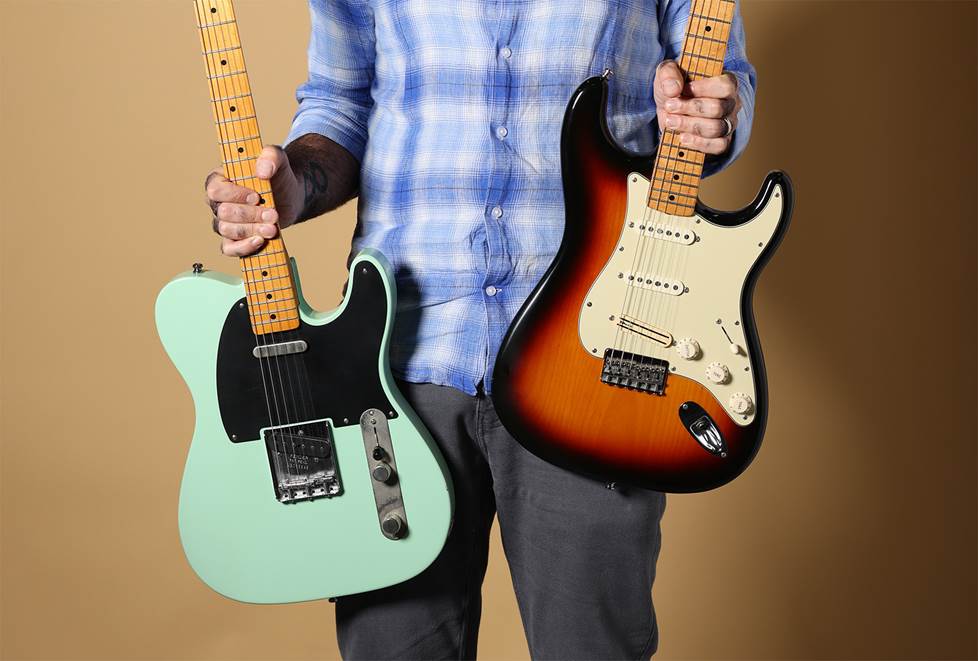
For a huge number of professional and amateur guitarists, it's not either/or. It's both.
Which one is right for you?
The correct answer for a lot of players, including me, is: both. Their designs and sounds are seminal, and different. One can't replace the other.
If you're a beginner, the Telecaster is easier to set up and play, thanks to its fixed bridge. I almost always choose mine for gigs because it's rock-solid and tonally versatile while liberating in its simplicity.
That said, if the Stratocaster appeals to you and you've got the drive to make it work, go for it. Just be ready to accommodate the tremolo bridge. That means adjusting it to your taste or having a luthier do that for you. If you leave it floating, you'll need to be mindful that any pressure you put on the bridge with your picking hand will alter your pitch.
Also, tuning a floating-bridge Strat is always a little more fiddly, because changing the tension on one string can affect all of the others. You might have to fine-tune each string two or three times. But...
The range of tones and the freedom to bend notes up or down with the whammy bar makes the Stratocaster irreplaceable in certain musical situations.
Yep: it'll have to be both.
Guitar insights from our experts
Want to dig a little deeper? Our music pros can help you choose the right guitar and answer any questions you have about the different Stratocaster and Telecaster models, or about any other Fender gear we carry. Give one of our Fender Advisors a call at 1-800-315-0443 or contact us online. Free lifetime tech support is included with your Crutchfield purchase.




Comments (0)