Which amplifier class is the best?
How Class D amplifier technology differs from Class A and AB

What is amplifier class? The way an amplifier combines power and signal defines its Class. Which class is best depends on your needs:
- Class A design is the least efficient but has the highest sound fidelity.
- Class B design is a little more efficient, but full of distortion.
- Class AB design offers power efficiency and good sound.
- Class D design has the highest efficiency and smallest footprint. It's the modern marvel of audio amplification.
And be sure to watch our video, down below.
We use a few car audio references below, but the amplifier design principles are the same for all audio amplifiers — car, home, and portable gear.
Amplifier basics
Typically, a car amplifier works by taking the 12-volt DC power coming into the amp, turning it into AC, and increasing the voltage via a transformer. Then it combines that high-voltage power with the audio signal coming from the stereo to create a high-voltage, high-current output version of that weak input signal.
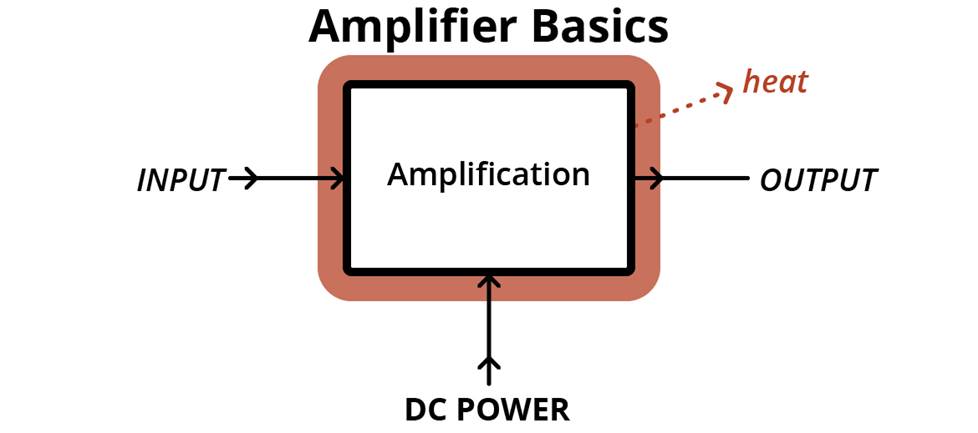
Amplifier Class is the system for combining power and signal. Amp class differs from amp to amp with efficiency and sound fidelity dependent on which design gets used. In all designs, banks of output transistors, each a little amp by itself, add their collective power together to provide the amplifier's final output.
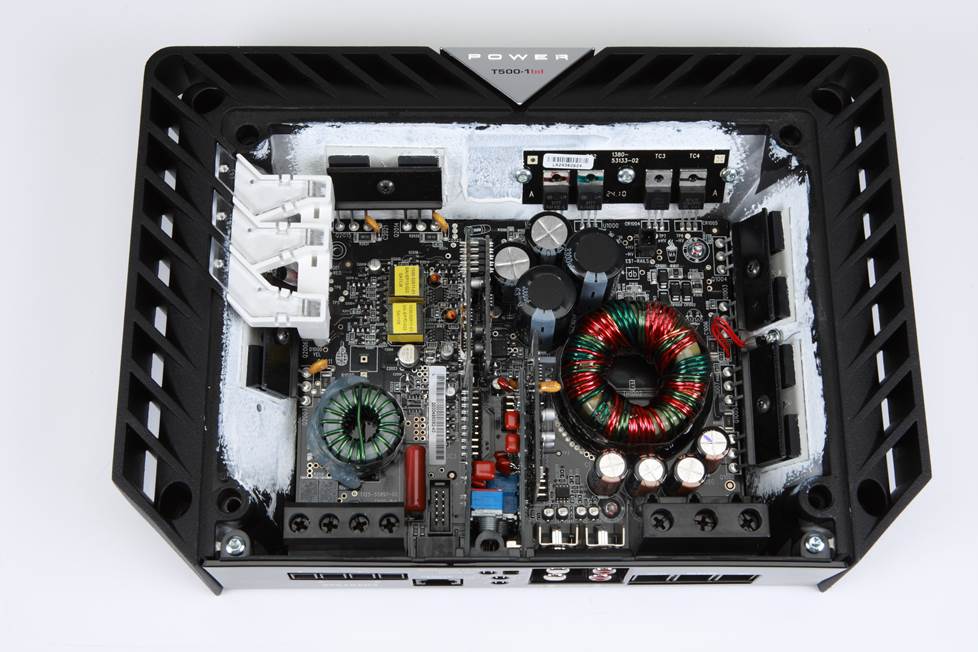
The inside of a Rockford Fosgate T500-1bdCP showing the transformer (the coil of red and green wires) and output transistors (black rectangles glued to the heatsink with white thermal paste).
Heat is the enemy
Amplifiers always put out less power than they consume. An amplifier's efficiency is the ratio of what it puts out divided by what it draws from the electrical system. No amp is 100% efficient, putting out exactly what it draws, nor can an amp put out more power than it draws. The power that doesn't make it to the output terminals is wasted energy that turns into heat. Too much heat will destroy the amplifier's output signal and internal components.
The different amplifier classes produce different amounts of heat. See each class description below.
Watch the amplifier classes video
Amplifier classes — what's the difference?
There are different ways to design an amplifier and heat is the enemy. Got it. Now let's talk about the different classes of amp design.
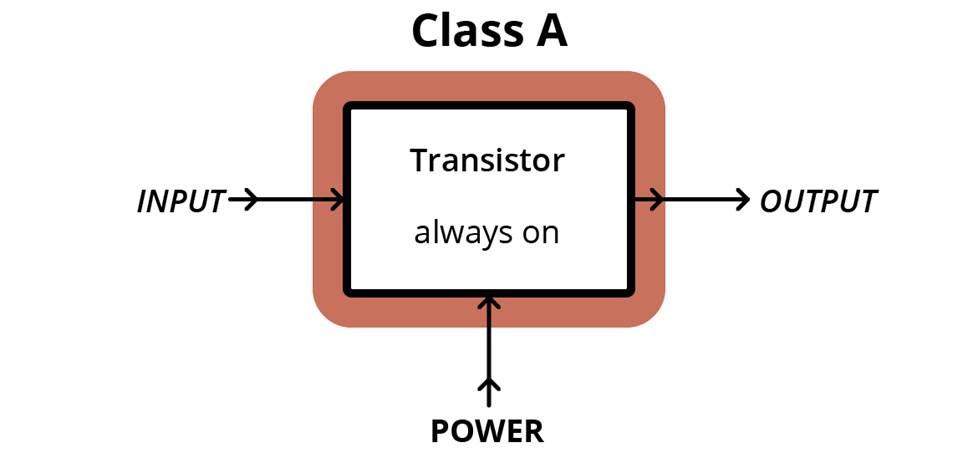
Class A amplifiers — the high-fidelity heat source
A Class A amplifier's output transistors run with "constant bias," meaning they always run at full power whether there's an input signal or not. When there's no signal, the transistors' power turns into heat. When there is a signal, the power goes out the speaker terminals. Also, each Class A output transistor amplifies both the negative voltage and the positive voltage parts of the signal's AC waveform, adding to the workload and generating more heat. Class A amps usually operate around a 25% efficiency level. That means that 75% of their power is turned into heat.
Highest fidelity amplifier Class
Because each output stage transistor is always on, there's no turn-on, turn-off, warming, or cooling cycles affecting the signal flow. In fact, the transistors perform in their most linear fashion, distortion-free, under this condition. And because there're no switching going on, there's no induced high-frequency interference either. Pure Class A amplifiers are rare, expensive, and never used in car audio. You'll sometimes find them in home audio and guitar amps.
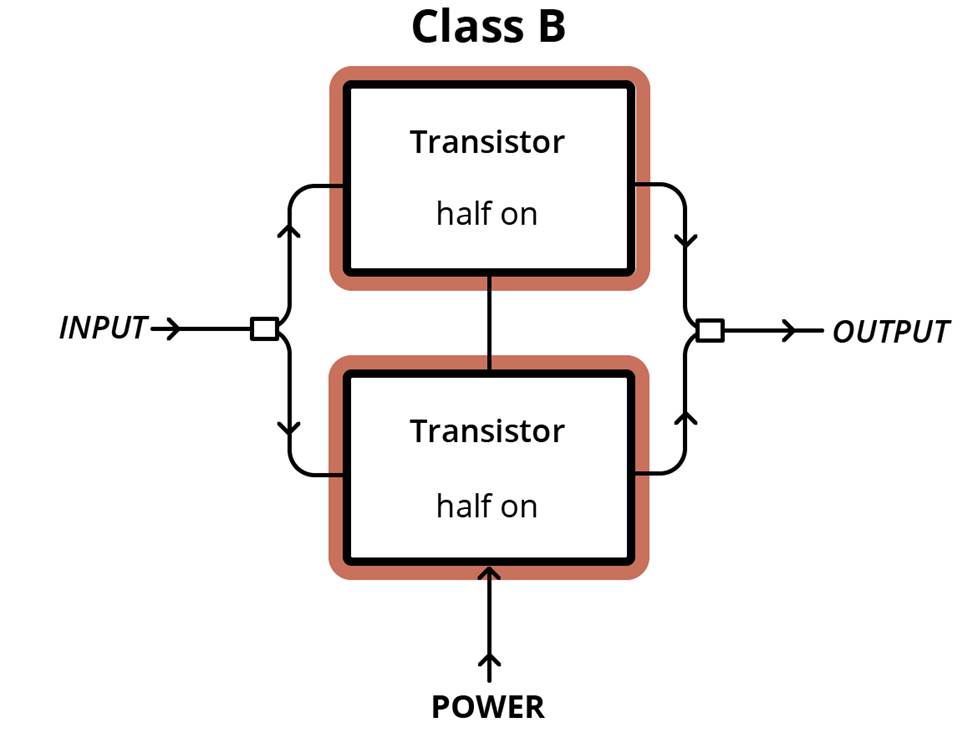
Class B amps — the two transistor solution
Class B amplifiers lighten the workload of each output stage by replacing the single transistor there with two transistors set up in what is called a "push-pull" arrangement. One transistor amplifies the negative voltage parts of the signal's AC waveform and the other takes care of the positive voltage, and then the two are combined into a unified output. Each transistor is on half the time and off the other half.
Efficient with low fidelity
Class B amplifiers are much more efficient than Class A amps — 50% or so — but produce distortion as the two transistors switch on and off. This "crossover distortion" is so bad that very few if any manufacturers offer or produce an amplifier of pure Class B design.
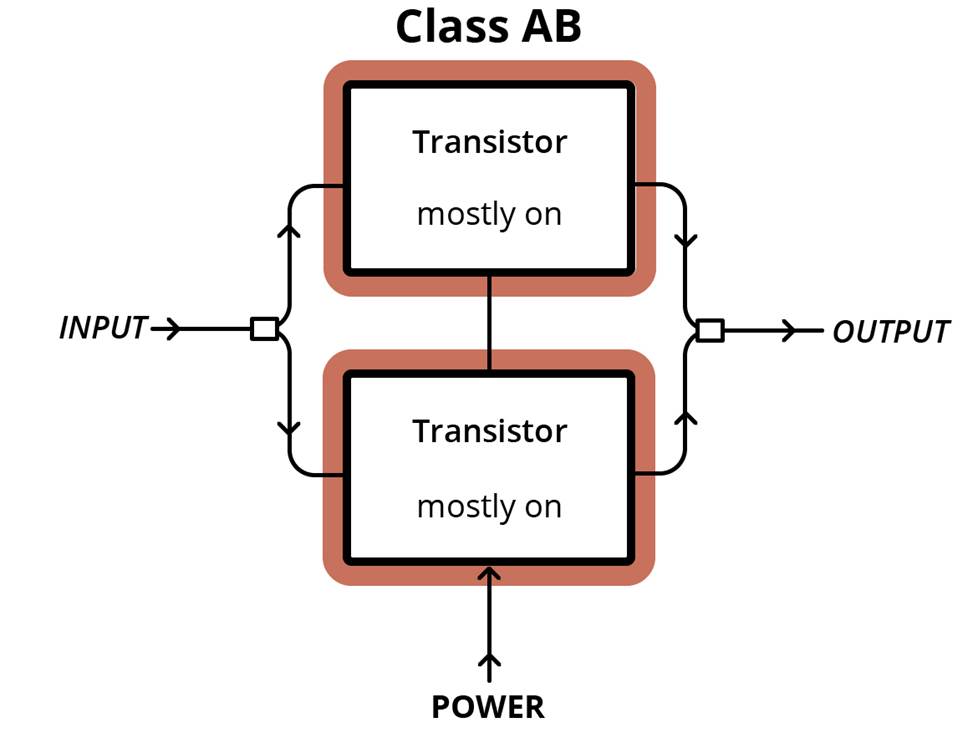
Class AB amplifiers — higher fidelity and efficiency
The push-pull pair of output transistors in a Class AB amp are each on more than half the time, and they don't turn on and off suddenly either. This gives the amp the characteristics of a Class A amp when the signal's at low power and conducting through both transistors, and a Class B amp when the power is high. For each amp, there's an optimum bias current, the amount of time when both transistors are passing current, that minimizes the crossover distortion of Class B design.
Class AB amps are everywhere
The result of this design is that Class AB amplifiers have much higher efficiency than Class A amps, up to about 60%, and much less distortion than Class B amps. Most home theater and stereo amplifiers and many car amplifiers are Class AB.
Until recent years, using an AB amp was the only practical choice for attaining high-fidelity, full-range amplification, but now Class D amps are being built that are just as accurate. (Class A is still the winner for accuracy, though.)
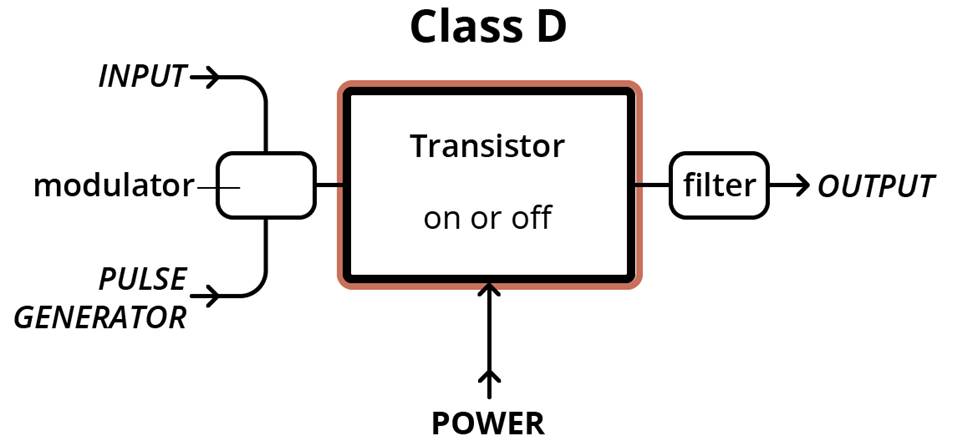
Class D amplifiers — popular kings of efficiency
Class D amplifiers operate in a unique fashion. Onboard circuitry creates very high-frequency (often over 100K Hz) pulses of DC current. The width of each pulse is then modified by the input signal — the wider the pulse, the louder the signal. This is called "pulse width modulation" or PWM. These DC pulses are run through the amplifying output transistors creating the high-power output. Because they are getting DC pulses, not analog signals, the transistors, also called MOSFETs, are either on full power or off with no power. This is the most efficient way of running these transistors — as much as 90% efficient in some cases.
Efficient ... and smooth
After amplification, a low-pass filter smooths the output signal so the amp won't put out pulses of power but rather, a continuous analog power output. It also removes the interference generated by those high-frequency DC pulses.
D does not stand for digital
Although making a signal by rapidly switching transistors on and off resembles digital processing that uses zeros and ones, Class D amplifiers are not digital devices. Some of them might have digital control circuits, but the amplifier circuits will be strictly analog.
Class D has become the go-to choice
When they first hit the market, Class D amps were only used for bass because of the high amount of noise they generated. But that has definitely changed over the years.
Modern Class D amplifiers are popular because they're smaller, lighter, and run cooler than the other Classes of amplifiers with the same amount of power. These are big advantages when you have to fit an amp in a vehicle or carry one around for gigs. You'll even find Class D amps in high-end home audio gear where they're tuned for incredible sound reproduction.
Small size, very little heat, and lots of power. Class D is where the action is.
Other amplifier Classes
There are other technologies used in amplifier output stages, usually enhancements to Class AB design, like Class G, Class H, Rockford Fosgate's Boosted Rail, and Alpine's Dynamic Peak Power. They usually manipulate the amplifier's own power supply in various ways in order to add power on demand more efficiently. Hybrid combinations of all of these technologies can be found in many amplifiers manufactured today.
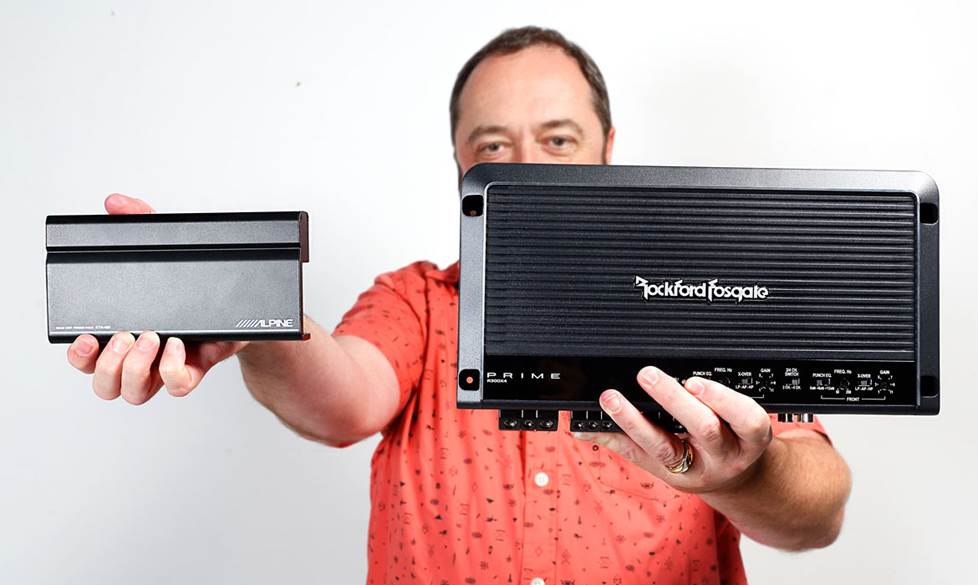
Two 50 watts RMS x 4 amplifiers: the Class D Alpine KTA-450 (left) and a Class AB Rockford Fosgate 50x4 (right). And that's Car A/V web editor Robert FV contributing his expertise.
Confused and looking for an amp? Give us a call.
For today's car amplifiers, you probably won't hear any differences between the different Classes of amplifiers, especially while driving. But it's good to know what those differences are so you can make educated decisions on which amplifier will work best for you.
Check out Crutchfield's entire selection of car amplifiers. Once there, you can narrow your focus by filtering the selection for each amplifier Class. And if you have any questions or want some help, contact our expert advisors via phone or chat.

_mobile.jpg)




Ole Martin from Notodden
Posted on 2/1/2026
hey i have dali opticon 8 mk2 which classs amp should i use? im already using denon x4800h and will be adding a power amp for the opticons
Collins Jacks from Nairobi
Posted on 8/27/2025
Thanks so much
Red
Posted on 6/2/2025
I have 4 kicker l7qclass 12 inch subwoofers...what amp would you recommend i use ?
Buck Pomerantz from Crutchfield
on 6/3/2025
Buck
Posted on 7/14/2024
Uhhhh. Does Crutchfield not carry Yamaha?? Buck Pomerantz from Crutchfield on 11/10/2023 Milton, McIntosh, Arcam, and Denon are three companies that make Class A amps.
Buck Pomerantz from Crutchfield
on 7/14/2024
mitchell
Posted on 5/7/2024
What is a pioneer direct energy class amplifier? Example would be the Elite VSX LX505. Trying to understand what class it compares to.
Buck Pomerantz from Crutchfield
on 5/10/2024
Phil
Posted on 12/13/2023
Very informative and written so most novices can understand. Thank you.
Milton from Berwyn
Posted on 11/10/2023
Very helpful. Who is making Class A amps?
Buck Pomerantz from Crutchfield
on 11/10/2023
Ali Motamedamin
Posted on 11/10/2023
Question pioneer elite went from class D sc-lx801 to class AB in their new vsx-lx805 is there a difference in sound quality I have a. 801 and interested in the 805 but the change to class AB from D is that something I should be concerned about thanks
Buck Pomerantz from Crutchfield
on 11/10/2023
Robert Anthony Watts from Alexander County, North Carolina.
Posted on 10/31/2023
Thanks for your tour de force excellent concise explanatory essay/article. Are you guys really serious about us giving you a call if we're trying to select an amplifier? Also, I really like that the comment form here at Crutchfield's site has such a generous character allocation: I have 1208 characters left! This fact is very accommodating to long-windedness, as usually I always think companies are really simply Not Interested in feedback or comments when the return form limited to 500 like GooglePlay Store's Help Section, or 200 allotted to this Motorola G Stylus' feedback form! Again, thanks for extremely efficiently explaining the difference in amplifier classes: It proves to be very helpful in my hunting online for a 'network receiver' home audio component from Marantz to Wiim different products offerings. Maybe reading more expertise from Crutchfield will really help me make the right selection for streaming, amplifying and listening needs. What do you guys think about differential explanations on DAC microchips? I think I am going to have to look all that up! Thanks Again!
Kevin from Lexington
Posted on 10/5/2023
Hello I read the article but don't know how to tell one class from another I have a pioneer sx-5590 I bought new in 1976 how do I know what class it falls into thank you Kevin.
Buck Pomerantz from Crutchfield
on 10/6/2023