Podcast: Ep 67 Fender basses, guitars, amps, and more
Fender guitars, basses, amps, and more - now at Crutchfield
In this episode:
Fender, the iconic brand of guitars, basses, and amps, is now available at Crutchfield. To celebrate this momentous occasion JR and Huffy (not guitar players) invite some of Crutchfield’s most experienced guitarists to talk about the instruments they love so much. Ned and Charlie have been very busy writing about all the new Fender products but were able to take some time away from their keyboards to join JR and chat Fender gear.
Cory and Rodell then take to the mic to discuss how Fender and Crutchfield are working together to provide the legendary Crutchfield experience for anybody looking for Fender gear. What type of training are we doing? Do we have special Advisors to help our Fender shoppers? What are we carrying and how do we support it all? All those questions (and more) are answered in this episode of Crutchfield The Podcast.
Hello, and welcome to Crutchfield, the podcast. I'm your host, JR, joined in studio by my cohost, Huffy. How you doing, buddy? Doing great.
Happy to be here. Hey, question for you. Hit me.
Was that new intro music? Yes, it was. Wow. All right.
Mm-hmm. We should get into that. We should talk about why we have new intro music? Yeah.
Yeah, we should do that. I think we should. Do you remember last episode when we sort of teased something new coming to Crutchfield? Yeah.
Yeah. I definitely remember that. And we said we'd talk about it on an upcoming episode.
This is that episode, isn't it? This is that episode. Nice. We get to talk about it.
Very good. I got a question for you. Yes.
What's your question? I happen to know that you are not a guitar player. No. Yeah, definitely.
I am not a guitar player. I recognize one if I see one. Not a player necessarily, but a guitar.
Got it. I am also not a guitar player. Okay.
You play drums though. If I asked you to name one brand of guitar, what would it be? Fender. You could name Fender.
I could name Fender. You've heard that name. Yes.
Yes. You know that's a brand of guitars. Yeah.
Cool. I also happen to know you're a big Jimmy Buffet fan. I am the best guitar player ever.
Clearly. Okay. That's a take.
That's one take. That's not. Wow.
Yeah. No. Bold statement.
I'm kidding. Okay. I'm kidding.
What kind of electric guitar did Jimmy Buffet play? I have a feeling you're going to tell me Fender. Fender is correct. Okay.
Okay. I see a theme here. Yeah.
Tell me, to keep going with this theme, tell me what kind of guitar do you think the following guitar players played? Jeff Beck, Eric Clapton, David Gilmore of Pink Floyd, George Harrison of The Beatles, Jimi Hendrix. I think maybe. I've heard of him.
Yeah. Yeah. Yeah.
He was a big time. Yeah. Yeah.
He was pretty good. Kind of a big deal in the guitar world. Very much so.
Buddy Holly. Yeah. Mark Knopfler, you know, Money for Nothing.
Yeah. Yeah. I know Mark Knopfler.
Yeah. Yeah. Yeah.
Stevie Ray Vaughn also. Definitely. Yeah.
What kind of guitars did those guys play? I have a feeling you're going to tell me Fender. That's correct. As of today, Monday, October 27th, 2025, the day this podcast drops on the world, people can now buy Fender guitars and basses and amps and all the other stuff here at Crutchfield.
That's awesome. That's kind of a big deal. That is a big deal.
That is a big deal. I'm actually surprised. I didn't know it was going to happen.
I knew it was going to happen. I'm still excited and kind of surprised to be honest. Yeah.
This isn't just like another brand of home speakers joining our mix or a new brand of smart home gadgets, right? Where we add that to the mix of a whole bunch of different brands of stuff. A new subwoofer brand, right? We do that all the time. No, this is like a totally new category of products that, I don't know, it kind of takes Crutchfield to like a whole new level.
I totally agree. We've been here for 50 years helping people like play music in their homes, in their cars and on their headphones, right? Wherever they want to listen to music, we can help them play music. You're going to say that now we can help them make music.
That's exactly right. That's cool. Yeah.
Yeah. Yeah. It's not just the ability to play music that other people created.
You can now create it with stuff from Crutchfield. That's cool. And we're jumping in with both feet into the world of music creation, right? Not just playback of music.
Now we can help people create music of their own. We can help them record it and or play it live for an audience with all of our pro audio gear. And then once they've recorded it, we can help them enjoy it at their homes, in their cars, in their headphones.
It's the circle of life for music. We are now in every part of that circle. That's awesome.
So with that, how do we do that Crutchfield thing that we do for guitars? How do we help people get the right guitar or bass or amp and all the stuff they're going to need to go with it, like pedals, cables, strings? How do we help them shop on the website? How do we help those that call or chat with us to speak with a live advisor with specifically tuned guitar shopping help? How do we do that Crutchfield thing for this whole new realm of products? That's one of the questions we're looking to answer on this episode of the podcast. There we go. Don't fret.
We have a plan. The guitar puns are coming out. I've got them written into my script and everything.
And you're going to add your own. I love it. How do we make every guitar purchase as emotionally enriching as it can be? After all, buying a guitar might be the most emotionally charged decision any of our customers could possibly make.
So that's quite the challenge. We've got to rise to that challenge. That challenge resonates with me.
Nicely done. Thanks. Nicely done.
Thank you. It strikes me as we talk about this right now that neither you nor I are the right person to answer those questions. Definitely not.
Definitely not. I'm a drummer. I am a musician.
But I'm not a guitar player. A guitar confuses me. Yeah.
I'm definitely not a guitar person. I think we've established that. So we have several people on the show today that can help us all understand why we are now carrying guitars and how we are going to attack this new world of products.
First, we'll bring in two veteran musicians, Charlie and Ned. Together, they own somewhere between 30 and 40 guitars. They lost count.
They couldn't give me an exact number. And these guys are prolific on stage and in the studio. They also happen to be copywriters here at Crutchfield.
So they are the ones shaping the look, the feel, the tone, the way Fender products are presented on crutchfield.com. So we're going to hear all about how they're doing that. Then we'll talk with Corey and Rodel. Corey is one of the many guitarists here at Crutchfield, but most importantly, he's the one that kind of ignited the spark that led to us carrying Fender guitars.
He's the guy that sort of made this happen. We'll hear how all that happened. He and Rodel are also working hard to prepare our customer care center to provide that legendary Crutchfield customer service to our guitar shoppers.
Yes. So, why don't you and I get out of the way and let's let Charlie and Ned put us into their world of guitars, right? Playing them, writing about them, creating the look and feel of Fender at Crutchfield. All right, how many guitars do you guys own? Let's start with Charlie.
I'm at the 25 instrument point right now. I sold a few to buy the NAD amp I just got from my audio system at home. So I'm at an all-time low right now.
Oh, at 25 is an all-time low. What's basses? Includes basses and acoustics. Basses, acoustics, and electric guitars, 25 total.
Yes, sir. All right, Ned. Well, I don't really keep track.
I don't know, but not as many as Charlie. I know that much. I got a bass.
I got an upright bass as well. I got about a half a dozen electric guitars and a couple acoustics, and there's probably a couple other sitting in the closet. You get five points for a stand-up bass, though.
Okay. Yeah, that's next level right there. Ned, tell me more about your history with music.
Oh, I was always interested in guitars, and when I was about 12, I grabbed an old guitar out of my grandmother's basement. It was already a little beat up, and I beat it up a lot and just sort of taught myself. And then ended up, during college, I went to the University of Virginia, and it was a great time to be in bands.
We got to work at the fraternities, work at the bars, work regionally, go play parties in other colleges and places around the region. Best job I ever had, probably, working while being a full-time student. And then after college, played a lot with my brother Will, played a lot with my own band, The Anomanon, and then lately, I don't do much touring lately.
It's all just regional and very, sort of, whenever something cool comes around, I don't really hunt for gigs, because that was my least favorite part of the job. Yeah. It's everybody's least favorite part of the job, I do believe.
You just wait and let the gigs come to you? Yeah. And it's just enough. And I just love to play.
So, you know, unlike Gene Simmons, who said that any rock and roller who says they didn't get into it for the girls is lying, I really didn't. I got into it for the music, and I really still just love sitting around with a guitar. And it's a great antidote to picking up your cell phone and doing something like that.
It's just a great way to think differently. And are you guitar first or bass first? Like, what's your favorite? Learned on the guitar, made the most money playing the bass, but primarily guitar. All right, Charlie, tell me a little bit more.
As if our customers don't know, you've been with Crutchfield for quite a while. 30 years. But tell me more about your history with music.
And I know you also play bass and guitar. What's your favorite, and what's your history? Well, I like bass and guitar equally. I have fun playing both of them.
I don't really care one way or the other. When I was 11, my parents were getting divorced. It was pretty bitter.
So they sent me away to a private school in Connecticut. And I roomed with a guy who played guitar. And I started picking up his guitar and playing when he wasn't there.
And then the next year, we started a band together. And we played all the way through high school. And then we all agreed.
It was a very good high school band, like really, really good. And we agreed we'd all go to the same school. So we all applied to Brown.
And they got in. I did not. So I came down here to UVA.
And I said, well, I'll just go to UVA for a year and then transfer back up. But I immediately was playing frat parties, making the rent money every night. And those guys couldn't find a gig in New England to save their lives.
So I said, I'm staying here. And I'm so glad I did. I got into a band called Rock Luster with Corky Schoonover, a former employee here.
And we were the only band, probably in the state of Virginia at the time, playing Grateful Dead material. So some of the students would come see us. But every hippie within 50 miles would drive their trucks down out of the hill and come to our gigs.
So we had great crowds from the very beginning. And I went on to other bands, the Hawaiians, Captain Toons and his Note Guns, Rock Luster, Skip Castro Band, Hammond Eggs. And I've had a great time.
Yeah, we don't have time for you to continue listing all of the band names. You sure? Didn't even get to the current ones. Yeah, right.
Needless to say, prolific. You guys know guitars. What's your history with Fender? Well, I can start that one.
OK. I was poor when I came down here. And I was playing a Gibson guitar that somebody gave me through my Guild bass amplifier, because that's all I had.
And after a couple of months of playing, this guy that I knew, not that well, but I knew him. He was a friend, came over. And he said, look, I want you to play some decent stuff.
So he loaned me a 53 Telecaster and a 53 Deluxe amplifier, both Fenders, both incredible instruments. So I plugged into that, and my world changed. And then it changed again 18 months later when he came and took them back.
Oh, no. So I had to start scrambling to find Fender instruments and Fender amplifiers that I could play and I could afford. And back then, you could find used stuff, good stuff for not much money.
And people always go, those are the golden years of guitars. But I don't agree at all. I look now, I buy a good used guitar for $300 back then.
I can buy a really nice brand new guitar now for $300. I'm really wild about Indonesian guitars, especially the Fender guitars made in Indonesia. I think they are stunning, playing-wise and sound.
They're really well-made. So I think this is the golden age. And we're going to have a pretty wide range of Fender stuff, right? From the $300 range up into the thousands of dollars range.
And you're telling me that the $300 stuff is solid. It really is. It's more than solid.
It's like you could play gigs with it, no problem. Don't you agree? Yeah. And you would... Well, I can give you my Fender story.
My first Fender was a bass that, unlike you, Charlie, my friend didn't loan it to me. I was playing bass in his band. And he said, it's time for you to get a nicer bass.
And so I went and bought a 74 Jazz Bass. But it only cost a few hundred bucks. It wasn't that much in the early 80s to do that.
But then later, around 1990, I bought a Fender Mustang. 1965 Fender Mustang, obviously used in Orange, Virginia. It aptly had been stripped and painted orange with like house paint.
But I toured. I still have that guitar. I, well, in the last couple of years, put stainless steel frets in it.
But it kind of gets to what I think is awesome about Fender guitars. So I toured with that guitar. Well, that guitar, when I bought it, I told you it has a different paint job.
But it also had a tune-o-matic bridge added to it. It always seemed to be in tune whenever you pick it up. And if you did have to tune it up, it would just kind of be like locking it back in.
It wouldn't be finicky, ever. I changed that tune-o-matic bridge out with a mastery bridge. And that's something about Fenders that I think a lot of our customers might be into, is that you can really get the information you need from the manual and online from Fender on how to work on these things.
It's not rocket science. And they're designed to be worked on by you, the player. So I know nothing about guitars.
I hear people talk about doing the setup, right? So a guitar is not something that you buy from the store, bring it home, and you're done. You just start playing it. There's work to do when you buy a guitar.
Can you sort of go through, like, what types of things do the average Joe, do they need to do to their guitar before it's, like, ready to go? Well, first you make sure the neck is straight, or close to straight. You know, you might want a little bit of a bow in it. And if it's not, you can adjust that.
Or find someone who can adjust it if you're nervous about it. The second thing is adjusting the height of the pickups so that the balance between the pickups is accurate and they're as hot as you want them to be. Closer to the strings, they're louder.
Lower, they're quieter. And then the last thing is the action. You can adjust the bridge pieces so the action goes up or down.
Some people like really low action. Some people like high action so they can get their fingers in, pull the string, you know, really easily. And I think Fender goes through a lot of trouble to kind of send out a nice playable guitar every time.
But it is remarkable how different players want their guitars to be. And if you don't know what you want, it's going to take you a minute to figure out. If you're a new player, you might wonder, you know, can I make this feel different? Fender guitars, they send, you know, in every guitar, you know, they send you with the wrenches.
They pack these guitars with the wrenches you will need to make adjustments. And you might not feel like you want to. Sometimes you get one and it's set up just how you want it to come out, you know, right out of the box.
But it's fun and it's empowering to know that you can make those adjustments quickly. And the last one is intonation. Intonation.
If you pop the harmonic at the octave E, if you pop the harmonic and then push down and contact the string, they should make the same note. If they don't, you have to move the bridge pieces forward or backward until they do. Yeah, you can tell on the string when you touch right in the exact middle of the string, it makes the octave note of the string.
So that's the pure mathematical thing. If the fret that is supposed to be that same note is a little sharp or flat, you can adjust the length of the string to compensate for it and get it exactly right. What kind of things are you guys doing on the website, in videos, in articles, you know, the stuff that we do at Crutchfield to help our customers understand how to shop for guitars? Well, right now we're just writing about them and pointing out, or at least I've just been writing about them and pointing out features that, you know, they may not know about.
I've been mostly concentrating on the vintage twos, which are, you know, more expensive guitars, and they're exact replicas pretty much of guitars from the past and beautiful. And I really want some. I'm gonna ask you more about that in a second.
So you're writing, and we're carrying a lot of guitars, right? How do you write a page about each guitar without just copying and pasting the same text, right? There might be some of that, but you gotta write something special about each guitar, right? How do you do that? Well, you know, you're writing about each model, and then we're putting the different types of different items that are that model on the page with their weight, the different weights they have. But they all have the same features. We don't have that write-up.
But we'll also, if you're asking about sort of different, there are several different Stratocasters from, you know, entry-level Squire Affinity models up to the Vintage Reissues that Charlie's talking about right now, that when you're writing about it, you're trying to capture, like, what is this guitar trying to do? Or as I mentioned, some of them are modified. What are the modifications that make it unique among all the other Stratocasters, for example? But there are also a number of specs that are just, they're constant, that everybody, I think once you start, if you're going to end up playing guitar, and you're going to stick with it, you start to look at these specs differently. And you think about, well, that sounds like a little bit wide of a neck for me, or that sounds like a little bit too curved of a fretboard for me.
So you're looking for numbers, very sort of fill-in-a-field kind of specs. And what I've been trying to do with that is just to narrow it down to a really easy-to-look-at piece of, you know, list of information that lets you sort of really, at a glance, take in all the things that might influence your decision to purchase this guitar, if you already know about it. If you don't know about guitars at all, we're trying to remind you who might, what players you might know of who've used this model, or different sounds you might be able to get out of it, and so forth.
Also, Fender's very good at explaining, to us anyway, when you start at the very lowest level, like the Squier Affinity, what do you get when you step up to the upper-level Squiers, and to the Classic Vibe, and then to the Fender Standard, and on up, you know, they make a change to bodywood or, you know, to something every step up. And, you know, it sounds like everybody thinks, well, Squier Affinity is very low on the totem pole, you know, they can't be that good. But I know of two or three professional guitar players, one who used to play with the Allman Brothers, who uses a Squier Affinity Strat.
So, you know, they're good guitars. It just sort of depends on what you're looking for. And we're trying to help people go, do I really want to spend a hundred more dollars to get this low-level Fender, as opposed to this high-level Squier? That's kind of hard to dope out, and I think we're going to do a good job on that.
So are you writing pages differently for the guitars that are likely to be attractive to, like, a first-timer, like a mom or dad buying it for their kid, their first guitar, versus the, you know, more, the guitars more likely to be sold to guitarists? Yes. Yes, and also no, because as Charlie said, some really experienced and highly skilled players have chosen to use some of these less expensive guitars, and there's going to be an appeal to them as well. And I don't know how to put this, but some kids get a pretty fancy guitar for their first guitar.
Sure, yeah, yeah. And so I think there's a little bit of appeal for the beginners across the board, and there's an appeal for the experienced players across the board, just because of the way Fender approaches what they do. And who are we to stop a parent from buying their kid a guitar that is maybe out of their league? You know, that kid might end up spoiled, or that kid might end up saying, when I was 13, my mom bought me an American vintage reissue, and I will be eternally grateful to her.
Thank you for this Grammy. Yeah. No, I thought you said it was the mom, not the Grammy.
Yeah. Let's talk about amps a little bit. You know, when I hear Fender, I think guitar and bass, of course, as a drummer.
But amps, right? Like, that's where they started, right? Was with amps. What is our selection of amps going to look like? Well, on the tube side, we've got the Deluxe Reverb 65 reissue and 68 custom, and we've got the Princeton Reverb 65 and 68 editions. And I'm trying to think if we have other tube amplifiers in our lineup right now.
But just to, you know, your electric guitar is not nothing without an amp, because in the studio, a lot of great sounds have been made by plugging straight in. Or these days, with the amp modelers that are out there, the interfaces that have these, you know, all the world's virtual versions of the world's great amps, sort of all at your fingertips, plus all the pedals and all the different cab simulations that you could ever want. But for live, still for me, the tube amplifier is supreme.
I love, I've played the Tone Master Deluxe Reverb here in the studio, in our video studio, just to try some guitars in it. And I think it's a great, it sounds so much like a Deluxe. But there's something, there's some level that you can reach to me on the real tube amp version, that those never quite get all the way there.
It usually has to do with the crank, the most cranked settings you could make to me. But I know Charlie would probably disagree. But I still, I prefer the tube versions personally, but have been amazed by the Tone Masters.
But just to come back, you can't do much live, you can't. You really need a guitar amp to make your guitar speak. And so don't second guess it, don't sell yourself short on the amp.
Get a good one, because it makes all the difference. It does. Yeah.
What do you want to say, Charlie? Oh, I just, I've learned that I crank up those Tone Master amps about two notches past where I would a tube amp. Like I run my Princeton on nine, which on most amplifiers would be unholy. And it just sounds incredible.
And it's got the most, in fact, I wouldn't even say it's authentic, sag, what they call it. With tube amps, you hit a note and it's spongy. It like oozes out kind of, and it sustains.
I like now the sound of that spongy sag on the Tone Master amps better than I like the tube amps that I've got. It just sounds great to me, and it's forgiving. And the XLR output on the back of those things is fantastic.
That is a great feature. You can plug, no need to stick a mic in front of your amp. You just plug in the back.
And the first sound man after I bought that amp said, what? No way. I said, well, just try it. Plugged in, he said, all right, bring up the guitar.
And I started playing, went, wow, wow. Never thought I'd see that. And that's important because when you're on a live stage, there's a lot of noise when you're on an electric band.
And even though those mics that they use on a guitar amp, like a Shure SM57 or 58 on a guitar cab are directional, but they still pick up other stuff, whereas the XLR is just a signal. Yeah, super clean right out of the amp. And those, at least the Deluxe Reverb does, I don't know if the Princeton does as well, has a cab simulation.
Just a couple choices. And microphone choice too, yeah. Pretty crazy.
Switching, you know. Is that virtual or is that an actual switch on the back? It's a switch. Charlie, what I know about your job here at Crutchfield, you spend a lot of time thinking about car audio.
Yeah. How does your experience in Crutchfield, you were an advisor, you write, you edit, you work on the 12-volt side of crutchfield.com. How does that experience combined with your music experience inform what you're doing now in writing and thinking about guitars at Crutchfield? Because we're going from selling the stuff that you just play other people's music on in your car and for Ned in the home, right, to now we're on the other side of that coin. The creation of music is now something we can sort of take part in, right, or facilitate for other people to take part in.
Can you speak to that a little bit? It's all about, any product we get has specifications. And it's all about looking at those specifications and translating it into English that a customer can understand. And when new products come out in the car market that are different, we have to sit there just like anybody else and figure out what's going on, what is this for, how is it going to work for people? Is it complicated? Is it easy? It's the same thing with musical instruments.
Who should buy this? Who should buy that? What do you get when you get this amplifier as opposed to that amplifier? It's just answering questions for people, I think. Yeah, I agree. It's like, I think of my job as trying to anticipate what people are looking for and need to know before they make a purchase.
And that when they get it, they don't say, I didn't realize this, because they did realize this because we put it out there. And a lot of times when you look at some other website and look at things, you're looking for what you want to find, but you can't find it. And so I feel like what we're doing here is trying to make the whole, and this is not just us, this is just Crutchfield in general on the website, which is a huge part of where we meet people, to just be like an uncluttered and very sort of focused and clear and easy to look at place where you can learn about what you're thinking about putting your money into and hopefully not sending back, because that's the main thing.
Yeah. Yeah, so you guys, your goal is to put the information out there on the website so that people can make an informed decision and get the right guitar, hopefully the first time. Exactly.
And if they need more help, they can call us, right? And also in this episode, I got a chance to talk with Rodel and Corey, who are really spearheading the effort to make our specialized group of advisors knowledgeable, competent, and able to take that help that you got. You guys are laying the foundation for that on the website. They're going to take it to the next level in a live conversation with a customer.
So I feel like they've got your back, if anything's, you know. Well, I think the advantage for us, Charlie and me for this, is that a lot of times with new stuff, we have a learning curve, because it's brand new stuff. With guitars, there's some new stuff, but these are specs that I think we're both so familiar with, we're looking at it, we're like, oh, it's this.
We have the understanding, and I think that our advisor team that's going to be talking to customers, people who live with guitars, people who work on guitars, people who play them in bands, in clubs, and we have so many musicians working here. When I was taken on the tour by the guy who interviewed me, and we walked into the tech department, and I looked down a row of people, half of whom had guitars in their hands with their headphones on, jamming away while they're talking to the customer. I went, I want to work here.
Playing music in the Charlottesville area, you start to hear about people who work here and hear, yeah, it's a nice place to work, and that's a nice thing to find, is a nice place to work. I found it to be a really nice place to work, but I tried to get the job once before, the same job in 2017, and then one day, I was trading gear with Charlie, and it was during COVID, I remember, because he had a mask on, and it had a big skull grin printed on the front of the mask, and we had just traded, I don't know what, an amp and a guitar or something at my house, and he's like, you know, we're hiring. He's behind his mask with this big skull grin, we're hiring, and I was like, oh, I'm going to apply, and I did, and it worked out, and it's a nice place to be.
I was hired long enough ago that the guy who was interviewing me said, now tell me about your previous work experience, and I said, well, not much to tell. I've never had a full-time job. He said, you're 44 years old, you've never had a full-time job.
I said, yeah, that's about right. He goes, dude, you are so hired. I think that's the perfect way to end this, guys.
Thank you so much for joining me in studio. We've got Ned, we've got Charlie. Just like in the call center, we found the people that are passionate about guitars, and that's who's going to be talking to our customers about guitars, and in our creative department, we found two guys that are pretty passionate about guitars, who will be writing all about guitars.
I'm sure there's videos coming out, right? So yeah, this is what we do at Crutchfield, and I couldn't be more happy that you took some time to join me in our underground bunker podcast studio. Thanks for the invitation. Yeah, thank you.
Thanks for joining me, guys. Have a great one. You too.
So that was my time here in the studio with Charlie and Ned, and I mean, I could have just like said, ready, go, and those guys could have talked guitars and basses and amps and tubes and solid states and pedals and how they play and listen to and all the guitar things, right? I didn't need to do anything there, just prompt them. Just strumming along here. Yeah, that's all I had to do.
Exactly. Just keeping the rhythm, right? There you go. Yeah, perfect.
So let's change gears a little bit, and now let's move from the website into the call center, or as I think we like to call it, the customer care center. All right, this should strike a different chord. Well done.
I love it. So Corey, again, as I mentioned at the top, is one of the guys responsible for us carrying Fender to begin with. Rodel is one of our sales managers.
Together, they have done a lot of the back-end work to make this all happen, and well, I mean, I should just shut up now, and let's let them sort of talk about how we're doing Fender here at Crutchfield. So I am here in the studio with two people that know significantly more about guitars and music than I do. I'm just a poor, lonely drummer in a guitar world here at Crutchfield.
I am joined by Rodel and Corey. Can I get some introductions real quick? Rodel, how long have you been here? What do you do? Who are you? Hey, AJR. It's good to see you again, be back in the podcast studio.
So I am a sales manager here. I've been at the company for coming up on five years now, and as a fellow drummer, hopefully I can help you bring into the fold of Fender a little bit. And luckily, I've got Corey with me.
He'll do all the real expertise here. Hey, AJR. What's up, Corey? Corey.
Your turn. My turn. I've been at Crutchfield for 11-ish years around there.
Has it been that long already? Yeah, it seems like just yesterday, you and I were in the room over in the corner talking about how to be a Crutchfield advisor. Yeah. And now I've kind of grown into a management role, heading up the pro audio advisors that we have, and then also a group of commercial design specialists.
So mostly putting together AV systems for businesses, and then talking to folks who need to learn about recording or get recording equipment or PA equipment. Very much in the same realm as some guitar stuff, but not quite as fun as the guitar stuff. Yeah, we started with pro audio, what, about the time you started at Crutchfield, right? Yeah, I think it was a couple years before I got here.
And so you get to talk to people already that are musicians, people that record stuff, studio people, right? That's a regular part of your job. Yeah, it's always been... It's fun when you're talking to somebody and they need something for their studio, or they're calling about their guitar or a keyboard and they need an amp, and we're loosely related to musical instruments, but never quite there. So now we kind of get to talk directly about some musical instruments, which is... The fun stuff is coming.
So before we get into all of the Fender-ness of this episode, can you tell me about your personal history with music? I want both of you to do this. We'll go with Corey first. I grew up in a musical household.
My dad and mom both played some basic guitar chords. They were hippies who were into folk music. So I was always picking around on my dad's acoustic guitar.
And then when I was around six, I think, for Hanukkah, I got a three-quarter scale acoustic guitar that I was sure was a Red Ryder BB gun. I kept on looking at the box and I'm like, oh, that's going to be a BB gun. I'm going to shoot my eye out.
And imagine my disappointment when it was just a guitar. But then my dad could teach me the chords that he knew, and we could play some songs together, and it grew from there. I got my first electric guitar when I was seven or eight, and then my first good electric guitar around third or fourth grade.
First talent show, third grade, me and a kid from band played Wipeout. Yes. And I just remember the applause from the whole school just screaming and yelling, us fumbling through Wipeout.
And from that point, not only did it secure the guitar-ness of it, but the being up in front of people and performing. And ever since then, it's been constant. I played my first professional gig when I was 15 or 16.
I had to have my parents come and get me into the club, and they put big giant Xs on my hands, kept an eye on me the whole time. And then, yeah, it just exploded from there, and I haven't stopped since. How many bands are you currently in? Right now, I'm just in one, amazingly.
How did you do that? The lockdown happened. All of my other bands kind of just dissolved. But the band I'm in now is made up of a few of the people who were in some of those other projects, so just one band at the moment.
But I fully expect that to change. You're going to drop the name? It's called The Lone Rangers. What? There's not just one of us.
We're not exactly lone. It's an event band, so I'm making more money in this group than I have in any other project. But it's not original music, so I think that's the one thing that's missing right now, is I need to get back into an original project so I can flex some more creative muscles.
Nice. Rodel, tell me about your history with music. Yeah, so as we're getting excited about Fender, it really got me thinking about my musical journey and how I started as a fifth grader playing flute.
And my mom hated it and wanted to get me out of the house. And when she sent me to music camp, they showed me drums. And that's when it really got started.
So once I got to UVA, I was part of all the music programs and converted my time as a student actually into position as a band director for the marching band at UVA, which was incredible. It was a dream come true. Never imagined in my wildest dreams that that would be something I could do at the collegiate level.
And what a blast to be able to teach people about music and write these crazy shows and do a different halftime show and move a lot of chairs along the way. That's the primary job of a band director is moving chairs. But in my spare time, I've taken that and have worked with some local projects.
I've taught at some local high schools. And occasionally, I'll sit in for a band here or there if they need it. But unfortunately, I don't get to live the rock star lifestyle like Corey does, at least not that often.
But I've got a sweet kid at home that my neighbors hate. And in my spare time, I try to play a little bit of keyboard just so I can contribute something a little bit more to my musical projects. But yeah, it's part of the reason why Crutchfield was a natural fit for me.
Getting to go into the office and talk about music and how to make music and how to listen to music all day was kind of a no-brainer. I love it. Corey.
JR. What has been your role so far in bringing Fender to Crutchfield? It's been constantly pestering our merchandising department about, when can we bring in guitars? When can we bring in guitars? It almost felt like as soon as I got here, I was like, oh, wouldn't it be great if we did this? And we toyed with it a couple of times. There was one Christmas where we brought in some Yamaha acoustics, and we had some keyboards. But it was just kind of dipping our toe in the water.
But being part of the Pro Audio team, the question came up, hey, how can we sell more Pro Audio stuff? And I said, well, every Pro Audio store also sells musical instruments. And finally, I was able to convince a merchandising group to bring them in. And at that point, I was in on all of our initial meetings with our Fender reps.
Kind of convincing them that we were a good partner, and that we would be able to work well together. And from there, trying to determine what parts we should carry, which lines of guitars, which amplifiers. And kind of going through all the way through organizing and making sure the trainings are going to be up and running, and the people who are talking to customers on the phones are ready, and know everything that they need to know to answer questions and make good recommendations.
And all of the other little logistics that kind of pop in, which wasn't what I had in mind when I said, hey, let's do guitars. So I can talk about guitars and get cool guitars at home. Yeah, I'll get a discount, I get to play some guitars, and work will just be guitars.
Which, you know, it feels like that's definitely increased. But there's a lot of... Administrative, logistics, all the little nuts and bolts that have to be put into place to make it possible to sell guitars. Exactly.
Which is fun, because there's things that I never thought about. People like Riddell and everybody else who's behind the scenes here has been able to let me in on and kind of see how that side of the business is working. And as I understand it, you were integral in deciding which stuff we should carry, right? Not only the guitars, but all of the other stuff, the peripherals, the things you need to make guitars work, is that right? Yeah.
And that's one of the reasons why Fender was such a great partnership, is Fender has everything that we need to create a whole category. So I went through and picked out the guitars and basses and acoustic guitars, and we needed strings. So we figure out, you know, what's the good starting selection for strings and guitar picks, cables and pedals and pedal boards and power supplies, all of the little things that make a guitar player tick.
Man, that sounds daunting. That sounds like there's thousands of items you got to look through and decide which ones do we carry. How do you make those decisions? It's kind of like shopping, right? You were shopping with Bill Crutchfield's money.
There is no more fun thing on the planet to do. Right. It was funny, though, as I was doing this and our folks at Fender were super helpful in bringing us back or bringing me back to earth.
And an example that our rep Pedro had mentioned is he had an account where a certain store bought all the guitars that he liked, everything that he thought was great. And he wasn't really selling any of it because what he liked wasn't what people necessarily wanted. So I had to keep in mind, you know, this isn't stuff that just I want, which some of it is, but things that, you know, other people are going to want and other people are going to need.
What do you have your eye on? What's going to be your first employee purchase Fender product? I don't have any Fender offsets. So I could see a Jaguar or a Jazzmaster coming into the fold sooner or later. There's a Fender Mustang Micro Plus, which is a little headphone amplifier that just plugs right into the guitar output jack.
Those aren't expensive and they're cool. And I could just sit on the couch and plug that in, plug some headphones into it and jam right in front of the TV without disturbing anybody or pulling out a whole bunch of gear. So that's probably going to be somewhere in the fold soon.
A parlor-sized acoustic guitar would be nice. How many guitars do you already own? Around 12, I think. Okay.
The number, things are always going in and out. It's kind of fluid. Yeah, it really is.
And I try to do a one-in one-out policy, right? So if I'm going to, if I'm getting a hankering for something, I'm going to sell something else to make some money to cover the new cost, but also it makes physical room and it keeps things sane at home. So I'm not constantly bringing in new guitars and not having other guitars go out. It seems to me like we have the right guy in charge of deciding what we should carry.
And it makes sense too, because it sounds like you've been integral from day one, before we even started carrying guitars, all the way into the process of picking them up and picking the stuff out. I'm curious, since you were in the meetings, what did it take, what did Fender need to hear for them to go, yes, we should sell guitars through Crutchfield? We do a great job on our website of presenting not only the information about the equipment, but ancillary information. So there's great articles that we can help people learn how to use the equipment that they're buying or interested in buying that we've been around for over 50 years.
And Crutchfield is a reputable company that people just really love. So I think they got the warm and fuzzies by hearing that Crutchfield was interested in their business and doing business with them. Rodel, what has been your role so far in this whole Fender introduction at Crutchfield? So as a sales manager, I work with a lot of the specialty groups, including Pro Audio, and I take care of that boring non-guitar stuff that Corey was mentioning earlier.
A lot of the administrative side, scheduling the trainings, making sure that our systems are set up that we can route the customers to where they need to go, taking care of scheduling. A lot of the back-end IT stuff is something that I work with our partners in IT to handle. And ultimately, trying to help make sure that we're making organizational decisions that make sure we can deliver the kind of experiences with the warm and fuzzies that you mentioned, the expertise, the know-how, and the knowledge.
We can bring all that to the Fender group. And what does training look like? Because we're in the middle of that right now, right? As we're recording this, we're a week and a half away from go live with Fender on crutchfield.com. We've had a couple trainings. We've got one or two more, I think, scheduled for next week.
What kind of training are we providing our advisors with so that they can be... so that they can provide the warm and fuzzies with Fender? Yeah. So, step one was put the call out for any interested guitar players. And it's Crutchfield, so there were dozens of people who responded.
And starting from there, we made sure that all the personnel made sense. We've invested, at this point between all of the individual agents, dozens of hours of training, not just on guitars, but on amplifiers. We've got another training coming up on accessories.
We're giving hands-on experience and live demos, really making sure people know the gear in and out, and are ready to talk about it and help people make decisions about their next exciting purchase. But ultimately, this is what we do, right? Like every day, our teams are helping connect people to music. The sound that they want, the experience that they want.
And now we just get to bring guitar players into that fold. As we talk about the training, I do want to highlight, I've got in my notes here, we've got to thank Brad and Pedro from Fender. They've been absolutely stellar in helping facilitate a lot of this training.
They've gone to both of our locations and worked one-on-one and in groups with our advisors to give them hands-on experience, to give them lots of really good information about the guitars themselves, the amps themselves, the accessories themselves, but also how to talk to customers and make sure that we're in the best position to help them and that this transition is going to be as smooth as possible. How do you see the job of an advisor talking to a customer about a Fender guitar or peripheral products? Is it any different than talking to a customer about a TV, a home theater receiver, a car stereo, a subwoofer in their trunk? How is it different if it is at all? There are certainly nuances that are specific to certain products, all sorts of pitfalls that you can help people avoid. But I think really foundationally, our advisors are really good at listening.
And that's what's most important is understanding, okay, Mr. Customer or Mrs. Customer, you might be a gigging professional and you're going to have very specific needs, or you might be shopping for your child's first guitar present and your child's going to think it's a BB gun, but actually it's a guitar. What do you get them? That would never happen. And our advisors are really good at listening, understanding exactly what the customer needs, and then being able to help point them in that direction.
A guitar is a very emotional purchase. It's something that you're passionate about, something that you're excited about. And we can help you make sure that all of the side stuff that you might not be thinking about doesn't get in the way of you sitting down, plugging into your amp, and getting to enjoying and making the music that you want to make.
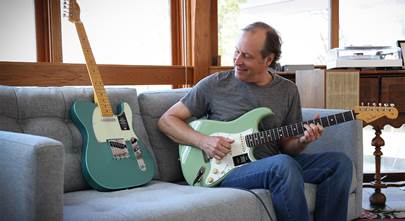
Corey, how's it been working on creating the product pages for Crutchfield for these guitars? I know that you've spent quite a bit of time in the video studio playing some of the guitars. Here, just a little example of what Corey's been doing. Sounds like a telly.
Is that a telly? I don't know. It is. Yeah, it says telly in the file name.
I heard that through the wall. My office is on the other side of the video studio. So I heard every single time you played that basic thing on a whole bunch of different guitars.
Are we playing all the guitars in videos? What's the deal with what we're doing there and what your role has been doing that? So Philip and our creative and our video production team had a wonderful idea as we were just doing initial roundtable conversations of how we can present our opportunity in this marketplace and what can we do differently to set us apart. And he had the great idea of, you know, we just shot a whole bunch of bookshelf speaker demos and we set it up and knocked it out in X amount of time. I'll bet we could do the same thing with guitars.
We set up an amplifier and roll through and spend three minutes on each guitar. And that's what we did. So right now we're just focusing on the American Vintage 2 line that we're bringing in, which right now just consists of a lot of different strats and tellies and a few different variants, 50s, 60s, strats and tellies.
And yeah, I got to... I played 36 different Fender guitars over two days. Yeah. And it was cool.
It was probably the most guitars I've ever played in one single set. In that amount of time? Yeah. But, you know, so all of those are going to go on the web.
So a customer will be able to go and if they're looking for an American Vintage 2 butterscotch telly, they can go to the product page. They can see pictures of individual guitars and what their serial number is and how much they weigh. And then they can click on the video and see what it sounds like in all three pickup combinations, clean and dirty.
And it'll help, hopefully, them narrow down and say, yeah, this is the one and pull the trigger and bring the guitar home. And so we're doing that for like the upper echelon of the Fender guitars, right? Right now, but wouldn't it be awesome if we could do it for all of them? Every single one. Somebody's got to play all those guitars.
Somebody has to do it. And, you know, I've always loved the phrase play music, feel better. It's always, in my opinion, applied to not only my life as a drummer, musician, you know, because playing the drums makes me feel better.
Playing guitar makes people feel better. Playing music, creating music makes you feel better. But I've also applied it to like everything we do here at Crutchfield, right? When I play music on my car stereo, on my drive home from work, I feel better.
And this, you know, is what this brings to Crutchfield. I think the part of this that I'm the most excited about is that we're not just playing other people's music now. Like now we are in the business of helping people create music so that they feel better once they create it and they create music that makes other people feel better.
Like I truly feel like we're making the world a better place as we do this. Do you guys feel the gravity of that as well? Yeah, I think it's closing the loop, right? We've been able to play back high quality music in a whole bunch of different environments and now to be able to provide the ability to make music. It's like going to the grocery store and you can buy corn, but you could also, you know, set up a garden bed in your backyard and plant a seed and grow your own corn and then eat it like that.
There's a whole different satisfying, wonderful feeling of eating something that you've grown. And it's the same thing here, you know, listening to music that you've made or music that you've helped make or that your friends have made. It's an entirely different feeling than just throwing on something in Apple Music.
Go ahead, do you have thoughts on that, Rodel? Yeah, I think everything you said is true and music is so strong, but I think even more fundamental is as much as music itself is this powerful thing that can affect change, creating the experience of, I always think about somebody opening the guitar case for the first time and just how striking the finish is, how excited you are to put your hands on it, just that overwhelming feeling of excitement and being able to put that in the world, even if they don't, even if, I hate their music. Being able to put that in the world is what makes it easy to go to sleep at night and wake up early to come to work next day. That's what gets me really motivated.
You guys mentioned that it wasn't hard to find musicians at Crutchfield. That's always been a thing, that musicians seem drawn to us and we definitely enjoy employing musicians. What is it about musicians that makes for a good Crutchfield advisor? That's a great question.
You can tell a great question when somebody tells you that and then they really have to think about the answer. Well, Riddell said earlier, what we do great is listening and the best musicians are really good listeners. You need to, especially if you're playing with other people, listening to what they're doing and finding where your instrument fits in into the mix and finding something to add when it's appropriate and laying back when it's not appropriate is probably the most important part of being a great musician and listening to customers and figuring out where's their problem? What's the pain points? What are we trying to solve or fix or improve? That's all about listening before you talk.
And I love that about finding your place in the mixture of the musicians in a band and thinking about other people's feelings and how the song, what can I do to serve the song? All of those things, that's not just a good thing to do at band rehearsal. That's a good way to approach life. 100%.
It's hard to imagine somebody who's passionate about music that hasn't been really impacted by music and then wanted to share that. And so I think there's something to be said for musicians understand what it's like to wanna create this excitement, this energy, this passion experience, but knowing that you gotta put in a lot of work to really make it happen, right? You can't just pick up a guitar and all of a sudden you're making the best music ever. You gotta spend some time in the woodshed.
And I think similarly at Crutchfield, our advisors know that there's a lot of logistics, a lot of signal flow, a lot of expertise that needs to be developed so that when you get home after a hard day's work, you can turn on your favorite song, you can put on your favorite movie and just enjoy. And I think that's where a lot of the overlap between musicians and Crutchfield advisors lays. You know, I think about some of the things that we train our advisors on just for, just not the musician stuff yet, but like just home theater and home stereos and two channel.
We always talk about the connectivity of everything and we all need to fully understand. We call it the from the to the, right? Like the music goes from the CD player to the stereo receiver, from the stereo receiver to the speakers. You need to understand that signal flow.
And I combine that with what I know about like my, the guitarist in my band, he has a pedal board. We call it Frankenpedal. And there's like 10 pedals there.
And somehow the music goes from the guitar to the amp through all of those pedals. And are our guitar specialists gonna understand that level of the connectivity of guitars? Yeah, almost all of our guitar specialists are guitar players. And that's another reason why guitar playing, guitar in general fits really well into the world of recording or the world of AV because it's inputs and outputs, like I said, from the to the.
And maybe you start as a, I started when my first guitar and I had an amplifier and then I remembered my first pedal. So now I had to get an extra cable and I know that the pedal has an input and an output and it's just, it's innate, it happens. Almost through osmosis, like you're just trying to make music and find cool sounds, but you're also, you're learning the basics of signal flow.
Yeah. And the more I got into recording and PA gear, I realized, oh, this is all exactly the same. Plugging a four-track recorder in and patching in an effects processor so I can put some echo on the vocals we just recorded isn't all that different than taking a guitar amplifier and putting a delay into the effects loop.
It's all the same process. Rodel, what is going to be the experience of a person looking at crutchfield.com, looking at Fender guitars, they have a question, they pick up the phone and call. Does it go straight to one of our specialists? Will they have to be transferred? Like how do they get to talk to one of our guitar specialists? So we've got a lot of smart people working in operations whose job it is to make sure that in nine times out of 10, when you call, you're going to land directly with somebody who is the guitar specialist who's here to help.
You might slip through the cracks and then a very nice person is going to transfer you. But like I said, nine times out of 10, you should end up where you need to end up. And they'll have received all the training on the products as well as how to make sure we can get the guitar to you safely in your hands so you can enjoy.
Nice. So it's going to kind of technologically speaking happen automatically for the most part. For the most part, yes.
Take the minute to plug Connect ID, one of the incredible features on our website, which helps our advisors walk you through the aisles of our website and really creates an enhanced shopping experience. Some of the logic underneath that will let us know, hey, this person dialed a phone number on a page that had a guitar on it. So let's get them with a guitar expert.
And that's going to be one of the many ways that we make sure we get you talking to the right person as soon as possible. That's pretty magical how that works. And it's only going to become even more magical with this.
Are we doing anything different with our typical policies and procedures to deal with guitars? Are we going to still have a full 60-day money back guarantee on Fender guitars? Anything different at all? Or are we taking the same approach with the Fender guitars as we're doing with everything else? Yeah, we have figured out at Crutchfield that customers need to be able to purchase and feel confident that they're not going to be trapped or stuck. And that's got to apply to Fender as well. So the full 60-day guarantee is in play as well.
We, of course, have tech support for the lifetime of the product. So say the guitar does get to you and there's something wrong with it, give us a call. We'll walk you through it and make sure that it's not something that we can't fix ahead of time.
We'll get you in touch with the people you need to get in touch with to get that guitar that you wanted, that you're excited to purchase and make sure that it's ready for you to play. And if all else fails, you're not stuck. You can always send it back and we'll figure out something that does work for you.
We're going to treat this like we do any other product. We want you to have the full faith and confidence in Crutchfield, whether it's buying a car radio, a TV, or an American vintage. So can you call tech support and get help with figuring out how to write a song and play a guitar? Or is it just make the guitar work? You know, I'm still working on Phil, our director of tech support on that.
He can't get them to commit to songwriting just yet. But he has promised that they'll do what they always do, which is troubleshoot and help walk you through any potential issues. They're experts in signal flow.
They're experts in connectivity. They can help you set up an amp, but they're probably not going to teach you how to play. They might listen to a song that you wrote and give you some feedback if you wanted them.
They'll have opinions. Yeah. Yeah.
No, no, for sure. All right. One last question for you guys.
Fender. I mean, I'm not a guitar player. I'm a drummer, but I've heard of Fender.
I've heard of other guitar companies too, right? Why Fender? Fender's iconic. Since the fifties, I've been building amplifiers. The first mass produced solid body electric guitar.
And then pretty much any musician you can find a picture of, you're going to find him holding a Fender. Buddy Holly, the very, you know, Stratocaster first came out and then there's Buddy Holly holding it. You know, all the way through, you know, big time, you know, Cory Wong today, you know, brand new signature series strats, people pushing the envelopes of what is and isn't possible with guitar.
Fender is right there. Yeah. And they've just, they've got everything that you could possibly, that we could possibly need in terms of products and categories.
So it was, it makes an easy, just first step to go with, with an iconic brand like Fender that builds quality products for pretty much every price point. And that has everything you need to start from scratch. You got thoughts on this Rodel? Cory has really helped open my eyes to just how much Fender has defined modern music and modern instrumentation.
And Crutchfield has a 50 year reputation of helping customers choose complicated gear that makes their lives better. So I think it's a partnership rooted in credibility and history. And it's such a pleasure to have helped people for so long listen to the music that they love.
And now I think Cory said it earlier, we're closing the loop. We're helping people make the music they love. Yeah.
I think it's great. Gentlemen, thank you so much for coming into the podcast studio, talking Fender. I think there's a lot of excitement here around the building.
We are, as we record this a week and a half away from go live, and I'm pretty excited to see what happens as we open the doors to Fender at Crutchfield. Thanks for having us. This is awesome.
Thanks JR. Always a good time. So Crutchfield now has Fender. Like that's the headline for today's episode.
Major news. Major, major news. That's right.
And what do we have? We have their electric, their acoustic guitars, their bases. We've got pedals, strings, cables, all the things you need to make guitars work, right? And if you're looking for a new guitar to add to your collection, we've got some pretty baller guitars. Those vintage twos that Cory was talking about sounds pretty awesome.
If you're looking to help someone you know, their first guitar, you can now do that with the help of us here at Crutchfield. It's legendary service that we've been doing for 50 years, now applied to Fender. Go to crutchfield.com and search for the word Fender.
You'll see all there is to see here. Crutchfield the podcast is brought to you by Bill Crutchfield. Bill just bought a massive pile of musical instruments that are now sitting in our warehouses and are ready to go to good homes all across the country.
As far as I know, he can't play them, so we need to get them out to you. That's right. That's right.
We need people that want to or can play guitar to have these guitars. Yes. Bill has no use for them.
No, no. Crutchfield the podcast is recorded right here in beautiful Charlottesville, Virginia. Big thanks to our guests on today's show, Charlie and Ned, Corey and Rodel.
Thank you, Huffy, for joining me in studio to talk about talking about Fender. Thanks for having me. And thanks to Abby and Alexis for doing the social media thing for us.
If you see any of our Fender social media posts or anything else, mention the podcasts in your comments, and those comments will make their way to us. Also, we'd love to answer any questions you might have about Fender or anything else here at Crutchfield. You can do that using this email address, podcast at crutchfield.com. That goes straight to Huffy and me.
We would love to take any and all questions you have about anything in the Crutchfield universe. Any parting words before we go, Huffy? I feel like I should have something good here. This is your chance to solo, my friend.
I don't know. I don't want to be too plucky. Last but not least, thank you again to Bill Crutchfield for continuing to pay us to talk about the coolest gear on the planet.
Thanks, Bill.

Comments (0)