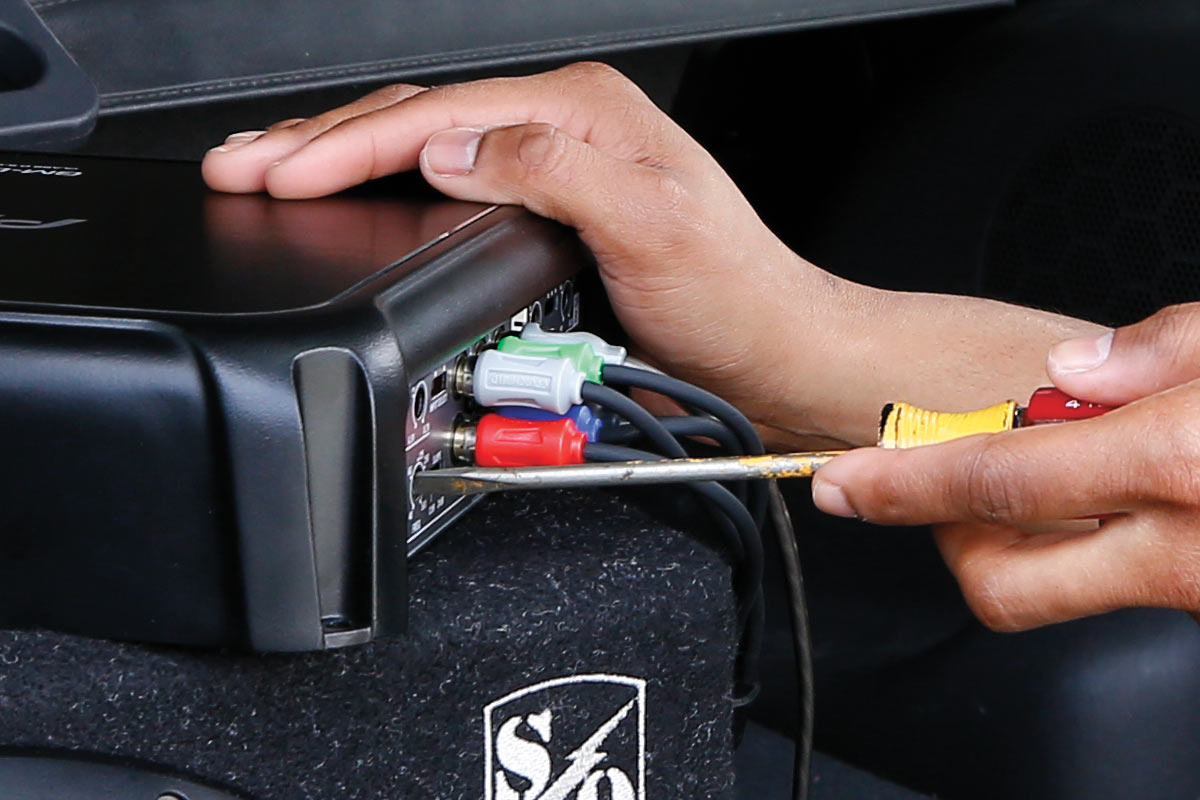
Troubleshooting your car amplifier installation
Solutions to some common problems

O
ccasionally we'll hear from a customer that "Everything's hooked-up correctly, but it's not working right. What can I do?" Sometimes things just don't work like we expect them to right from the start. Here are some of the most common problems that can occur when installing an amplifier — and their solutions.
Factory radios and their security codes
If you're using a factory radio, it may need its anti-theft security code reset. If so, you can usually find the code and resetting procedure in the vehicle's owner's manual, online, or from a car dealership service department (be prepared to prove you own the vehicle).
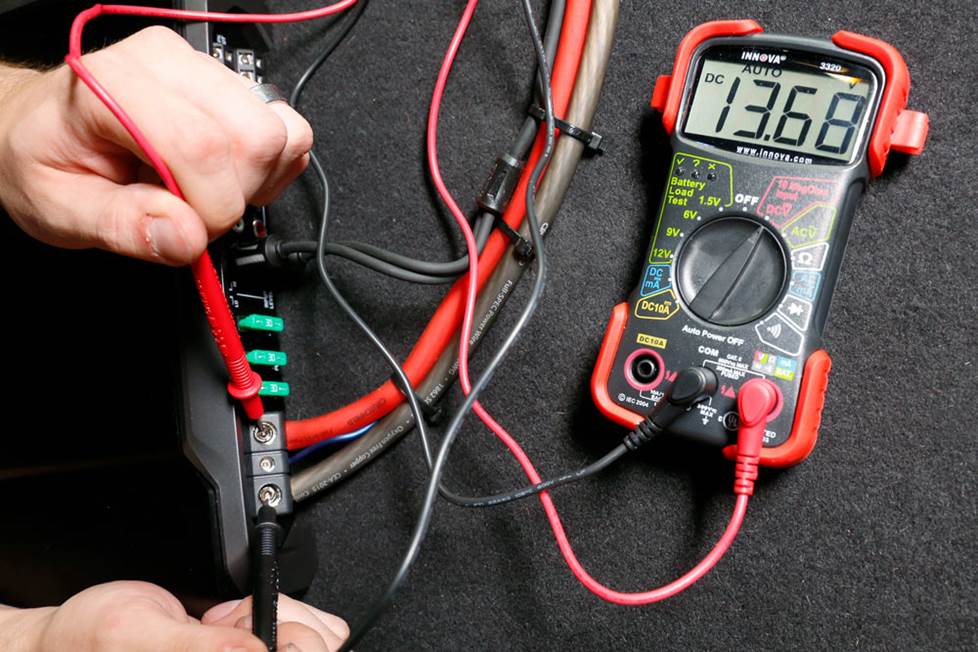
Reads good: A multimeter showing the DC voltage powering an amplifier.
Amplifier doesn't power-up
In order to properly and safely troubleshoot a malfunctioning electrical system you'll need to use a multimeter to measure voltages and check continuity. Crutchfield sells the Install Bay 3320 digital multimeter, but if you're in a hurry, you can probably find one at your local hardware or electrical supply store.
- Measure the voltage at the amplifier between the ground and positive power terminals. If no voltage is present, go to Step 2. If +12 volts DC is present, skip down to Step 3.
- Remove the inline fuse by the battery and check it for continuity. No continuity means the fuse is blown and needs replacing. Good continuity means that a power or ground wire is loose or not connected somewhere along the line.
- Measure the voltage at the amplifier between the ground and remote turn-on lead terminals. If it reads +12 volts DC, either the amp's onboard fuses are blown (check continuity and replace if necessary), or there's something wrong with the amplifier and you should return it to your dealer for repair. If you find no voltage here, it means the remote lead is either broken or not connected correctly.
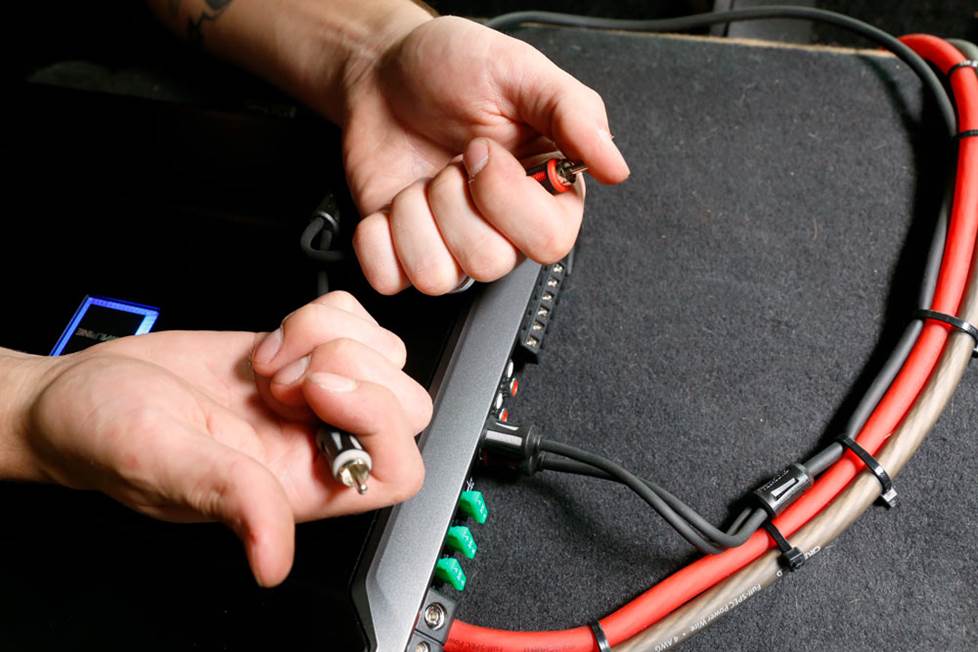
Testing: If touching the tip of an RCA conductor connected to the amp's input produces a hum — the wires, amp, and speakers are all good.
Amplifier comes on but no sound comes from the speakers
Finding the problem requires checking every piece of equipment in the audio chain. We'll start at the stereo and work our way to the speakers.
Check the stereo and amp settings
- Try turning up the amplifier's gain a little. Make sure all its filters are off or deactivated.
- Check your source. Make sure it's really playing music and not idling. If, for example, only some speakers aren't playing but others are, it may be that the receiver's fade or balance control isn't set to the middle. Some receivers have a mute function — you'll want to check on that, too. Make sure the RCA cables are plugged in properly.
Check the stereo's audio outputs
- Turn the receiver and amp off. Unplug all the RCA cables from the receiver. Turn the receiver and amp back on.
- Now, touch the inner pin of one of the RCA plugs with a finger. If the wiring is good, you will hear a soft hum coming from a speaker. Test all the RCA cables this way.
- If all the speakers hum, it means the receiver's not putting out signal and may need to be looked at by a service technician. Or, if you're using a line output converter, it's not hooked up right. If you hear no humming on any channel, turn off the receiver and amp and plug the RCAs back in.
Check the RCA cables
- With the receiver and amp off, unplug the RCA cables from the amplifier's input jacks. Get a short RCA cable that you know is good and plug it into the amp's input. Turn the receiver and amp on.
- Touch the inner pin of the RCA plug at the free end of the cable, and listen for a hum. Test all the amplifier's channels this way. If every channel hums, it means the RCA cables from the receiver are bad and need to be replaced. If you hear no humming, turn off the system and re-connect the patch cables to the amp inputs.
- Another, better, way to perform this test is to plug a portable music player or phone directly to the amp's inputs with a mini-to-RCA adapter from the headphone jack, and play music through the amp.
Check the speaker wiring and speakers
- No part of your speaker wiring should touch any part of your vehicle's metal body — that's a short circuit that could damage your amp and speakers. Another place to look for short circuits is at the amplifier's speaker terminals. It's very common to find a strand or two of stray wiring touching another wire, causing none of the speakers to work (the amp has sensed a short and shut down).
- Disconnect the speaker wires from the amp. Take a battery, 9 volts or less, and momentarily touch its poles to the positive and negative wires of a speaker. If the wires and speaker are good, you will hear the speaker click. Test all the speakers this way. If all the speakers click, it means the amplifier has a problem and probably needs to go in for servicing.
- If the speakers didn't click, you'll need to repeat this battery test at each speaker to determine whether the wire or the speaker itself needs to be repaired or replaced.
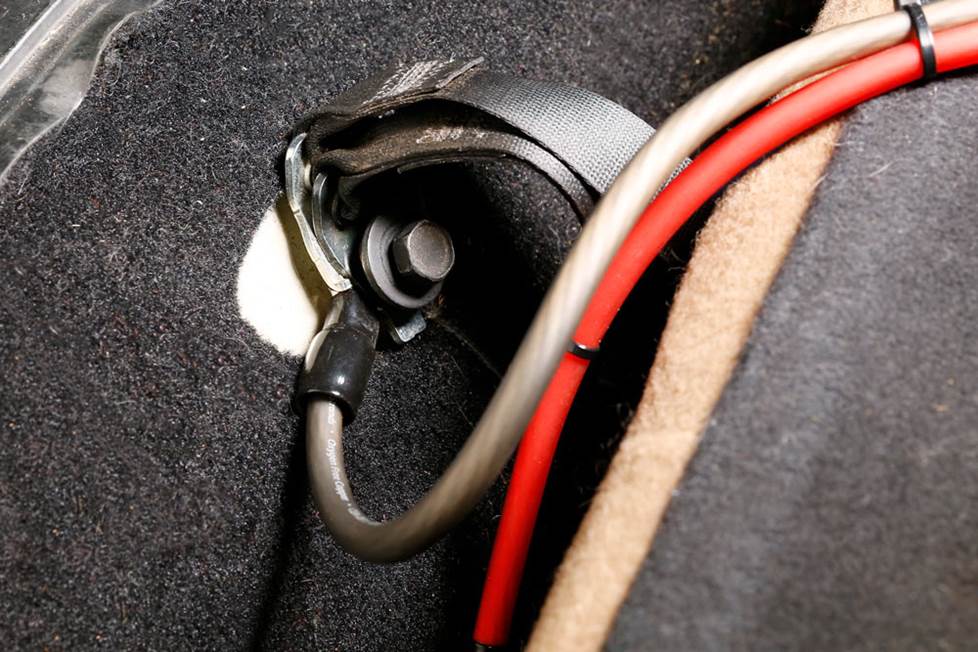
Ground: Connected metal-to-metal (no paint) and bolted tightly.
Noise: humming, buzzing, or whining
- The vast majority of noise problems are caused by bad grounding. If your ground point is free of dirt and paint and making a good connection to your vehicle's frame, try moving the ground to a different spot and see if that clears it up.
- Actually, any loose wire throughout your car could cause noise, even your battery terminals. Low battery fluid can also be a source of system-wide noise.
- The case of your amplifier making contact with your vehicle's metal body could cause noise. Any part of the signal system's negative wiring or shielding that touches the car's metal body could cause noise.
- See How to diagnose and suppress noise for more tips on fixing noise problems.
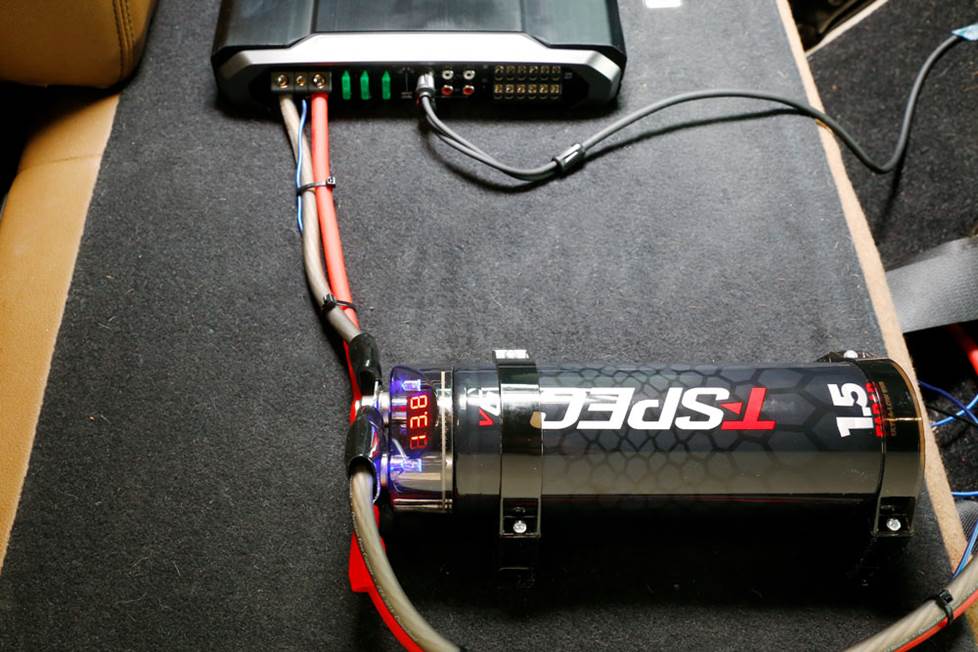
Capacitors: A cap gets wired to an amp's power input and can provide a burst of energy when the amp's power demands temporarily exceed the electrical system's power supply.
Don't overwhelm your vehicle's electrical system
We have assumed you picked equipment that your car's electrical system can handle. It would be wildly inappropriate, for example, to try to run 5,000 watts RMS worth of amplifiers in a compact car with a small-capacity alternator. Such a system would quickly bog down the car's system and eventually burn out the alternator. Some people, especially competitors, upgrade their alternators to accommodate their high-power systems.
One common symptom of over-powering is the dimming of lights when bass notes hit. If your lights dim just a little during heavy bass passages, you might benefit by installing a capacitor on the bass amp's power cable. Otherwise, check out Headlights dim when the music plays to help solve over-powering issues.

Nicole: One of our Technical Support Specialists based at our Norton, Virginia facility.
Crutchfield tech support
Hopefully these tips will help you solve any problem in your system. If you find yourself stymied by the situation, you can always give us a call for help. When you purchase your amplifier system from Crutchfield, tech support is free for the life of your gear. Our amazing tech support team is available seven days a week.
Just click on "Contact Us" at the top of this page for the toll-free number and other methods of contacting us.

_mobile.jpg)




Art Adkins
Posted on 11/5/2025
What would cause only having one side of speakers to work not the other
Buck Pomerantz from Crutchfield
on 11/6/2025
Don
Posted on 10/11/2025
My subs pop when powered on and off . What could be my issue? Thank you
Buck Pomerantz from Crutchfield
on 10/20/2025
Matt from HAYTI
Posted on 1/2/2024
I have a multiple amplifier setup in my 2014 Nissan Maxima SV with navigation/Tech package. It had the bose factory amp that I removed/bypassed using a oem integration dsp(Axxess AX-DSP-NI2). It's a fairly high wattage setup, totaling 3100 RMS, so I have an aftermarket high output alternator and XS Power D3400 AGM battery, upgraded all power/ground cables to 2/0 gauge, upgraded all speaker wire to 12 gauge. I'm running 8 speakers(two super tweeters, four 8" mids, two 6.5" mids), two four channel amps(DC Audio 1000.4, 150x4 and a JBL club 754 100x4). Then a MTX Jackhammer 1501 pushing two Memphis Audio MOJO Pro 12's 4ohm, wired down to 1ohm for 1,650 watts. I have absolutely no sound except for very distorted fuzzy muffled sound coming from the tweeters in my front dash/front speaker output terminals on the JBL four channel amp.... Absolutely nothing from the rear speaker output terminal on the same amp or nothing from my other four channel amp or monoblock amp. My grounds are good, I've checked and rechecked all my connections.... Amps are all turning on, not in protect, DSP is working normally, but no sound output besides the tweeters which is very distorted sound..... Any ideas?? I've been working on this for 2 weeks with no luck at all!!
Buck Pomerantz from Crutchfield
on 1/3/2024
Samuel
Posted on 7/23/2023
Does your amp suppose to have 12volts going to it if the truck is turned off or does it suppose to have 0 I have installed a remote wire to a fuse that cuts off when truck is off but still have 12 volts reading on amp could u tell me if it suppose to always keep a current when off
Buck Pomerantz from Crutchfield
on 7/24/2023
Tim Munyon from Cheyenne WY
Posted on 7/15/2023
I recently purchased a 2021 Nissan Frontier that came with a Rockford Fosgate 380 watt amp, with 10 speakers. From what I have read, the subwoofer consists of 2 - 6" dual voice coil subwoofers. The audio settings available are Treble, Bass, Balance, and Fade. If I turn up the bass, it sounds like all 10 speakers are trying to increase the bass output, not just the subwoofer. How can I get the most volume from the subwoofer? It does not appear to have a separate volume control, despite the claimed "discrete MOSFET sub channel." Thank you!
Buck Pomerantz from Crutchfield
on 7/17/2023
Tom Gardner from Cathedral City
Posted on 6/25/2023
Hi, I had just install my new Crutchfield Kicker 43DSC6704 DS Series 6-3/4" speaker and Kicker 43DSC6504 DS Series 6-1/2" speakers, with a new Pioneer 4 channel amp, on a stock radio for 2018 Hondas Accord. The sound coming from the front speaker is good. However, the rear speaker volume is extremely low. I had adjusted the front and rear fade; even when the rear fade is set, the volume is still low. Any ideas? Thanks.
Buck Pomerantz from Crutchfield
on 6/26/2023
John
Posted on 3/10/2023
My amp button is turned on but the indicator light is off and there is no sound from my speakers
Buck Pomerantz from Crutchfield
on 3/13/2023
natanael from Austin
Posted on 3/5/2023
I just installed a rockford amplifier. When i start the ignition everything works good i have a blue lught on ampifier and all speakers works but when i start the engine, my amplifier start blinking blue and red and no speakers dont work.I know red is for short circuit but how this is possible when with only ignition everything works?
Buck Pomerantz from Crutchfield
on 3/6/2023
Adrian from Tampa
Posted on 2/22/2023
My amp is frying one of my 2 subs even with no input (rca disconnected). I tested the DC chanel output and one that's fine is at 0V and the one frying my sub is at 40v..? What could cause this?
Buck Pomerantz from Crutchfield
on 2/23/2023
Billi from Frenchville
Posted on 12/13/2022
After installing our amp, the front speakers work but the rear only hum? What is the issue with this?