How to choose a phono preamp
What you need to know before you buy one for your record player

In this article: We’ll cover the fundamentals of the phono preamp, explain how it works, and help you figure out which type you might already have — or need.
- Do you need a phono preamp?
- Where is the phono preamp?
- Determining which phono preamp you have
- What to look for in an external phono preamp
...We'll also break down the ins and outs of different connection types, and discuss how to integrate your new preamp into your system.
So, you’ve got a shiny new turntable, a crate of records, and dreams of analog glory. But something’s off — maybe your music sounds super quiet, or maybe it’s (unintentionally) loud and distorted, like if Hendrix smashed his amps BEFORE rocking out. Odds are, it’s a phono preamp issue — or the lack of one.
Feeling lost? Don’t worry if you're not experienced — we’ll break it down in plain English, keep it fun, and drop some "sound advice" along the way (pun fully intended).
What is a phono preamp?
A phono preamp takes the signal from your turntable and boosts it to line level — the standard strength your amp, receiver, or powered speakers expect. It also applies something called the RIAA curve, which balances the bass and treble so your records sound just right.

The NAD PP 2e is a good example of a standard external phono preamp.
Do you need a phono preamp?
In a word: yep.
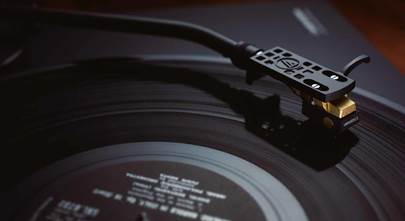
When your record spins, the needle (or stylus) traces the groove and picks up tiny vibrations. The cartridge turns those vibrations into an audio signal — but it’s super weak. Before it can blast through your speakers, that signal needs a serious boost. That’s where a phono preamp comes in.
Without it, all you’d hear is a whisper. It’s why you can’t just plug a turntable straight into any ol' speakers — it needs that extra “oomph” to come alive.
Understanding the RIAA EQ Curve
During vinyl mastering, bass frequencies are reduced and treble is boosted to save space and improve clarity. The phono preamp reverses this during playback, restoring the original tonal balance.
Unless you collect a lot of pre-1954 records and equipment, nearly all your vinyl will follow the RIAA standard.

During the recording process, bass frequencies are diminished while upper frequencies are boosted, and during playback, the RIAA circuit in the preamp ensures the opposite happens
Where is the phono preamp?
Good question — it has to be somewhere, or your records won’t sound right. You’ll typically find it in one of three places:
- Built into the turntable
- Inside your receiver, amplifier, or powered speakers
- As a separate, standalone component
So which one should you use?
It all depends on your setup:
- If your turntable doesn’t have a preamp but your receiver does — you can use the one in the receiver.
- If your turntable does have a preamp and your receiver doesn’t — you’re covered, just use the one in the turntable.
- If neither has a preamp — grab an external one.
- If both have preamps — pick just one to use, and it’s important to not use both at the same time.
Using both at once won’t double your sound — it’ll just double the distortion. Running a boosted signal into a phono input is like shouting into a megaphone that's already cranked to 11. Your speakers won’t explode, but your music will sound downright nasty.
How to determine which preamp you have
Before shopping for an external preamp, it’s good to know what you’ve already got — or don’t have — so everything works together smoothly.
Turntable side
Many newer turntables come with a built-in preamp, often with a switch labeled PHONO/LINE or ON/OFF.

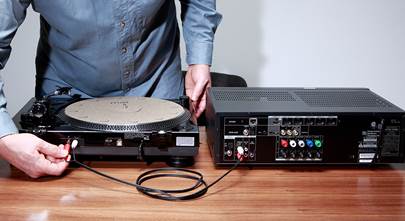
The PHONO/LINE switch on the back of the turntable controls whether the built-in preamp is active. Set to PHONO, the internal preamp is bypassed, so the signal will need amplification from an external phono preamp or a phono input on your receiver.
However, not all turntables with built-in preamps offer phono preamp switches, so be sure to confirm the features of your specific model before considering an external preamp.
Receiver side
On the receiver or amp, look for an input labeled PHONO — usually near a ground lug. This input is designed specifically for turntable use and typically can't be reassigned for other equipment. It is generally only compatible with moving magnet cartridges.

This Onkyo receiver includes a dedicated phono input and ground lug — so you can connect a turntable directly and use the receiver’s phono input.
Powered speakers
Some powered speakers also include a phono input and ground lug, just like a receiver.

These ELAC speakers feature a dedicated phono input for turntables without built-in preamps, so you can connect directly using the speaker’s built-in phono preamp.
Do you need a separate phono preamp?
If neither your turntable nor your receiver/speakers have a preamp — or if your cartridge isn’t compatible with the one you do have — you’ll need an external phono preamp. No way around it.
Even if you already have a built-in preamp, going external is still an option. Many folks upgrade for better sound and more fine-tuning control.
Solid-state vs. tube preamps
One of the first choices you’ll face is solid-state vs. tube-based.
Solid-state models use transistors. They’re clean, accurate, low-maintenance, and super quiet — great for detail and precision.
Tube preamps use vacuum tubes. They often add warmth and harmonic richness — especially nice for jazz, vocals, or acoustic music. They need occasional tube replacements but offer that glowing, vintage charm.

The Pro-Ject Tube Box S2 uses vacuum tubes for a warm, natural sound.
What to look for in a phono preamp
Most phono preamps include stereo RCA inputs for moving magnet (MM) cartridges. Some high-end models support both moving magnet and moving coil (MC) cartridges — a plus if you’ve upgraded your cartridge.
Additionally, you'll usually get a ground lug, which is a crucial component in keeping your system hum-free.

The Cambridge Audio Alva Duo offers both MM and MC input options, as well as a balance adjustment knob, to help fine-tune your soundstage as needed
Of course, you’ll always get unbalanced RCA outputs for connecting to your amp, receiver, or powered speakers — but some high-end preamps go a step further with balanced XLR inputs and outputs, delivering a cleaner signal with less interference. If your turntable, or amplifier, support it, it's worth considering a preamp with balanced connectivity.

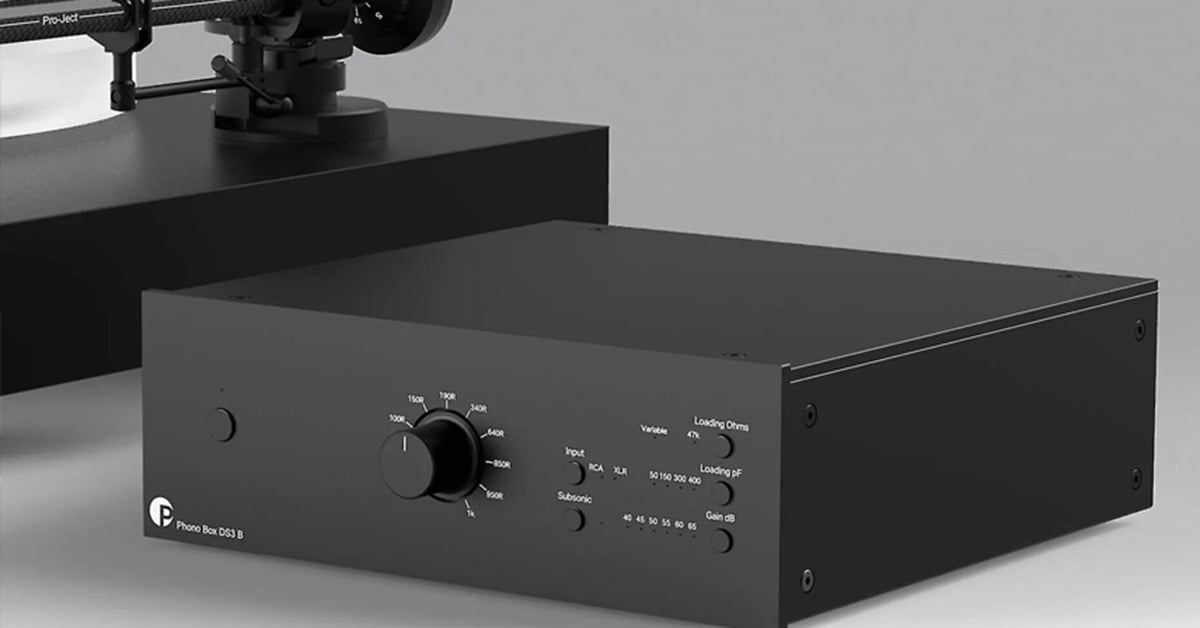
The Pro-Ject Tube Box DS3 B offers both balanced and unbalanced connectivity, for clean, noise-free listening.
Extra features to consider
Along with balanced and unbalanced connections, many phono preamps come packed with useful extras. You might find a headphone jack for private listening, a subsonic filter to tame low-end rumble — especially handy with older or slightly warped records.
Some upper-tier models even include built-in analog-to-digital converters, delivering high-resolution digital signals via optical, coaxial, or USB connections. That makes them a great fit for integrating into modern digital systems — and an excellent choice if you’re digitizing your vinyl collection for archiving or portable listening.

The McIntosh MP100 preamp includes both balanced and unbalanced connections, digital coaxial and optical outputs, as well as a USB port for digital conversion.
You’ll also see preamps that offer gain and cartridge loading adjustments. Let’s break down why those features can be worth having.
Gain adjustment
Moving magnet cartridges typically produce a relatively high voltage — usually between 4 and 8 millivolts (mV). Most cartridges we offer are around 4 mV. For these, you’ll want to keep your preamp’s gain setting on the lower side. A solid starting point is 40 dB. You can experiment by nudging it up a bit, but keep this in mind: the higher the gain, the more noise you may introduce — push it too far, and distortion can creep in.
Higher gain settings (60 dB or more) are designed for low-output moving coil cartridges, which usually deliver less than 2.5 mV and need that extra boost to sound their best.
Cartridge loading
Some preamps let you fine-tune load capacitance and impedance — settings that help optimize how your cartridge interacts with the rest of your system.
- Load capacitance shapes how your cartridge and cables behave together, mostly affecting MM cartridges. It’s measured in picofarads (pF) and tweaks the high frequencies—too much, and things can sound harsh or rolled off.
- Load impedance controls how your preamp receives the signal from the cartridge and is more critical for MC cartridges. It’s measured in ohms and has a big impact on overall clarity and tonal balance.
Think of these settings like tone controls tailored to your cartridge. Get them dialed in, and your records will sound more natural and balanced. That said, most preamps are already set up to work well with high-output MM cartridges — the most common type — so you may not need to change a thing.
A final note on experimenting
Whether you're using a built-in or external preamp, don’t be afraid to experiment. Getting it “wrong” won’t hurt your gear — it just might not sound all that foxy, as Jimi might say.
Questions?
If you have any questions, or need assistance choosing the correct preamp for your system, our friendly and knowledgeable Advisors are here to help. And don't forget free lifetime tech support is included with your Crutchfield purchase.






Mike from Brentwood, CA
Posted on 4/26/2022
How can you tell if your turntable or receiver has a built-in phono preamp? The manuals for both my receiver and turntable make no mention if it is included.
James from Louisa, KY
Posted on 3/11/2022
Just read your article. If I'd read it before purchasing, and struggling to effectively install my turntable preamp, I would have known not to plug the preamp into receiver in the phono jacks. I drove myself crazy, and some of Crutchfields advisors as well. Now lets listen to see if it does what I was looking for. Thanks.
Kathy Hanna from Elmwood Park
Posted on 1/20/2022
Great commentary. With little cash and stuck in the house , when do you think you will be able to restock the tables that are currently sold out? If get one that's available , please advise on shipping availability as well. Many thanks
Mike from Hyde Park, NY
Posted on 6/30/2021
I have a Pro Ject T1 SB turntable has a pre amp, do I need another external pre amp?
Eric Angevine from Crutchfield
on 7/1/2021
Jamie Specht from Sausalito, CA
Posted on 4/22/2021
Jim - excellent article, very helpful. Do you take customer calls? I'd love to chat with you about a turntable upgrade. Please let me know how I can reach you.
Jim Richardson from Crutchfield
on 4/23/2021