
A conversation with DMS, YouTube's industrious headphone reviewer
Crutchfield's headphone writer interviews the popular personality and creator

I
n the loud, bombastic world of YouTube headphone reviews, it's hard to stand out from the crowd. Yet, Doug “DMS” Stephens has managed to make a name for himself — all while delivering thought-provoking, level-headed content.
On a platform that tends to incentivize hype and snark, DMS cuts through the noise. His deliberately paced videos are brimming with distinct visual language, reasoned observations, and blade-sharp criticism. To put it bluntly: he’s put in the work, and it shows.
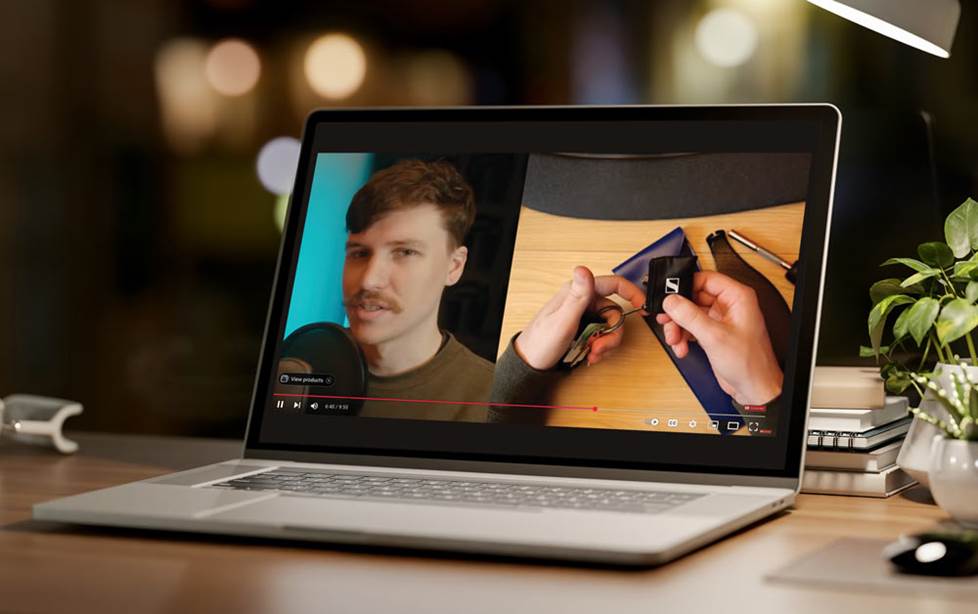
DMS videos have become a "must watch” for personal audio aficionados, who flock to his various channels for perspective whenever a new headphone drops.
Naturally, we gravitate towards his videos here at Crutchfield — after all, "seriously into audio" is one of our classic taglines. And I personally first met DMS a few years back at the world's premier traveling show for audiophile headphones, known as CanJam. (He's scheduled to attend the upcoming CanJam NYC 2025, February 22-23 in Times Square.)
It’s always a thrill to catch up with him at industry events — and compare notes on headphones, trends, and really all things personal audio. When I heard he was on the verge of releasing his own set of headphones, introduced on his YouTube channel as “Project Omega,” it felt like the perfect time to interview him for Crutchfield.
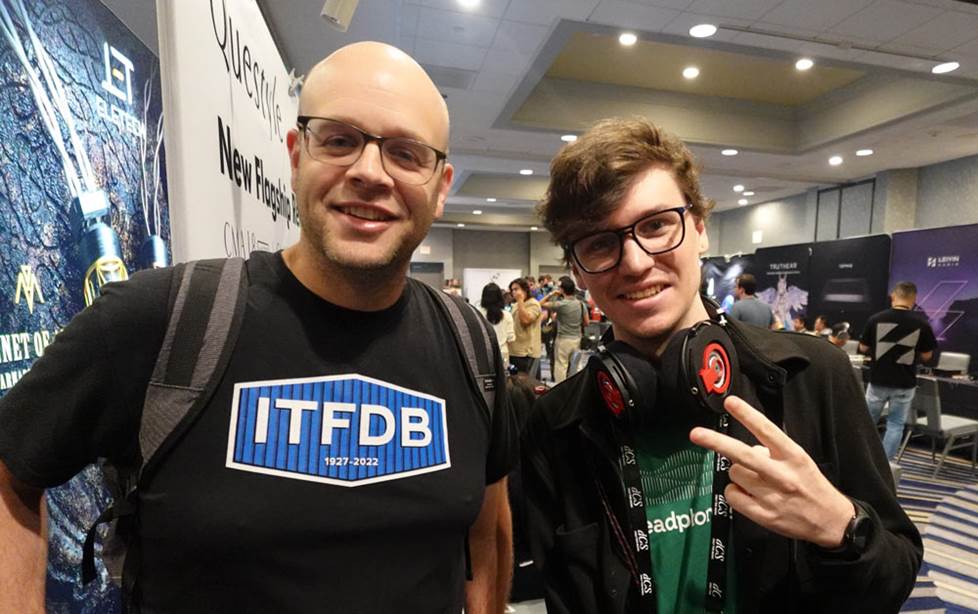
Crutchfield's Jeff M. and DMS (of Headphones.com) met at CanJam, the world's premier traveling headphone audio show (presented by head-fi.org).
“I'm terrified and excited at the same time,” DMS told me from his new warehouse space in Nashville, the week he completed his first of four batches. (After the last batch of 100, he’s vowed to open-source his schematics for others to build their own.) “You put your heart and soul into something — and now it’s out in the world for people to judge.”
We connected over video chat to discuss stepping out of his comfort zone, how his growing experience influences the way he evaluates gear, and why he thinks headphones are so addictive to those of us in “this hobby.”
A peek behind the creative curtain
DMS has grown to become one of the top audiophile headphone reviewers online. His video library has racked up millions of views and spans several YouTube channels. (Both his personal channel and The Headphone Show boast over 125,000 subscribers.) His overall vibe is patient, literate, and exacting — yet he's also a lighthearted scamp, capable of pulling the most notorious prank in the history of high-end headphones.
His hybrid Nashville workshop is both his main video studio and the production facility for the Omega headphones. It also serves as a homecoming. In 2024, he returned to Tennessee, the place where he grew up. That's where he started the DMS channel from his bedroom, back in 2016.
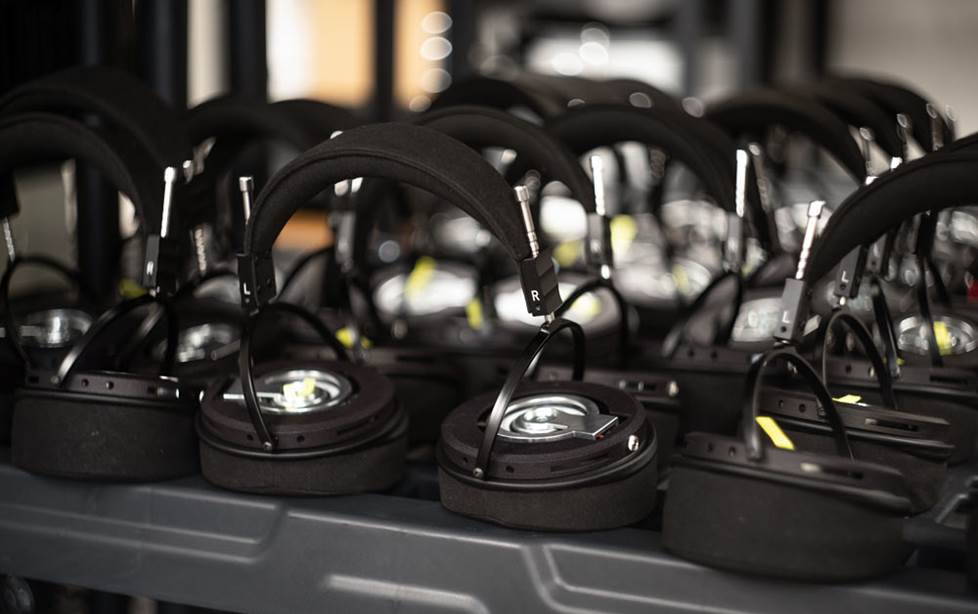
A batch of in-production Project Omega headphones wait inside DMS' new hybrid production facility and video studio in Nashville, TN.
For several years in between, he honed his review and production skills in upstate New York. Then he began his affiliation with Headphones.com (our competitor, but friendly fellow retailer), granting him more freedom. "I figured one thing I won’t regret is coming back and spending time with family," he said.
The interview
It’s hard to articulate why DMS is so effective as a reviewer. But for most, the “it” factor is evident from the moment you hit play. He takes a studious approach that rarely leads him to hyperbole. His critiques have real bite, backed by strong opinion and deep knowledge — so they come off constructive rather than cruel.
VIDEO: The thrill — and fear — of releasing something new
And I can feel that verve for personal audio on our video chat. As he picks up his laptop and guides me around his workshop, the pace remains steady and kinetic. I always feel like I’m in good hands, along for the ride.
Jeff Miller: So, you’ve got a lot going on these days!
DMS: Definitely. It’s a lot — and nerve-racking — but I’m having a blast.
How do you construct your day? Is it regimented? Do you declare, “this is my time to listen and review, this is my time to record a video, etc.”?
Oh, it's chaos. There is a program I use that I feel like every YouTuber ever loves called “Notion.” I use that to keep track of every single video that I produce for The Headphone Show, the DMS channel, and other small channels that I manage.
That kind of gives me an idea that, "okay, this thing is approaching in a week, so we need to have this thing done now." Or that something else is finished filming. [It tells me when] we need to get a video moved along to an editor or another program.
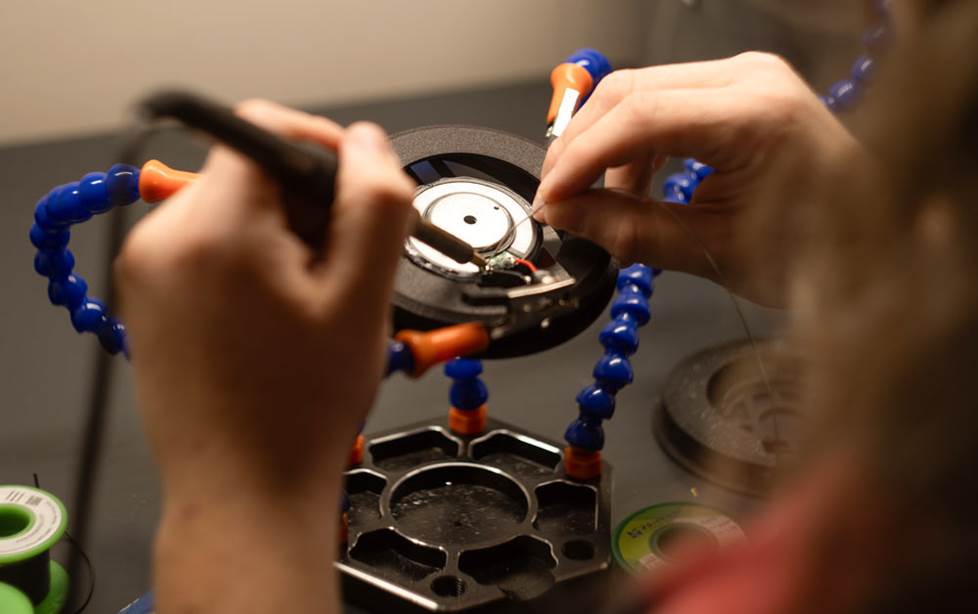
DMS builds headphones with his childhood friend and engineer, Isaac: “He’s a precision machine..who's great at problem-solving and optimizing our process.”
And then of course, I’m spending a lot of time working on the Omega headphones. I'm lucky I have my childhood friend, Isaac, here to take on a lot of the workload of assembling [those headphones] — another advantage to coming back home to Tennessee.
“It was just bliss from there...”
Before we got too far into his current project, I wanted to take DMS back to the beginning. Back to the source of his enthusiasm for headphones — where did it all start?
We all have our own story of how we ended up hooked on headphones and personal audio. But I’m especially curious when headphones drive people to your level of infatuation — or, dare I say, obsession.
That’s a good word for it.
How did you get so deep into what we affectionately call “this hobby?”
I've been in love with this hobby for as long as I can remember. I mean, literally, when I was a kid, and was definitely not tall enough to reach this table. Back then, my dad took me to a hi-fi shop, and I was really into audio gear from the start. Something just clicked.
Is your father into headphones or is he more of a two-channel (speaker) guy?
Oh, he’s speakers for sure. I mean, he definitely has some headphones around. He has a set of the Omega. I had a blemished B-stock pair I was never going to be able to sell. He enjoys them, but he's always been into speakers — going back to his days working in the music industry.
He had his own company here in Nashville that worked on a lot of live productions in the area. He did gigs at the Ryman Auditorium for ages. I think he had the longest running continuous contract there for A/V providers.
Wow, talk about a Nashville landmark!
I’ve always loved that venue. I remember him doing all kinds of gigs at the Ryman — for so many music legends. Every once in a while, he let me tag along. Absolutely magical place to experience a show, because it’s all these huge artists playing in such an intimate historic venue.

DMS fondly recalls tagging along for his dad’s production gigs at the iconic Ryman Auditorium: “Absolutely magical place.”
So yeah, he lives music. He's used to having the music [playing] all around him, while he's working, doing stuff around the house, you name it.
I bet you guys had a great stereo at the house when you were growing up.
He did have some nice speakers. You remember those old, old Polk Audio speakers that have that kind of square-box tweeter and then two midrange drivers? They also have that big passive radiator on the bottom? He's got a set of those that he's had for probably like 30 years. (I presume he's referring to the Polk Monitor 7s — Jeff M.)
He's got some Magnepans, he's got some Vandersteen's. And he loves, loves JBL, the old-school JBL.
My uncle is the same way! When I visited Harman (JBL’s parent company) last year to interview Dr. Sean Olive, he got very excited. He had the OG L100s, with the waffle grilles that they based the newer L100 Classic series on.
They're so pretty. Those angular grills. I'd love to get a set of those one day. I also really love the JBL 4329P studio monitors. Those are fantastic — I got to hear them at [the Hi-Fi Munich audio show] last year.
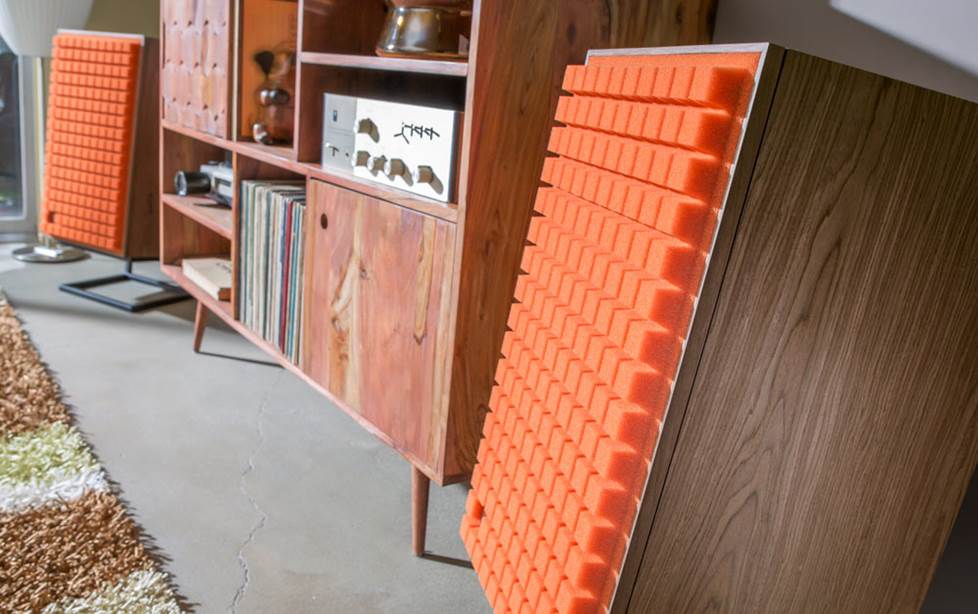
The vintage-styled JBL L100 Classic MkII speakers are inspired by the iconic L100 from the 1970s, right down to the waffle grille.
Does your dad get a kick out of you going to all these shows? Or maybe jealous that you get to hear all this two-channel gear?
(Laughs.) No, he’s super supportive. And while he’s always been into two-channel, he’s actually not the kind of guy who will put them in a room and sit in a chair and listen. Instead, he sets [speakers] up all over his house. Then he goes from room to room [letting the music follow him]. He starts cooking up something in the kitchen and just starts singing along.
He likes to crank up his hi-fi tunes and, listens to, you know, Alan Parsons and stuff like that while he goes about doing things. [He keeps his soundtrack] thematic, like if he's cooking Cajun food, like gumbo, he listens to Louisiana music. So, I grew up in a house that was always full of music and, you know, decent sound quality. I guess it was sort of inevitable that I would love this hobby to some extent.
Do you remember your first pair of headphones?
Yes. The first set of headphones that I ever bought with my own money were Sennheiser headphones, the Sennheiser HD 201 [closed-backs]. They were also the first set that I heard and was like, “Whoa! There's something special happening here.”
At the time they were like, $18 or $19. You can get them now for like 30, 40 bucks. But I had the HD 201, I had the [second generation of that model]. We lived on a farm and I would go out and push mow the front yard. And I'd be wearing those headphones — no noise cancellation — push-mowing the yard. And I had a CD player on my belt. (Laughs.) It was just it was bliss from there.
I hear you! But once you get that itch...
It definitely turned into a slippery slope. And in high school, I tried the Beats [headphones] because that's when everyone was big into those. But I think that Sennheiser definitely got me early. They introduced me to this immersion that you get out of headphones.
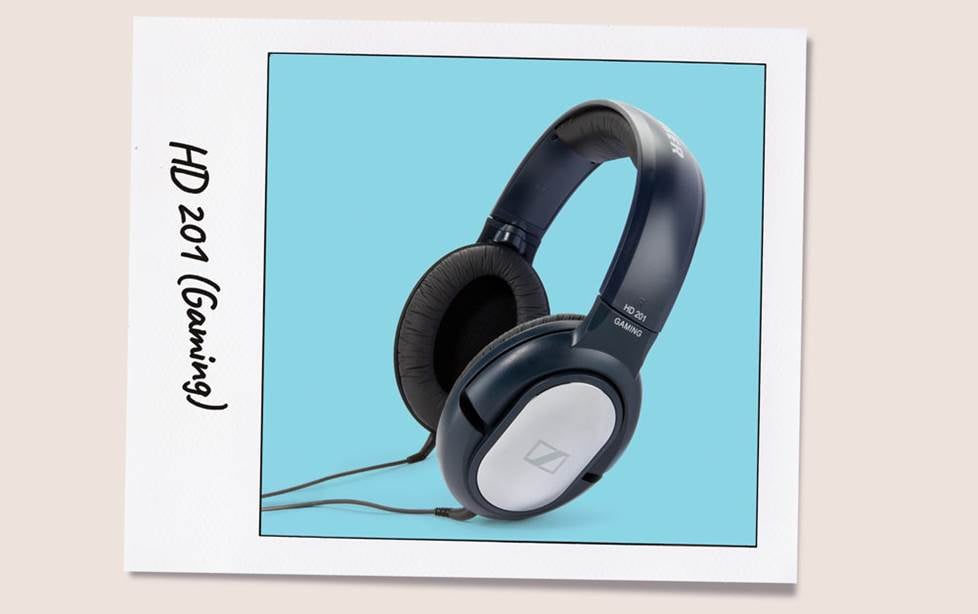
The "G4ME" gaming edition of the Sennheiser HD 201 headphones (from the Crutchfield photo archives, 2008).
Don’t get me wrong, I love stereo, I love two-channel… I’ve bought a bajillion speakers over the years. But there's something I really love about sitting down in a nice chair, or couch — or even at my computer — and putting headphones on. And rather than having the sound in the room with me, be fully immersed in it. You know, in my own little world.
It tickles a special spot, you know? And I think those HD 201s, which, you know, looking back, it's not the best headphone Sennheiser had then or certainly now. But it gave me that experience that just kind of started it all! Between that and my dad introducing me to hi-fi, I feel like really sent me down the path... Experiencing that full immersion is something I've never really gotten away from.
On spatial audio, HRTF, and future personal audio trends
The word “immersion” naturally led us to another hot topic in sound — spatial audio with Dolby Atmos. This newer format has been popularized by Apple Music. Instead of the traditional left/right stereo music presentation, the soundfield envelops you with sonic artifacts pouring from all directions.
Manny Marroquin, the 14-time Grammy Award-winning mixing engineer, told me that it requires a whole different approach to music. “For stereo, it’s always been an evolution of how we ‘glue’ [sounds together] to make emotion,” he said. “Now we’re trying to make emotion with space.”
It’s also fueled newer research for the people who make the gear. A lot of these studies center around the head-related transfer function, or HRTF. HRTF refers to how your brain detects direction and distance based on the relation of the sound to your left or right ear. It’s top of mind for DMS, too.
What are your thoughts on spatial audio?
Did you ever see the video I put out a few years ago where [I put together] a 12-speaker, 7.1.4 Atmos system on the cheap? That is the closest experience I've had to headphones in a speaker system — like a similar level of immersion. And it wasn’t even with [super-high-end speakers]. It was a bunch of bookshelf speakers mounted to the ceiling and all around the wall using mini-DSPs (digital signal processors).
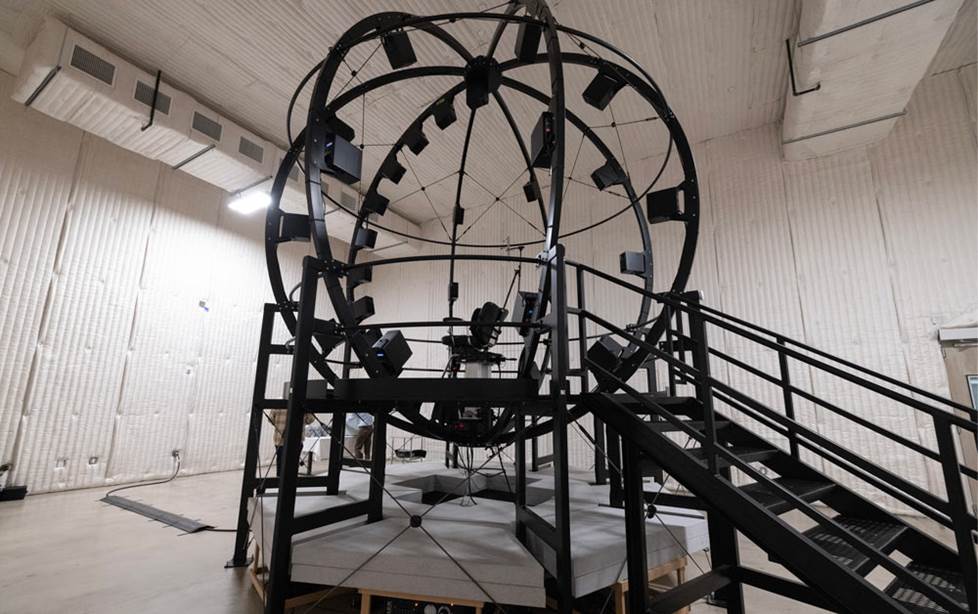
26 professional JBL loudspeakers (including four subs) surround the massive Hyperion Sphere in Harman's labs. It's all to effectively measure HRTF and improve spatial audio.
One of these days I'm going to rebuild a big, crazy Atmos [home theater] system again. But that's a similar feeling. And there's something about that immersion that's super, super fun.
Especially with the right spatial audio mix!
For sure, the Atmos mixes can be hit or miss, but there are some mind-blowing ones out there.
Talking to customers, it’s something everyone is excited about or at least curious, but there’s still that barrier to entry. It’s better than the old surround formats of the past — spatial audio starts with a subscription to Apple Music and a few taps on phone. Plus, you can play it with a wider variety of gear. But even thought it's so accessible in some ways, some functions still require proprietary gear like the Apple TV and AirPods.
I'm enthusiastic about where they're heading. I've talked to some of [Apple’s] engineers about things they're working on. I’m excited about their direction and future of Atmos with their products. But something that matters a lot is having, in my opinion, a frequency response that's similar to a realistic HRTF.
That's the center of Sean Olive and Harman's research into spatial audio. They showed me that huge, 20-foot high Hyperion Sphere that takes HRTF measurements at all angles, so they can figure out how to better create directionality and space.
If you take the HRTF measurement of the listener — and this is a very loose explanation of this — and you were to put it in a room... You basically take a calibrated speaker and put it in a semi-treated room and then take measurements at the eardrum instead of getting that response. That's just like a normal diffuse field curve. You get [a measurement curve] that is a bit more sloped, and you get a little bit more bass.
You're still getting what is a natural head related transfer function, but you're experiencing how things would actually sound in a room versus how things sound in a completely empty, diffuse field. Because, you know, you listen to speakers in a room, not necessarily in a void.
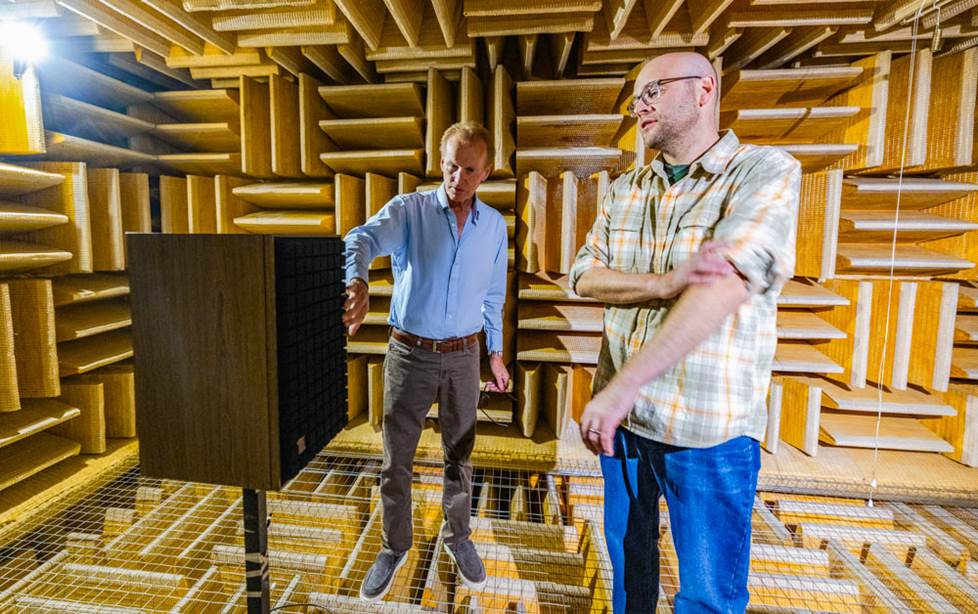
Inside one of Harman/JBL's anechoic chambers with Dr. Sean Olive, who helped develop the famed “Harman Target” listening curve for headphones.
Yeah, like with bass — you’re hearing the initial bass impact, but also the nearby reflections, and eventually all around the room. And your brain isn’t taking it piece by piece, right? It’s absorbed all at once and figuring it out in real time.
Yep, but another thing is that in a room you have "room gain." So if you're listening to a speaker and [have it placed] way against the back wall, the bass gets louder. So, a lot of low frequencies will sort of amplify through the room as they're getting to the listener. Instead of getting a response that looks [flat] when calibrated, if you use [diffuse] field, you get a response where your bass is up a little bit higher and your treble is tilted a little bit lower. It's like a slope and it's about ten decibels downward from 20Hz to 20kHz.
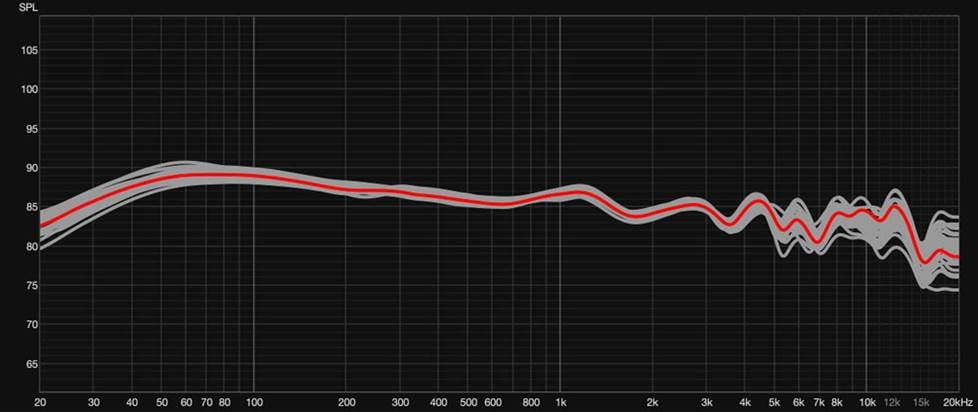
Frequency response measurements of 125 different sets of Project Omega headphones. (By DMS on the B&K 4128C measurement rig, compensated to it's diffuse-field HRTF.)
That's basically the target I was going for with the Omega — within a couple decibels of that. [Listeners at trade shows have told me that the Omega] sounds “spacious and natural.” And it's like, well, that's because it's similar to the frequency response of your ear. It's not severely altered from that.
“Measure and measure again”
One of the things that makes DMS a great headphone reviewer is his attention to detail. He’s able to home in on certain sonic characteristics that less-focused reviewers can miss. So, it’s no surprise that he remained mindful of sound quality, even on a design element that's usually an afterthought — where to put the serial number.
On your Omega introduction video, you said, “even the placement of the serial number was in service to the sound.” What did you mean?
Well, it wasn’t as calculated as that sounds. (Laughs.)
Like I said, the vast majority of the tuning was to the diffuse field — specifically, the HRTF of [my older Bruel & Kjael Head & Torso Simulator (HATS) measurement rig]. That way, everything translates well to [whichever measurement rig you might use]. But I would measure at each and every stage in the process.
VIDEO: A tour around the workshop and developing ear pads
If I changed some part of the geometry of the cup by like a millimeter — or change the positioning by a half a millimeter — then I would 3D print another test version of it. Then I’d measure, measure, measure… Clean up the model, assemble it, then measure again. And sometimes do that two or three times at the same model because the [measurement] would vary just a little bit.
It’s always best practice to get several measurements to account for weird anomalies, right?
Yeah. Keep trying and measuring. And eventually, I found that a certain part of the driver right here. (Points to the outer-facing grille.) If you blocked the internal structure of this part, then it would cause a peak [in the treble]. But if you blocked it on the external part of [the grille] — which is about 1.8mm out — then it would reduce that same frequency instead of increasing it.
And I was asking my friend, Blaine, about this — the online measurement guru who goes by the internet handle “Mad Economist.” He told me that I may have inadvertently created a quarter-wave resonator.
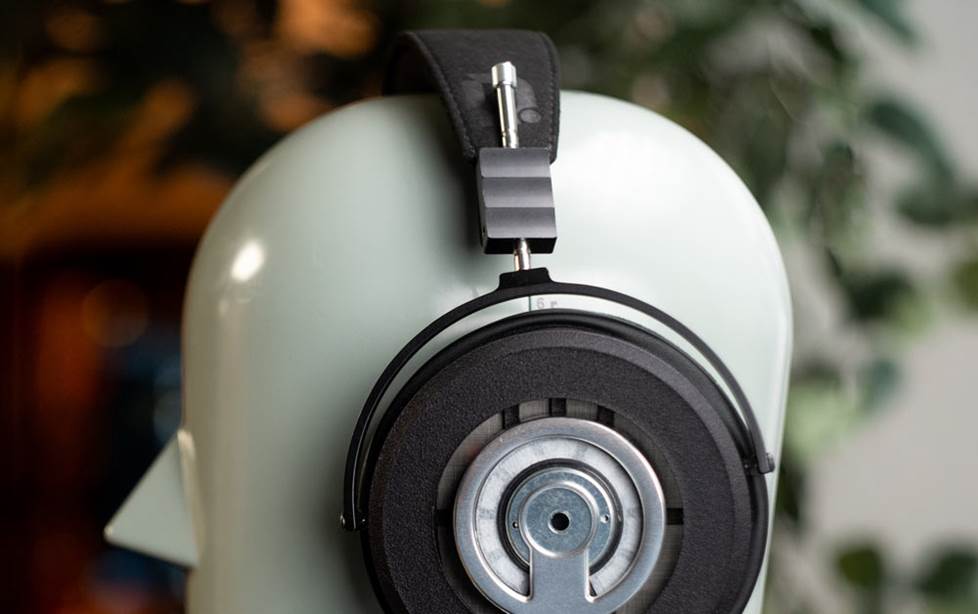
After every small tweak or change, DMS measured the headphones on his B&K 4128 Head-And-Torso Simulator headphone measurement rig.
Basically, the thickness of the plate combined with [a certain area being covered] created a [baffle] that would reduce and smooth out [the harshness of] the treble. And the more we experimented with it, we were able to use it to take out that bothersome [sonic] peak. So, I added a plate that sits right over the driver.
But how do you explain to people why there's a random square plate on the inside of their headphones? So I thought and it's like, “Oh, we should put the serial number on that! That'd be the perfect spot for it.”
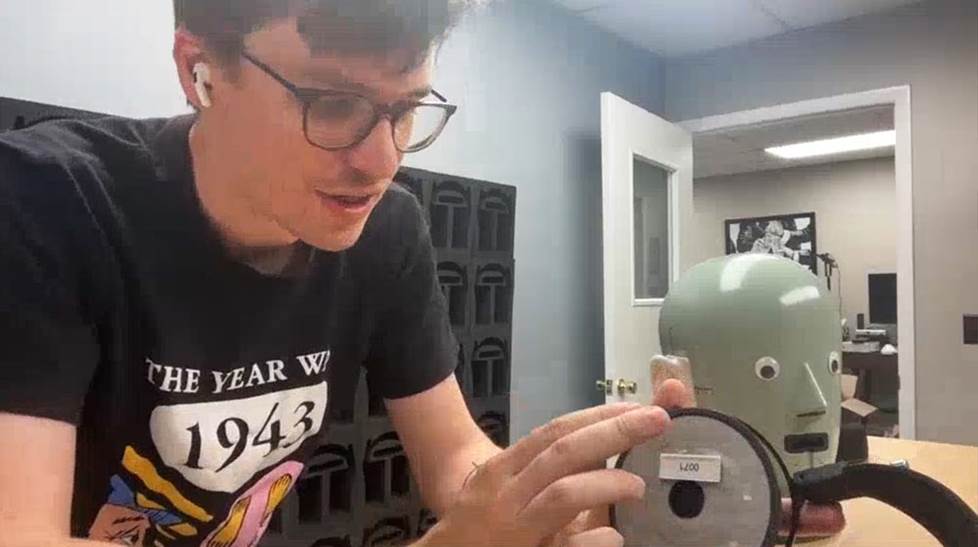
The serial number plate serves a dual purpose — it's also a damping filter that helps smooth out harsh high-frequency peaks.
It's just kind of like a happy coincidence that resulted from R&D. [The serial number plate] ended up turning into something that was functional, in more than one way.
Designing for comfort
Speaking of functional, DMS has always focused on comfort and ergonomics — making a point to highlight the fit and feel in his reviews. That also happens to be an area where we’ve done a ton of research here at Crutchfield. In 2019, our staff scored over 50 headphones for comfort and fit, testing that still informs our “Top 5 comfortable headphones” today.
I came out of our own in-house comfort testing a little surprised that “security and stability” were what mattered most to our testers. Some snug-fitting headphones scored as well as relaxed ones, and light ones as well as heavier ones. It was more about getting the clamp force and weight distribution right.
Interesting. I'm very sensitive around the top middle of my head. Which is probably part of why I love like the Sennheiser HD 600 so much, and the HD 650. And they do have a little bit more clamp force. (The HD 600 series also scored extremely well in Crutchfield’s in-house testing and the HD 660S2 is one of our five most comfortable headphones — Jeff M.)
So I wanted to try and balance it to where it would be. Not painful on top of my head, but wouldn't be too much clamping force, either. A lot of that comes down to the headband design. You have like where this rod right here, this adjustment mechanism goes down, but it doesn't go straight down to the yoke. The yoke actually comes out at an angle.
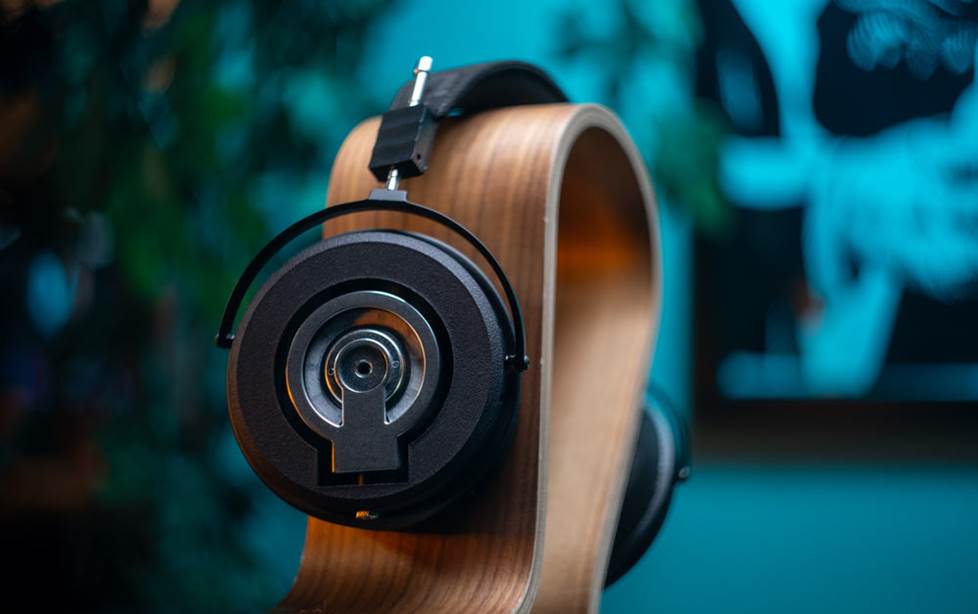
DMS set the metal yokes of the headband an angle to help relieve pressure on the top of the head.
That way, when you pull the headphone out, [the headband] kind of tensions and then those pieces go flat. A lot of the headband tensioning comes down to the angle of these rods. And how this piece of spring is set in the headband up at the top. This took, I would say, way too many revisions.
It’s funny you mention that piece of spring. The Meze 99 Classics were named our #1 most comfortable headphones. When I interviewed [company founder and lead designer] Antonio Meze, he said they landed on a single spring that stretches over the head. That was after trying several different design and spring options.
So I'm sure you can tell looking at these headphones that I am not a designer. Again, I make things that are functional. But Antonio makes some true works of art. I think it would take me five of my lifetimes to make a product that is as beautiful as the things that Antonio makes. He's a brilliant industrial designer. He makes some of the most comfortable and beautiful art pieces that I've ever listened to. I'm a little bit envious of how great of a designer he is and I also really appreciate his contributions to the industry.
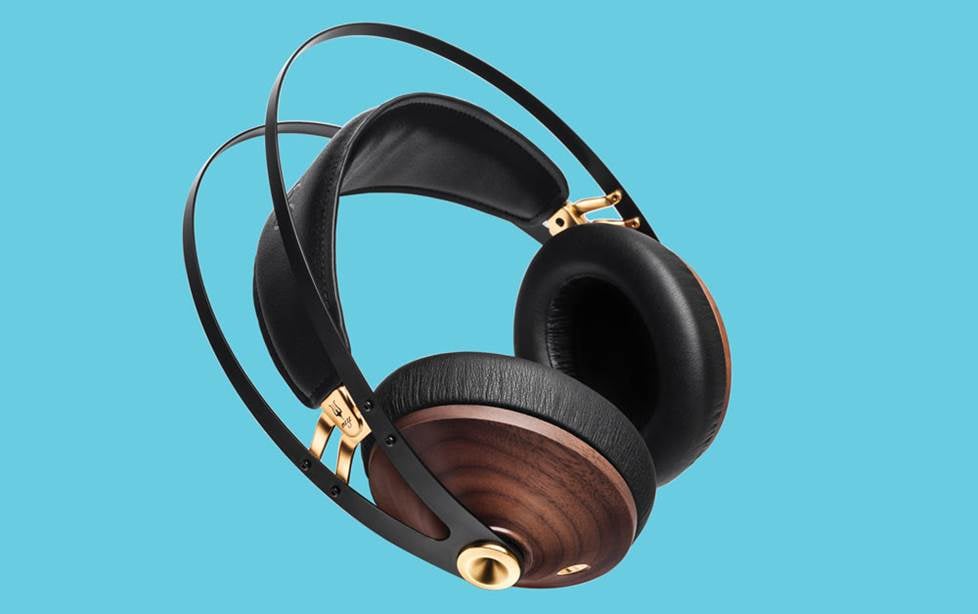
The Meze 99 Classics (Crutchfield's longstanding pick for "most comfortable overall") use a spring-suspension headband. DMS experimented with this style of headband, but it didn't work for his overall design.
But there were a number of people who told me that if I'm building a headphone, they wanted it to have a suspension strap [like the Meze models]. I didn't. I wanted to just do a soft headband. And when I did all my measurements, it's even pressure.
For some people with smaller heads, it'll probably be less clamp and more [pressure] on top, and people with larger heads will probably be a little bit more clamp and less on top. It will always vary a little bit — but I was getting more consistent clamp with a straight up padded top than I was with a suspension strap.
Oh, that’s wild. So almost completely the opposite of where Antonio landed.
With a suspension strap, I was getting much more variance in the clamp pressure. So, if someone had a small head, the clamp pressure wasn’t just a little bit less, it would measure dramatically less.
So through the creation process, it seems like you stuck to your guns. But at a certain point you decided “these aren’t just headphones I’m making for myself.” Since you were making the Omega headphones for a larger audience, what was the biggest compromise you had to make?
Nothing sonically. Again, it was back to the build. I already kind of know that the headband will be an unpopular choice in some circles, and that's fine. But if I was to change one thing just for me? (Pauses.) Hmmm. I would probably do one of the yoke retention mechanisms a little bit differently.
The very first model I made was my own original personal unit, so I made it basically just to fit my own head. Which was really nice. [Tweaking the design] to fit different sizes of heads added about ten grams and brought it from 290 grams up until up to 300 grams. So if it was just for me, I would make the version that's ten grams lighter.
VIDEO: The learning curve of working with laser cutting machines
I'd love to shave some more weight off these headphones, but I don't see a way to cut down any more than it already is at the moment. But, who knows? Maybe when [the design is] open sourced, somebody will figure out a way how to get that extra ten grams back somewhere else. I’m happy that they only weigh 300 grams — but I know that the perfect headphone would be functionally weightless.
Standing on “the other side of the table”
DMS has said that the Project Omega is not primarily about commercial gain — in one video, in fact, he detailed that his margins are razor thin. Instead, he hopes to gain a deeper understanding of what goes into the products he reviews. He also believes that there is value in his vast experience of evaluating headphones.
“Over my years of reviewing headphones, there’s been a lot of little things that I’ve nitpicked about,” he said in the launch video. “So, I decided to make a headphone that would avoid all of those various 'dealbreakers.'”
It’s funny you mention the “perfect headphone,” because you and I both know that can change from use to use. (We have nearly a dozen “Best headphones” lists at Crutchfield.) And of course, we all strive to be the “perfect headphone reviewer.”
That’s not a real thing! (Laughs.)
One of your goals with this project was to improve yourself as a reviewer. In your words, “to see all that’s involved in taking a headphone to market.” That way, you can speak with more authority about the products and companies you review.
More or less, that’s the idea. To stand on the other side of the table. Instead of being the one dishing out the feedback to, kind of, receive it.
On the other end of this — and this is one of my worries just from meeting some of the engineers, designers, and artists we cover: a bad movie is a bad movie, even if you know the limitations or understand why certain choices were made. Do you worry at all that in some ways you’re going to be a better reviewer, but in [knowing the compromises made along the way] that you may become, too...[forgiving]?
(Brief pause.)
Maybe. I mean, the thing is, is I feel like we can never really know. In a lot of ways, you know, I think that intentions matter — but also how we apply them matters. So for me, I have loved being a reviewer...and I still plan to be a reviewer for a long time. But a big part of that is also just trying to do my best.
And there's a lot of things that I feel like already I've learned. I can look at other products and think, "Wow, that was, you know, really tough or really expensive to do." Some of the impressive things that they do in the construction. The Dan Clark Audio E3 is a good example, and a fantastic headphone.
It is! Certainly one of the most spacious closed-backs I’ve heard.
I think it's like probably the best closed-back headphone on the planet. (Since our interview, DMS has named the new Dan Clark NoireX his 2024 pick for headphone of the year.) There are facets of the construction that I look at and I'm like, "Gee, that must have been expensive."
[Before I started working on Omega], I always saw a construction like that and thought, well, that looks cool. I don't know why they did it that way, but it looks cool and it's comfy. But now, I think to myself about all the trial and error, “It must have gone through like so many iterations.”
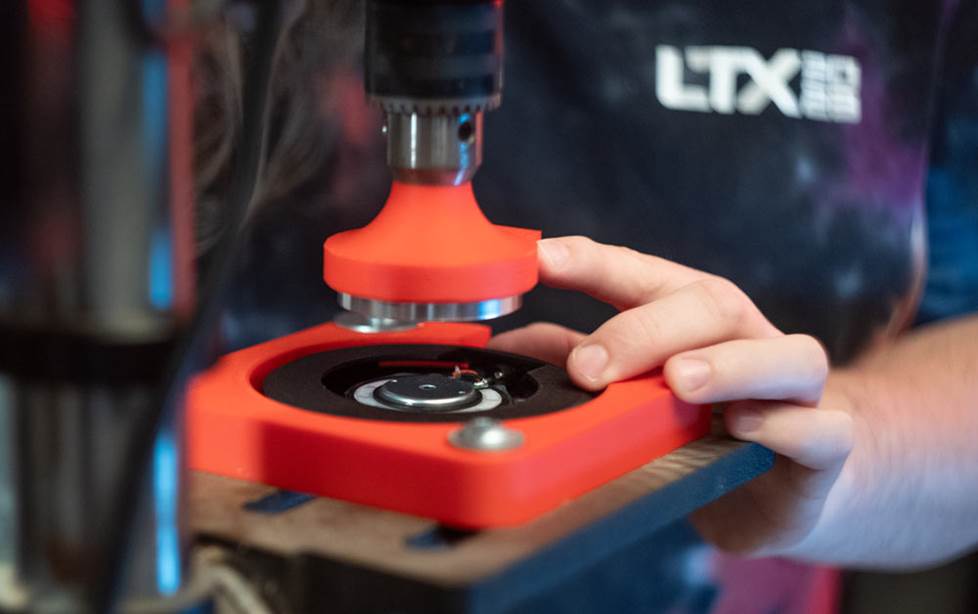
The Project Omega creation process has helped DMS recognize and appreciate the attention to detail in other headphones.
Now when I look at how like this mechanism catches right here when the headband folds. Or how it limits itself when it goes in any given direction. It's like, "Oh, wow, that was really smart! That makes sense." So, it definitely gave me a lot more appreciation for things that I never would have noticed in the past. Because they didn't have to do it that way, but they did anyway, and it made a better product.
The inverse is looking at another company's headphone and thinking, “why did they do it like that? Like this is a cheap headphone.” There's no real way around it! I can immediately see that one piece is going to fall apart or another part isn't going to retain the same way [over time].
In the past, [I could say] something felt cheap but I couldn't articulate why. So, building these headphones really like gave me a deeper understanding. Now, is that knowledge is actually practical and applicable? It's hard to say, because there are some things I feel like I can look at now and be like, "Oh, well, that piece is probably going to wear out faster."
You can better pick out those moments of attentiveness versus carelessness?
Right. But, if I know how a certain mechanism works, does that make the headphone any more comfortable to the end user? Probably not. Someone's never really going to think about that. It's hard to say whether or not that will actually make me a better content creator. I definitely feel like it feeds my obsession with this hobby — and it’s fun to have a greater understanding of it.
But you know, as far as reviewing goes, you know, I love headphones and I love my job. I wouldn't trade it for anything in the world. And [this experience] has been something that kind of enables me to love it a little bit more.
Need help choosing headphones? Contact us.
Do you love headphones or have questions about them? Contact us today.
Our expert Advisors know our gear inside and out. And free lifetime tech support is included with your Crutchfield purchase.








Comments (0)