Best high-end DACs for 2026
Our top high-performance digital-to-analog converter picks

In this article: I'll offer some shopping tips to give you a head start on picking out the best DAC for your needs. And I'll go over our top five high-end DAC picks...
- Best DAC with lossless Bluetooth — iFi iDSD Valkyrie
- Best headphone amp/DAC — Sennheiser HDV 820
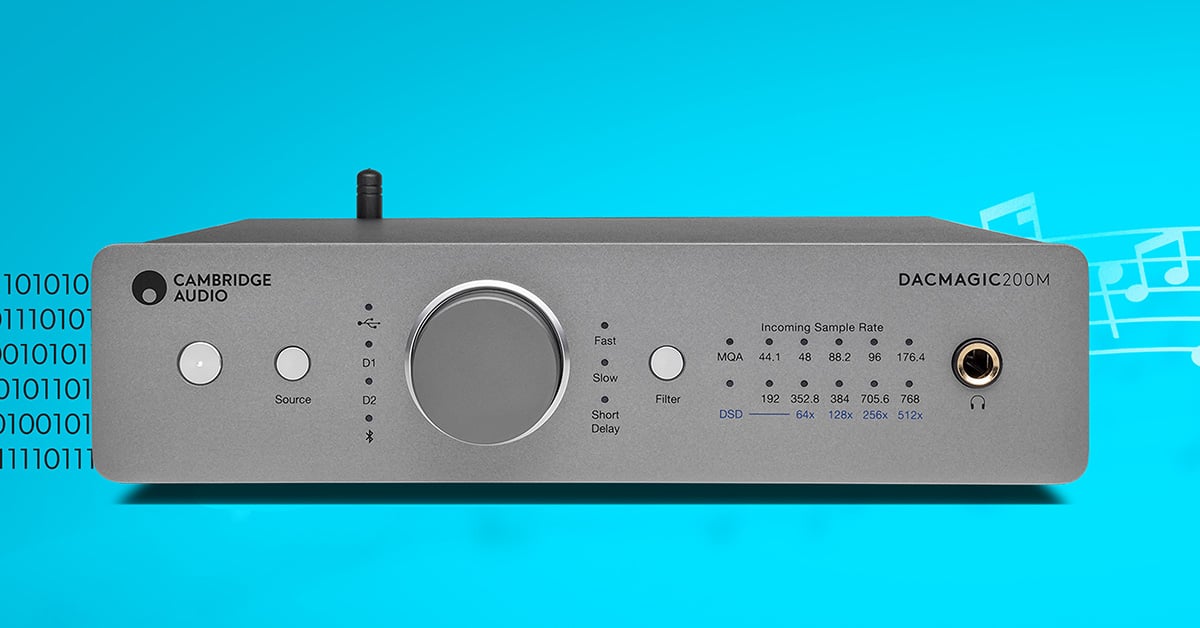
- Most versatile DAC — Cambridge Audio DacMagic 200M
- Best Wi-Fi DAC for streaming — Naim Uniti Atom Headphone Edition
- Best-looking DAC — McIntosh MDA200
In our modern, digital age, digital-to-analog converters (DACs) play a crucial role in sound and music reproduction. Since most sources are digital these days, their signal needs to be converted to analog before your speakers or headphones can reproduce the source's sound. DACs are everywhere, from smartphones, car stereos, and computers to TVs, Bluetooth speakers, and more.
Not all DACs are made equal, though. In fact, most "stock" DACs that come built into your electronics are there to do the bare minimum. High-quality outboard digital-to-analog converters make a tremendous improvement in sound quality since that conversion is the main focus of their design.
It's crucial to note that DACs do not add any details to your music that weren't already present. To use an analogy a colleague of mine once used: Think of a dirty window. You can use a paper towel to wipe some of the grime off and see a little better outside. Or, you can use window cleaner and a squeegee to clean the window for a much better look outside. The outside is still the same in both scenarios, but with the window cleaner/squeegee combo, you can see more of it and take in more details.
Before we dive into the picks, I want to cover some important specs to look out for, as well as some DAC shopping tips to guide you along.
Understanding the specs
Before beginning your search for the right DAC, one of the first things you should understand is the relationship between bit depth and sampling rate. Without getting too into the weeds:
Bit depth (measured in bits) is how much information the digital-to-analog converter can handle. The higher the number, the better.
Sampling rate (measured in kHz) is how many times that information is sampled per second.
For a practical example, you may see DACs that are capable of 32-bit/768kHz resolution. The digital-to-analog converter chip can handle 32 bits of information, and that information gets sampled 768,000 times per second. Compare that to a 24-bit/192kHz DAC, and you'll see that the 32-bit DAC is capable of handling more information, which improves the overall resolution of the track, and that the information is sampled four times as frequently.
A DAC's frequency response tells you the range of frequencies, from lowest to highest, that the DAC is capable of reproducing.
Total Harmonic Distortion (THD) tells you, as a percentage, how much noise is introduced into the signal during the digital-to-analog conversion process. The lower the number, the better.
Signal-to-Noise Ratio (SNR) is a ratio of how much signal is present to how much noise is present in the signal. This is expressed in decibels (dB). The higher the number, the better.
Connections
When shopping for a DAC, the first thing I recommend considering is how the DAC will integrate with your system and connect to your sources.
Inputs
You'll want to snag a DAC that has enough digital inputs for what you're looking to connect. The most common types of digital connections that go from sources into DACs are listed below.
Optical digital connections are found on CD players, TVs, and game consoles.
Coaxial digital connections are also found on CD players, as well as Blu-Ray players, TVs, and the sound card on some computers.
USB connections are found on computers, smartphones, and tablets.
Outputs
You'll also want to make sure the DAC has the right outputs for the gear you want to connect. Here are some common ones to look out for.
Analog RCA outputs are found on most DACs. These outputs are compatible with anything that has analog RCA inputs, like receivers and integrated amplifiers.
Balanced XLR outputs are found on higher-end DACs and offer better sound quality than their unbalanced counterparts. Just make sure your receiver or amplifier has the inputs to accept them.
Headphone outputs
If you're a headphone user, you want to make sure your DAC has the right headphone output.
1/4" headphone outputs are offered on a ton of DACs. This kind of output is unbalanced.
4.4mm and XLR headphone outputs are balanced and offer better sound quality. If your headphones terminate into a 4.4mm or XLR, this connection type is the way to go.
Streaming features
The last thing to keep in mind is whether you'd like to stream to the DAC over Wi-Fi or Bluetooth (or both). A lot of digital-to-analog converters come with those features and integrate nifty things like Apple AirPlay 2, Spotify Connect, and TIDAL Connect.
Why we chose these DACs
The DACs on this list were chosen for their top-notch performance. These are some of the very best digital-to-analog converters we carry. They all offer exceptional sound quality, ample inputs and outputs, and robust digital-to-analog converter chips.
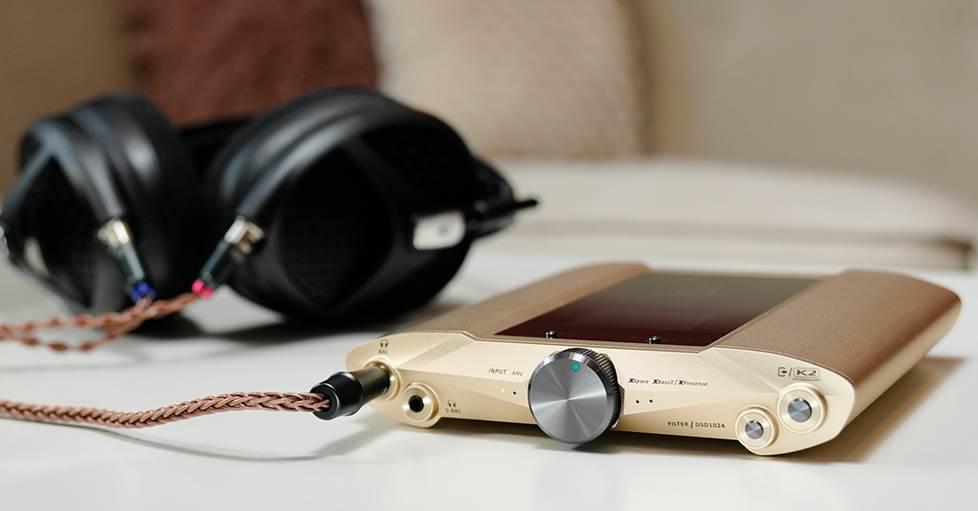
Best DAC with lossless Bluetooth — iFi iDSD Valkyrie
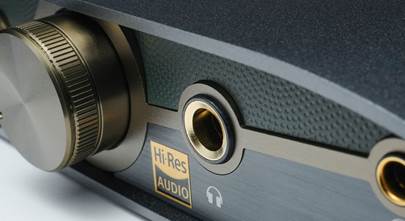
British hi-fi masters iFi continue to push the envelope of what digital-to-analog converters can do. The iDSD Valkyrie is a sleek, portable digital-to-analog converter filled with audiophile goodies. It uses advanced sound processing technology to deliver pristine sound, and comes with lossless Bluetooth so you can stream your music without compromise.
The Valkyrie features four 32-bit/768kHz Burr-Brown "True Native" digital-to-analog converter chips. Two chips are dedicated to the left and right channels of PCM audio; the other two are for the left and right channels of DSD audio. iFi also teamed up with JVCKENWOOD to bring K2HD™ technology to the DAC. K2HD restores high-frequencies that may be missing in your and gives your music a much fuller picture. And to top it all off: this DAC's proprietary DSD audio processing can upscale DSD files to DSD1024.
The Valkyrie has aptX Lossless, which lets you stream your tunes wirelessly at an astonishing 1,200 kb/s. The signal retains more information when being transmitted, which means you can stream FLAC and other high-res files without a loss in fidelity with compatible devices.
- 4-channel Burr-Brown "True Native" digital-to-analog converter chip for high-quality sound
- coaxial/mini optical digital combination input and USB-C digital input; analog 3.5mm combination line input/output
- unbalanced 3.5mm line output and stereo pair of RCA line outputs; 4.4mm balanced line input/output
- one unbalanced 3.5" headphone output; one balanced 4.4mm headphone output
- signal-to-noise ratio: 116dB
- THD: <0.002%
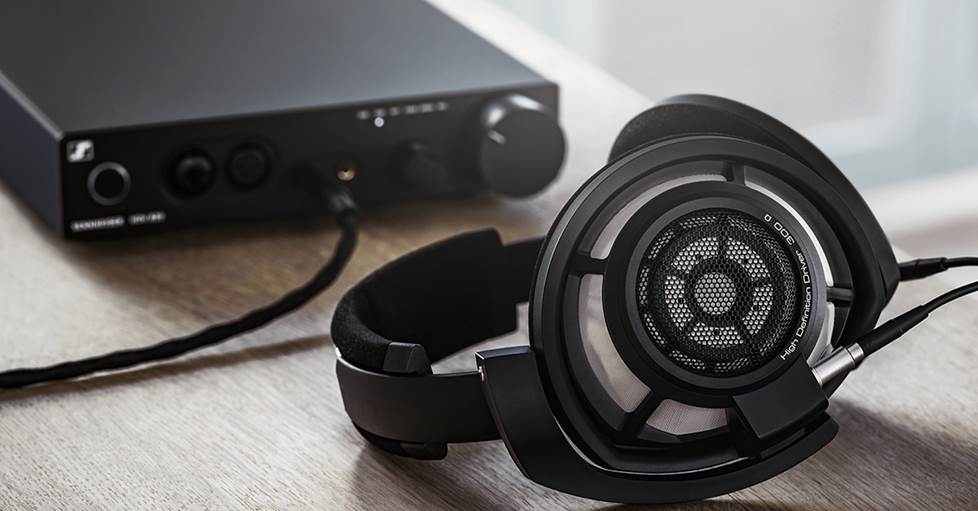
Best headphone amp/DAC — Sennheiser HDV 820
The Sennheiser HDV 820 was purpose-built for one thing: to make any pair of headphones sound fantastic. It achieves this by being as no-frills and audio-focused as possible. It's one of the best headphone DAC/amp combos I've ever used, and my demo session with it left an indelible impression.
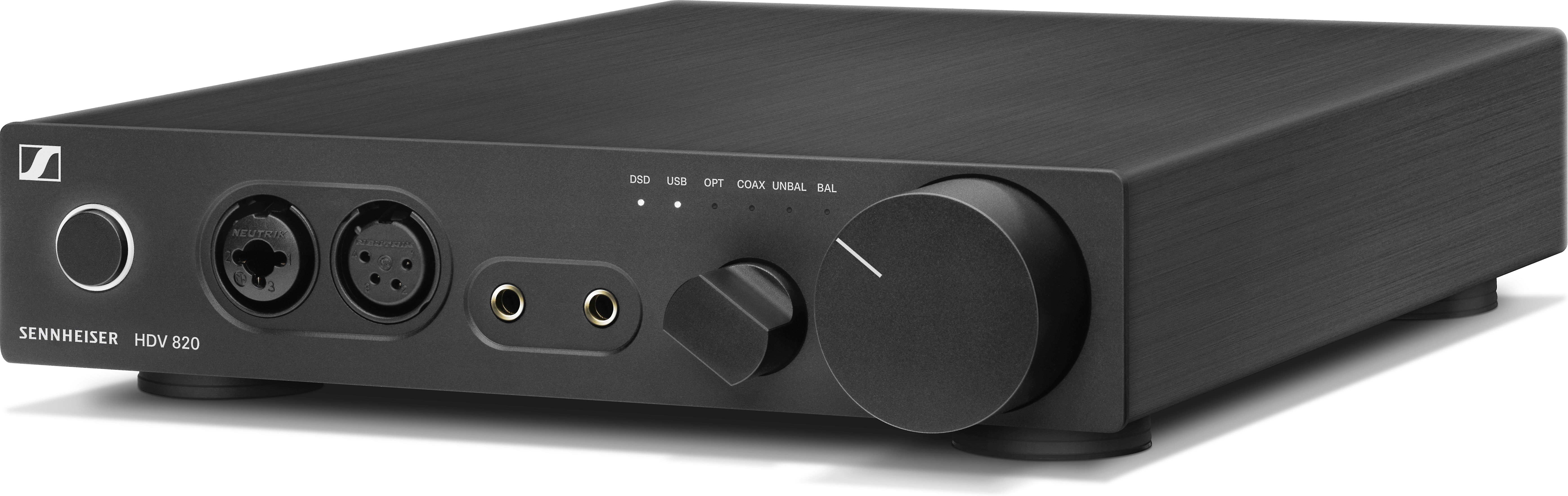
The HDV 820 uses a premium ESS Sabre 32-bit/384 kHz digital-to-analog converter chip that handles the switchover from digital to analog. The circuitry going into and out of the DAC is symmetrical (also called balanced), which improves stereo separation and reduces the chance for noise to come into the audio signal.
This is a DAC/amp made for virtually any pair of headphones. It features a 5-stage gain switch that makes it compatible with lower impedance headphones. The HDV 820 also has a balanced 4-pin XLR headphone output, a combination headphone output consisting of a balanced 3-pin XLR output and unbalanced 1/4" output, and two 4.4mm outputs. And to wrap things up, here's a neat fact: This amp can provide signal and power to four pairs of headphones simultaneously.
Details
- premium ESS Sabre32 digital-to-analog converter for detailed, dynamic sound
- optical digital, coaxial digital, and USB digital inputs; balanced 3-pin XLR and unbalanced RCA analog inputs
- balanced 3-pin XLR preamp outputs
- balanced 4-pin XLR headphone output, combination balanced 3-pin XLR and unbalanced 1/4" headphone output, two balanced 4.4mm headphone outputs
- THD: <0.001%
Most versatile DAC — Cambridge Audio DacMagic 200M
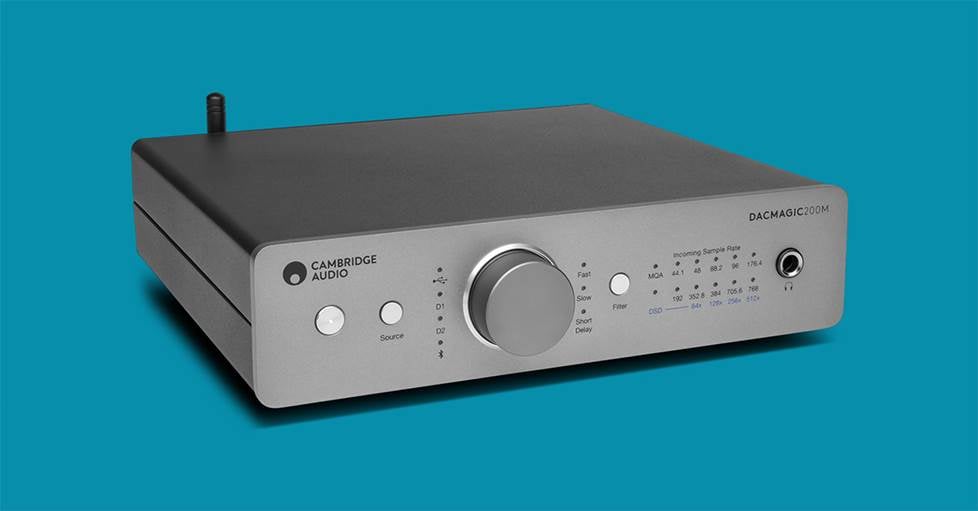
The most affordable DAC on this list, the Cambridge Audio DacMagic 200M, has performance that's on par with other DACs costing double its price. Not only is the DacMagic 200M a fantastic value, but it's well regarded by audiophiles and our customers alike.
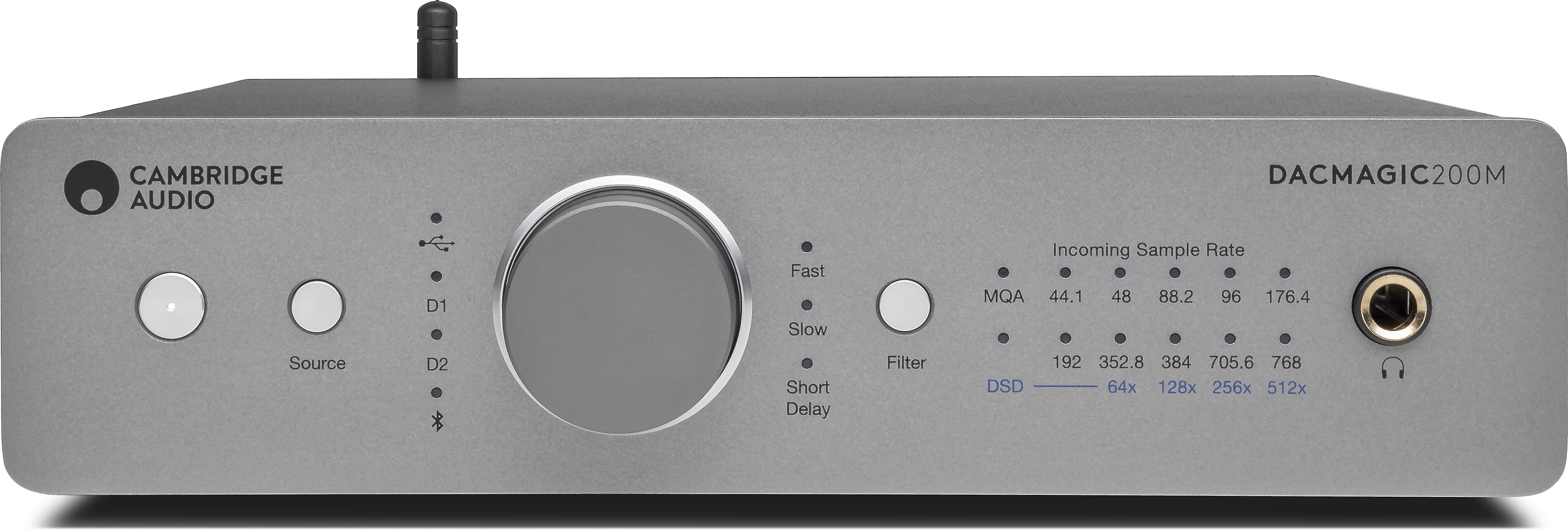
Under its sleek steel/aluminum chassis are two premium ESS Sabre 9028Q2M digital-to-analog converter chips capable of supporting up to 32-bit/768kHz resolution. One chip handles left channel audio, the other handles right channel audio. This DAC also comes with full MQA decoding and rendering and is Cambridge's first DAC to do so.
You can stream to the DacMagic 200M via Bluetooth 4.3. If you'd rather have a physical connection, this DAC comes equipped with two optical digital inputs, two coaxial digital inputs, and a USB input. On the output side, it has balanced XLR and unbalanced RCA outputs, plus an unbalanced 1/4" headphone output. Speaking of headphones, this DAC has plenty of power on tap for all but the most demanding, ultra-high-impedance pairs.
Details
- twin ESS Sabre ES9028Q2M 32-bit digital-to-analog converters in dual mono configuration
- 2 optical digital inputs, 2 coaxial digital inputs, USB Type-B input
- balanced 3-pin XLR output; unbalanced RCA output
- 1/4" headphone output
- signal-to-noise ratio: 115dB
- THD: <0.0005% (DAC), <0.001% (headphone amplifier)
Best Wi-Fi DAC for streaming — Naim Uniti Atom Headphone Edition
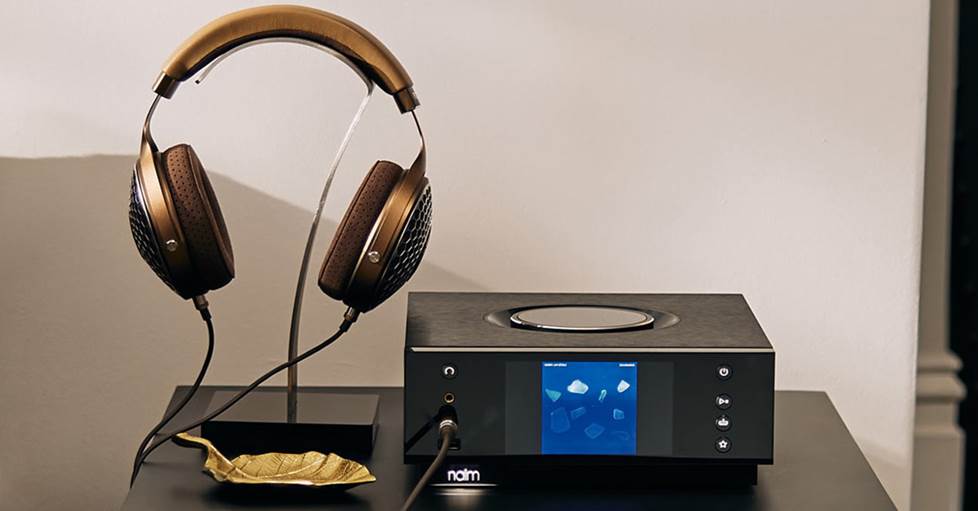
If you're looking for a DAC with powerful streaming capabilities and an excellent headphone amp, look no further than the Naim Uniti Atom Headphone Edition. This bad boy even made our list of best headphone amps for 2026. It takes everything that makes the non-headphone Uniti Atom integrated amp great — like Apple AirPlay 2, Google Chromecast, Spotify Connect, TIDAL Connect, Bluetooth, and one wicked proprietary DAC — and tacks on a powerful headphone amplifier.
I cannot stress enough how awesome the headphone amplifier is. It features a massive transformer tied to a tightly regulated power supply that outputs up to a whopping 1.5 watts of power to headphones. It's compatible with headphones from 16 ohms and up.
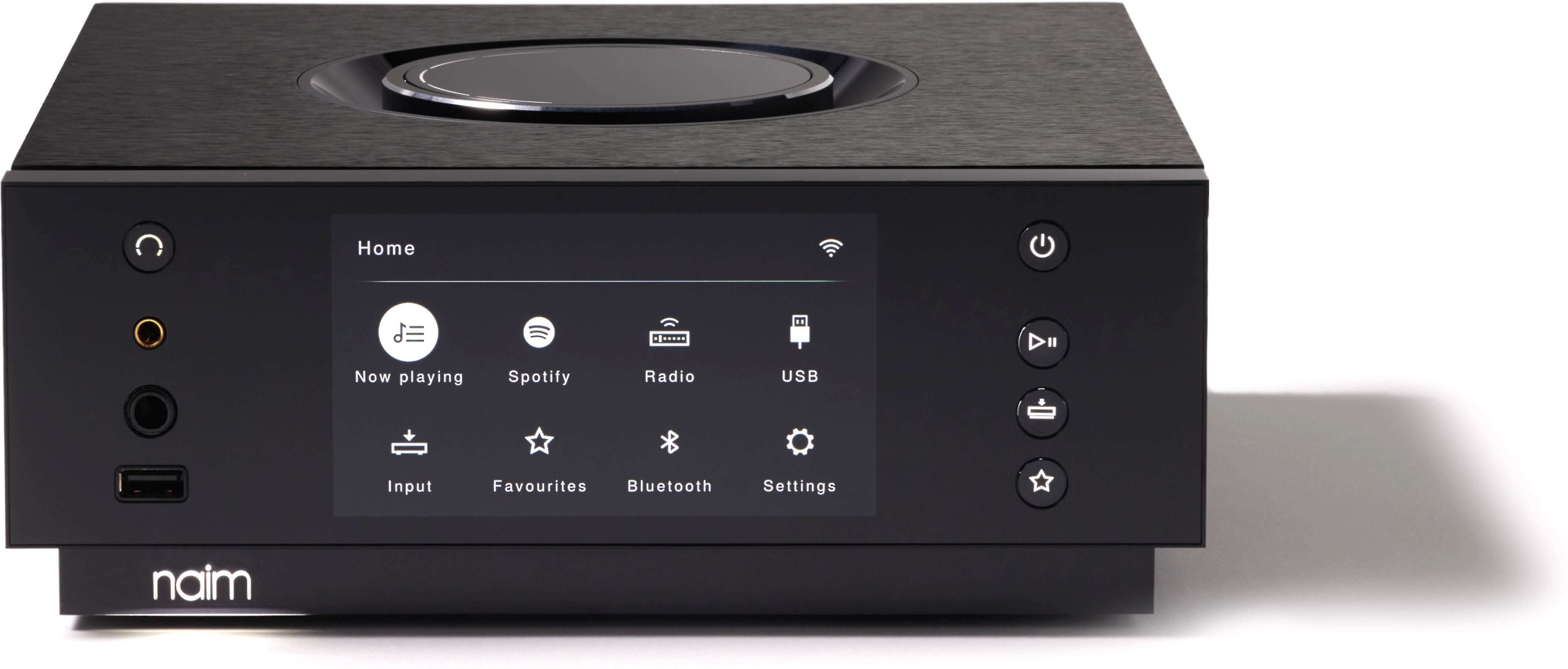
The Uniti Atom Headphone Edition is app-controllable through the Naim app. In the app, you can select your source (including NAS drives), control the volume and EQ settings, and even link it to other Naim speakers and components for an all-in-one music control interface. And even if you don't use the app, the Uniti Atom Headphone Edition features a vibrant front-panel LED display that shows album art, track titles, and artist info.
Details
- 32-bit/384 kHz digital-to-analog converter chip
- large transformer outputs up to 1.5 watts of power to headphones
- 2 Toslink optical digital inputs, one coaxial digital input, two USB 2.0 inputs, one pair of stereo RCA inputs
- mono RCA subwoofer output, balanced XLR preamp outputs
- one unbalanced 1/4" headphone output, balanced 4.4mm and 4-pin XLR outputs,
- app control through the Naim app (available for iOS® and Android™)
Best-looking DAC — McIntosh MDA200
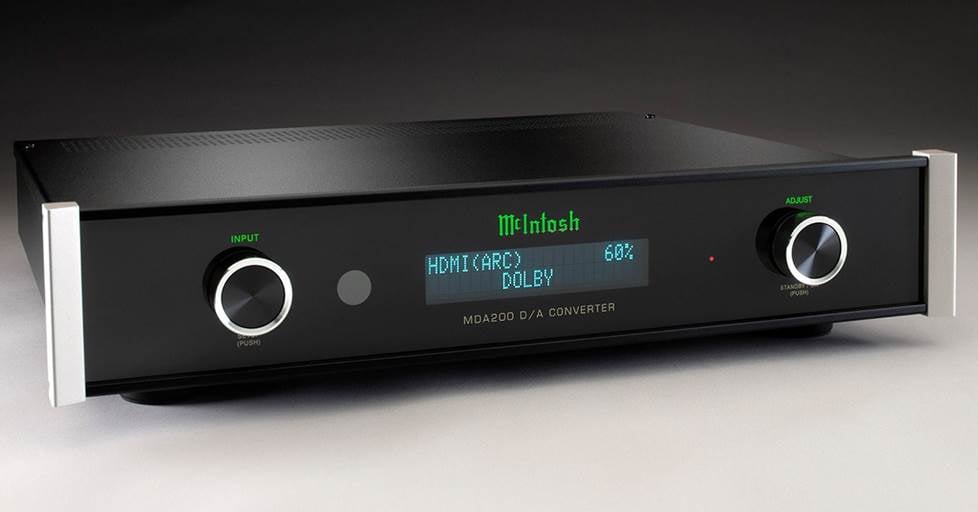
Looking for a vintage-but-modern DAC? The McIntosh MDA200 is a no-frills, vintage-styled digital-to-analog converter with no Wi-Fi or Bluetooth to speak of. That gave McIntosh more room to make this DAC sound phenomenal.
The front of the MDA200 is simple and has a glowing emerald green McIntosh logo above its unobtrusive front-panel LED display. To the sides of the screen are two tactile knobs that control the volume and source. Simplicity at its finest.
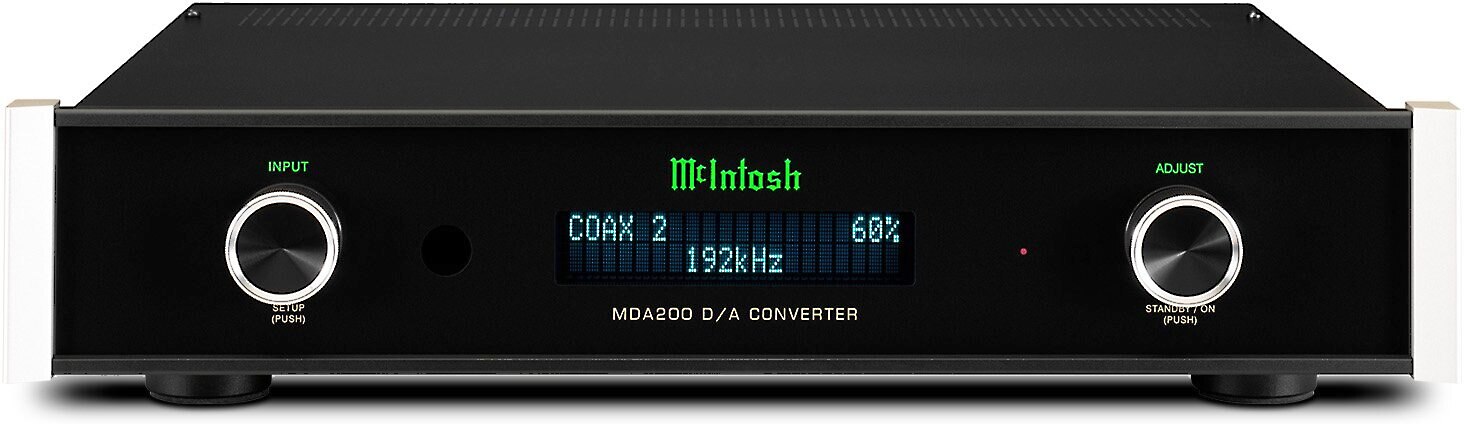
Inside this beast is a custom 8-channel, 32-bit/384kHz digital-to-analog converter chip that features Quad Balanced architecture, which almost completely eliminates distortion. And the neat thing about the DAC chip is it's housed inside McIntosh's DA2 Digital Audio Module. That module can be replaced with the latest one McIntosh cooks up, making the MDA200 future-proof.
This DAC doesn't have a headphone output. But it does have plenty of connections for tying it into your stereo music system, separate headphone amplifier, or even your TV. The MDA200 has two output modes to accommodate a wide range of scenarios. Fixed output mode lets you control the overall volume from the receiver or amplifier the MDA200 is connected to. Variable output mode lets you control the volume via the MDA200 directly. Variable mode is best used with external power amplifiers that don't have any form of volume control.
Details:
- audiophile-grade 8-channel, 32-bit/384kHz digital-to-analog converter chip with Quad Balanced architecture
- 2 Toslink optical digital inputs, 2 coaxial digital inputs, USB Type-B input, and HDMI ARC input
- features data in/out ports and 3.5mm power control in/out ports, and an MCT port for connection to other McIntosh components
- 1 pair of balanced XLR outputs, 1 pair of unbalanced RCA outputs
- THD: 0.005%
- signal-to-noise ratio: 100dB
Need help? Give us a shout
If you're deciding on which DAC to purchase and would like some assistance, feel free to contact any our helpful Sales Advisors. They get hands- and ears-on with a lot of the gear we carry and are more than happy to offer personalized, one-on-one advice. And every Crutchfield purchase comes with free lifetime tech support.
Popular questions customers ask
DAC stands for “digital-to-analog converter”. The DAC chip found inside external DACs is what converts the incoming digital audio signals into an analog one. DACs will always have some form of digital input and analog output.
The incoming signal enters the DAC through one of its digital inputs. The signal then hits the actual digital-to-analog converter chip, at which point the digital 1s and 0s are converted into an analog signal. The signal then goes through the analog circuitry to the DAC’s analog outputs (like a 3.5mm headphone jack or unbalanced RCAs).
While you might not need a DAC, getting one is a great idea. DACs help you get the most out of your music files by cleaning the off the digital “grime”. Plus, most DACs have headphone amplifiers that provide clean power to headphones.
DACs are great for improving the sound of digital files. They help give your music more clarity, depth, and imaging. External DACs also can sport audiophile-grade headphone amplifiers, giving your favorite pair of cans all the clean power they need to sound their best.
Most external DACs feature built-in headphone amplifiers. These amplifiers have specialized circuitry for maximum performance and minimum distortion. They can also drive most headphones (including those with high impedances). Just check the specs to make sure the DAC you’re looking at will work for your headphones.





Comments (0)