Home speakers 101
Learn about the different types of home speakers that Crutchfield offers

In this article: We‘ll go over the basics of home speakers, including...
- The key parts of a speaker
- Types of speaker systems
- Types of passive speakers
- Types of powered speakers
…and we’ll touch on key accessories that help enhance the sound of your speakers and keep them safe.
The world of home speakers can be intimidating, even for experienced audio enthusiasts. There are a ton of things to consider, like which kind of speaker to go with or how a speaker can fit into your space. But fret not — this guide will break down the ins and outs of home speakers.
Parts of a speaker
All home speakers come equipped with drivers. A driver consists of a cone, a surround, and an underlying motor structure. They work in unison to translate electrical signals coming from your stereo or home theater receiver or amplifier into audible sound. Drivers come in all different shapes and sizes and produce a range of frequencies.

Drivers consist of a motor structure (magnet, voice coil, spider), a cone, and a surround.
The tweeter is responsible for producing high frequencies in music and movies. Tweeters are small and usually made of metal, polypropylene, silk, or other soft materials to achieve different sound characteristics. For example, silk tweeters are renowned for their buttery smooth, almost mellow sound presentation. Metal or polypropylene tweeters add sparkle and brilliance to the top end.
Often, tweeters will feature special waveguides or lenses that help dial in their frequency response while widening their "sweet spot." That helps the driver sound great even when you're not right in front of the speaker.

Tweeters come in all shapes and sizes. Both horn and ribbon-style tweeters are popular options.
The midrange driver handles the frequencies that rest between highs and lows. It's made from a variety of materials much like the tweeter. Having a driver that only deals with the midrange is common among three-way speakers. Two-way speakers have a midrange/woofer combo, where the midrange does double duty and handles every frequency below the treble.
The woofer pumps out bass frequencies and gives the rest of the speaker’s sound a foundation to build on. It keeps the speaker from sounding thin.

Midrange drivers handle frequencies between bass and treble. Meanwhile, woofers dish out the low end.
Each driver connects to an internal crossover network. Think of the crossover like a traffic conductor that sends frequencies where they need to go. It ensures the drivers stay within their frequency range and prevents damage that happens when going beyond it. Can you imagine a small tweeter trying to handle a 30 Hz signal? It'd be like hooking a cheap garden hose up to a fire truck and turning the pump on. Sheesh.
On the rear or bottom of some speakers, you may find a large hole. That's not a defect, it's a port! It regulates airflow in and out of the cabinet to enhance the speaker’s bass response. If you don’t see a port, odds are you have a sealed speaker. Sealed speakers have a tighter bass response but lack the “boom” that ported speakers have.

Loads of speakers have front ports, like the JBL L82 Classic MkII shown here.
Two-way vs. three-way speakers
Two-way driver layouts are common in more compact speakers and some entry-level floor-standing models. They consist of a tweeter and midrange/woofer. Three-way driver arrays are often found on floor-standing speakers and include a tweeter, a midrange, and a bass driver.

Three-way speakers are typically larger than their two-way relatives due to their extra drivers. Three-ways tend to be more detailed and accurate in their sound.
While either kind can sound great, three-way speakers tend to have more definition, detail, and dynamics. They have a higher cone surface area (meaning there's more room for sound to come from) and have dedicated drivers with set frequency ranges that focus on one job rather than multiple jobs.
Speaker systems for music and home theater
Now that we've covered the basics, let's touch on the types of systems you can build with them.
Speakers for stereo music listening
Home stereo systems, also called two-channel systems, consist of two speakers — one on the left and one on the right. The speakers you use in a stereo system can be either bookshelf speakers or floor-standing ones. This kind of system is most often used for dedicated music listening.
Our intro to home stereo systems article goes more in depth on the basics of two-channel setups. You can also check out our article on speaker placement for stereo music listening if you want to set up a dedicated listening room, or our guide on building a desktop music system if you're chasing sound for your computer.
Home theater speakers
Home theater systems add more speakers into the mix. The minimum number of speakers is three (front left, center, and front right), but in my opinion, home theater starts when you have five.
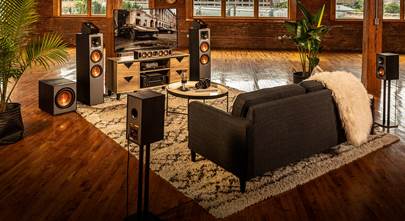
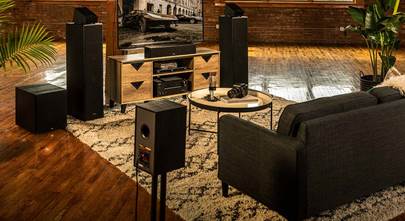
Five-speaker systems consist of a front left speaker, a front right speaker, a center channel speaker, and then two rear or side surround speakers, plus a subwoofer. Another name for that layout is “5.1,” where 5 is the number of speakers and the .1 is the number of subwoofers.

Home theater systems are made up of front left, front right, center, rear left, and rear right speakers
You aren’t limited to just five speakers and one sub though. You can expand the system quite a bit. Want to have both rear and side surrounds? That’s a 7.1 system. Want to go all out and add four in-ceiling speakers for immersive overhead effects and an extra subwoofer? That’s a 7.2.4 system. The possibilities are only limited by how many channels your home theater receiver supports.
A large system like that makes use of either Dolby Atmos or DTS:X soundtracks encoded into movies for a true three-dimensional soundstage. To learn more about Atmos and DTS:X, check out our DTS:X vs. Dolby Atmos article.
We'll cover the different types of home theater speakers below. Check out our intro to home theater speakers article to see how they all work together in a surround sound system. We also have a guide on home theater speaker placement to help you get the most out of your speakers.
Types of passive (non-amplified) speakers
Passive speakers are what most people think of when picturing a pair of speakers. These speakers have no onboard amplification and need to be connected to a receiver or amplifier for signal and power.
Bookshelf speakers
Bookshelf speakers are compact speakers designed to sit on a speaker stand or a shelf. They deliver crisp, clean sound and are often used in two-channel music systems. You can also use them as the surround or rear speakers in a home theater system, or even as the front speakers in a home theater system in a small or medium-sized room.

Bookshelf speakers, like the KEF Q150s shown here, work great as rear surround speakers, or they can be used as dedicated two-channel music speakers
Floor-standing speakers
Floor-standing speakers, also called “tower speakers,” are staple home theater speakers. They stand anywhere from three to five feet tall depending on the model. Tower speakers are narrow at the front and deep at the rear.

Floor-standing speakers are mainstays of home theater systems and two-channel music systems alike
Floor-standing speakers are sort of like matryoshka dolls, in that their main large cabinet has several smaller cabinets or chambers inside it, often one for each driver. Towers deliver full-range sound with an excellent bass response. While they’re great for home theater, they also perform well in two-channel music systems.
Take a look at our best speakers for 2025 for a handy list of some of our current favorite bookshelf and tower speaker models.
Center channel speakers
A center channel speaker is the most hardworking and important speaker in a home theater system. The center speaker handles all the dialogue and center channel effects in films and TV shows. It’s worth getting the best and biggest center channel speaker you can. The larger drivers and/or multiple driver sets help the speaker deliver more impactful center channel effects and clearer dialogue.
For guidance on picking the right center speaker, look at our center channel speaker buying guide.

The center channel is the most important speaker in a home theater system. It reproduces all the dialog and center channel effects
Surround speakers
Surround speakers sit to the sides of your listening position or behind it. They’re responsible for tackling the “wraparound” sound effects and help make the three-dimensional bubble of sound more immersive and believable.
A lot of folks like to use bookshelf speakers for their surrounds. I've done it myself for years. But a surround sound speaker doesn’t have to be a bookshelf-style speaker. There are also dipole/bipole speakers that have two sets of drivers and fire in opposite directions for extra sound dispersion.
Take a look at our surround speakers guide to learn more about the different kinds of surround speakers.

Surround speakers can be fairly compact, and many are wall-mountable.
Height speakers
Height speakers deliver immersive overhead sound effects in a Dolby Atmos system. Dedicated Atmos-enabled speakers, also called “toppers,” sit on top of your front left and front right speakers. These speakers fire upward and reflect their sound off your ceiling and down onto your listening position. They’re perfect if you’re unable to install speakers in your ceiling.

Topper speakers like the Klipsch RP500 SA fit on top of your tower speakers and project their sound upward. It reflects off your ceiling and down onto your listening position for immersive overhead effects.
There are also floor-standing speakers with upward-firing speakers built into their cabinets, as well as on-wall height speakers that work great in rooms with tall or slanted ceilings.
In-ceiling and in-wall speakers
In-ceiling speakers are the best choice for overhead effects if you’re able to install them. You can also use in-ceiling speakers for music, making them a great choice for a clutter-free jam-out space. A lot of folks put pairs of in-ceiling speakers in different rooms to create a whole-home audio system.
In-wall speakers are an incognito sound option that works well for music or home theater. Some in-wall speakers allow for horizontal or vertical installation and can function as front or center channel speakers. These kinds of speakers are often called "LCR" speakers (left/center/right).

Installing in-wall speakers requires cutting a hole in your drywall and running speaker wire to the location prior to placing the speaker in your wall.
Not sure where to start when shopping for hidden speakers? Check our in-wall and in-ceiling speakers buying guide. You can also check our in-wall and in-ceiling speaker placement and installation article to see what installing them entails. And take a look at our top in-wall and -ceiling speaker recommendations if you need help choosing.
Outdoor speakers
That about covers all the indoor passive speaker options, but what if you’re wanting tunes out on your porch or patio? That’s where outdoor speakers come in handy. Outdoor speakers are weather-resistant and come in all sorts of shapes and sizes.

Outdoor speakers have no trouble pumping out impactful tunes for your patio or back yard
Most outdoor speakers work as a pair and mount to most surfaces and under eaves. There are also stereo-input speakers that have two pairs of terminals and provide two-channel sound from a single speaker.
If you don’t want to mount something to the side of your home but still want to rock out (pun intended), rock speakers are the way to go. They look like regular garden rocks and blend in with your yard or flowerbed.

Find the speaker. Stumped? That's how well rock-styled speakers blend in. The speaker is in the middle beside that yellow patch of grass.
There are even outdoor subwoofers for rounding out your sound and adding much-needed bass to your system.
We have an article on how to choose outdoor speakers if you need help, as well as a guide on planning an outdoor speaker system, and some tips for installing them. And here's a list of our top outdoor speaker picks to get you started with some good recommendations.
Types of powered speakers
Powered speakers, also called “active speakers,” have a built-in amplifier, so you don't need a receiver or amp to power them. Everything you need for setup and control is included either on the speaker or through an app (or both).
Powered stereo speakers
Powered stereo speakers are the most common type of active speakers. They use speaker wire or a proprietary cable to connect the left and right channels together. There are ample rear-panel connections for hooking up almost any component you can imagine. Most have Bluetooth® and Wi-Fi for streaming and app control. Take a look at our top powered stereo speaker picks for some solid recommendations.
Sound bars
Sound bars are an easy way to add better sound to your TV. These slim speakers go underneath your TV, or they can be wall-mounted and don’t take up a ton of space. Sound bars help make dialogue clearer and more intelligible, and most models have some sort of dialogue enhancement feature that puts voices at the forefront of your sound.

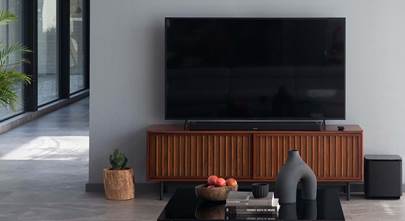
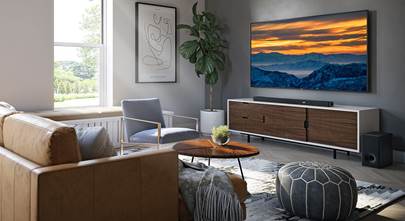
Sound bars are designed to fit right under most modern TVs.
Many sound bars come with a wireless powered subwoofer to add bass to your TV sound system. Most models have Bluetooth and/or Wi-Fi to make streaming your music a breeze. There are even some models that have upward-firing Atmos speakers, and others that can emulate a full 7.1.4 surround sound system from the bar and a pair of wireless surrounds.
There are lots of different sound bars to choose from. Our sound bar buying guide helps you narrow down the options, and we also have a good list of top sound bar picks if you're looking for some recommendations.
Powered subwoofers
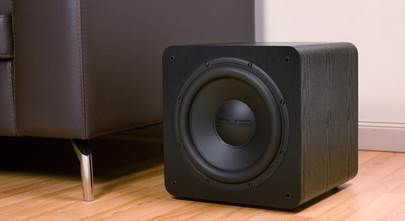
Powered subwoofers are an essential part of any music or home theater system. These self-powered thumpers add bass frequencies into your sound that traditional speakers can’t reach due to their smaller driver sizes. Powered subs are the final word when it comes to maximum bass impact.
Powered subs plug into regular wall outlets. They connect to your amplifier or receiver using a mono RCA cable to play along with your passive speakers. They can also work with powered speakers and some sound bars using the same type of cable.
Need help shopping for a powered sub? Take a look at our home subwoofers buying guide, and check out our top subwoofer picks.
Wireless home speakers
Wireless home speakers come in all shapes and sizes (really; just look at the Bowers & Wilkins Zeppelin Pro or the Devialet Phantom Ultimate 108 dB). Wireless speakers for your home are versatile, expandable, and often require only a connection to a wall outlet. Wireless speakers always have Wi-Fi and their own respective app or interface that’s used to connect to streaming services and play music. Most also include Bluetooth.

The Bowers & Wilkins Zeppelin Pro is one of the more uniquely shaped wireless home speakers we carry.
Wireless speakers provide an easy way to get music in multiple rooms throughout your home without the need for running miles of speaker wire behind your walls to a central receiver.
While shopping wireless home speakers, you may run across the word “ecosystem.” An ecosystem, in this case, refers to a group of products that all share the same app. The app can talk to each speaker individually or can talk to multiple speakers at once (or it can do both simultaneously).
For example, any Denon or Marantz HEOS product — from receivers to sound bars and more — all connect to the HEOS app and are controlled through it. You can have the same source, like Spotify®, playing on one HEOS device, or you can spread the source across some or all of the speakers and devices in your system. Some other notable wireless multi-room ecosystems are Sonos, BluOS, WiiM, and Yamaha MusicCast.
Portable Bluetooth speakers
Portable Bluetooth speakers can be tiny enough to clip onto a backpack or so large they need wheels to move. They connect to your smartphone, computer, or other Bluetooth device and pump out jams anywhere you take them.

Portable, rugged Bluetooth speakers come in all kinds of shapes and sizes, as shown here by JBL's legendary offerings.
They differ from wireless speakers in that they seldom have Wi-Fi and have an internal battery that needs charging from time to time. They are also more rugged, with most models having some protection against moisture and/or dust.
Check out our Bluetooth speakers buying guide to learn more about the different types, or have a look at our Best Bluetooth speakers for some good options.
Important accessories for your gear
You'll need speaker wire to connect passive speakers to your amplifier. Some speaker wire comes with connectors already attached to simplify the hook-up process. If you'd rather keep your speaker wire out of sight, we have plenty of in-wall speaker wire to choose from, as well as wall plates and in-wall volume controls. If you'd like to read more about picking the right speaker wire, take a look at our speaker wire buying guide.
If you're thinking of buying bookshelf speakers, I recommend getting dedicated stands for them to sit on. The stands place each speaker's tweeter at the ideal listening height when you’re sitting down. That keeps the speakers’ sound dynamic and engaging and improves their imaging. For more in-depth info on speaker stands, check out my buddy Kramer's "3 reasons why you need speaker stands for your bookshelf speakers" article.
Whether you’re going the passive or self-powered route, we always recommend grabbing some sort of power protection to defend your investment against damaging power spikes and surges. Surge protectors and line conditioners safeguard your equipment by soaking up the excess power coming from your wall outlet, ensuring your gear stays within the range it’s rated for. You can check out our power protection buying guide for more info.
How to audition speakers at home
Curious about how a speaker sounds? Want to compare two models but don’t have a showroom to audition them? You can check out our SpeakerCompare technology. It lets you listen to and compare different speaker models to help you find the right one, all without leaving the comfort of your home.
Need help choosing the right speakers?
Feeling a little in over your head when picking speakers? Contact one of our expert Advisors today for personalized, one-on-one advice. They get hands- and ears-on with a lot of the gear that we carry. They’re happy to help!
Free lifetime tech support is included with your Crutchfield purchase.



Paul from Knoxville Iowa
Posted on 5/18/2026
The woofer does a lot more than just bass. Middle C between bass and treble clefs is about 261 Hz. The LF crossover in Klipsch Forte IV is 650 Hz, so the woofer handles up to E5 which is the top space on the treble clef. Below 650 Hz is more than half of the 20 Hz to 20 kHz audio spectrum.
Richard Doucette from Bellevue, WA 98005
Posted on 8/2/2023
Sir, I need a good subwoofer. I have 2 Debut 2.0 B6 bkshelves, M&K LCR 750 M&K center An old Denon AVR 2105/885 what woofer in a small space . 90% classical Thanks.
Archer A. from Crutchfield
on 10/17/2023
Linda from Colorado
Posted on 7/16/2023
We have "wired-in" surround system including a nipple for a subwoofer (6 speakers total). We use room for TV/movie/home stereo, but moderate sound level. We are not interested in vibrating the house, only picking up lower-range sound. What table-top subwoofer & connector do you suggest?
Archer A. from Crutchfield
on 10/17/2023
Hal from Mobile
Posted on 3/25/2022
Just my recommendation for two channel listening! Cut through the all of the headache and expense and purchase the best 25 to 30 watt class A tube amplifier/pre-amp and a set of Klipsch Heritage line in whatever price range you can afford and be done with the chase, and you'll be a happy audiophile listener with a piece of mine knowing that you have audiophile grade components and listening to about as good as it gets without having are sending as much as you did on your home lol. Hope this helps! Enjoy the music!
Victor Paul from Ivins
Posted on 2/8/2022
I am looking for something to hook up to my bookshelf stereo. It is a Panasonic SA-AK610 model. The speaker I want to hook up would plug into what Panasonic calls the LOW 12 ohm port. I am thinking I need the 12 Ohm rated speakers. The specs say 55Hz-120kHz 65 W per channel. I got this stereo without the original speakers. If you have something like this speaker or I guess a pair please message me a link to your item. Thanks, Victor
Kramer Crane from Crutchfield
on 2/8/2022
Efrain Vidal from Cibolo
Posted on 5/24/2021
Im wondering how i could repair or replace Two standing Kenwood LS-P7200 4Way 6_speakers System
Kramer Crane from Crutchfield
on 5/28/2021
Dermot Meuchner from Westport,CT.
Posted on 3/31/2021
Do you recommend speaker cables or is 16 gauge fine? Thanks
Kramer Crane from Crutchfield
on 4/7/2021
I do recommend using banana connectors with your wire if your speakers have binding posts. You can add them on to bulk wire, or buy cables that are pre-terminated. They're simple, and secure.
FRED from FLORIDA
Posted on 2/18/2021
LOOKING FOR LCD PANASONIC TV SPEAKERS FOR - MODEL TH-50PX60U TV??
Kramer Crane from Crutchfield
on 2/23/2021
Azfar from Dubai
Posted on 8/13/2018
I am in process of building my first 5.1 home theater system and I am confused which type of speaker will be best for HTS (music not a priority). Big 6.8" speaker or smaller 4-5.5"? which type of speakers sound clear and deliver more details for movies. Similarly a warm with more bass extension speaker would be better for movies or flat, neutral sounding speakers?
Kramer Crane from Crutchfield
on 8/14/2018